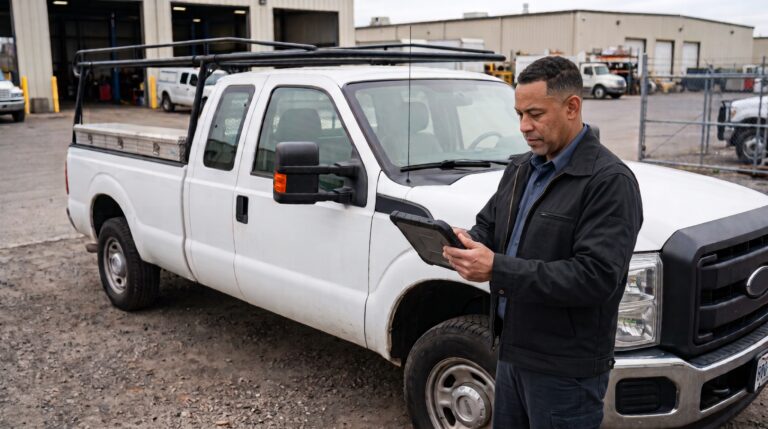
A construction crew might drive a dump truck to a jobsite, move equipment between projects, or spend most of the day working after a short trip in a company vehicle. Do those drivers qualify for an hours-of-service (HOS) exemption?
The short answer: Being part of a construction crew does not, by itself, exempt a driver from federal HOS rules. A driver who primarily transports qualifying construction materials or equipment to or from an active construction site within the applicable radius may use a 24-hour restart of the 7- or 8-day HOS period under 49 CFR § 395.1(m). A separate 150-air-mile short-haul exception may change certain logging requirements if its conditions are met. Neither provision is a blanket exemption for everyone on a jobsite.
Here’s how to tell which rule may apply to your fleet.
First, do federal HOS rules apply to the vehicle and trip?
Start with the vehicle and operation, not the worker’s job title. Federal HOS rules generally concern drivers of commercial motor vehicles in interstate commerce. Under the federal commercial motor vehicle definition, that can include a vehicle or combination with a weight rating or actual weight of 10,001 pounds or more; other passenger and placarded hazardous-material criteria also apply.
A crew member driving a smaller pickup is not automatically subject to federal HOS rules simply because they work in construction. A driver in a qualifying commercial vehicle should not assume the rules disappear because the trip is short or stays near a jobsite. Intrastate operations may also be subject to state rules, which can differ from the federal provisions discussed here.
What is the construction materials and equipment HOS provision?
The provision in § 395.1(m) allows a driver used primarily to transport construction materials and equipment to end a 7- or 8-consecutive-day period after 24 or more consecutive hours off duty. The standard restart for property-carrying drivers in § 395.3(c) is 34 or more consecutive hours.
The definition of qualifying transportation in § 395.2 includes construction and pavement materials, construction equipment, and construction maintenance vehicles moving to or from an active construction site. Generally, that trip must be within 75 air miles of the driver’s normal work reporting location. A state may set a lower radius of 50 to 75 air miles for movements entirely within that state after notifying FMCSA. The definition excludes placard-required hazardous materials.
An active site runs from mobilization of equipment and materials through final completion of the project. A construction company name on the truck is not enough; the driver’s primary transportation work and the specific movement need to fit the rule.
Example: A driver primarily hauling construction equipment between the yard and active sites within the applicable radius may qualify for the 24-hour restart. A driver whose regular work is transporting unrelated freight, with an occasional delivery to a construction site, should not assume the same provision applies.
What does the 24-hour restart change and what does it leave in place?
The construction provision concerns the 7- or 8-day calculation used with the 60/70-hour limits. It does not give a driver unlimited time behind the wheel or erase the other applicable daily HOS rules. Under § 395.3, property-carrying drivers generally face driving and duty-period limits as well as the 60/70-hour limits.
It also is not, by itself, an ELD exemption. Whether a driver can use time records instead of a record of duty status depends on a separate exception, such as the short-haul rule, and whether all its conditions are met. Keep these two questions separate: Can this driver use a 24-hour restart? and What records must this driver keep?
Could a construction driver use the short-haul exception instead?
Yes, if the driver meets the separate conditions in § 395.1(e)(1). The rule covers a driver operating within 150 air miles of the normal work reporting location, returning there and being released from work within 14 consecutive hours, with the required off-duty time between duty periods. The motor carrier must retain specified daily time records for six months.
The short-haul exception relieves a qualifying driver of the cited record-of-duty-status and supporting-document requirements. It does not simply exempt the driver from all HOS limits. It has a different purpose and radius from the construction materials and equipment 24-hour restart. For more background, read Whip Around’s article on the short-haul HOS rule.
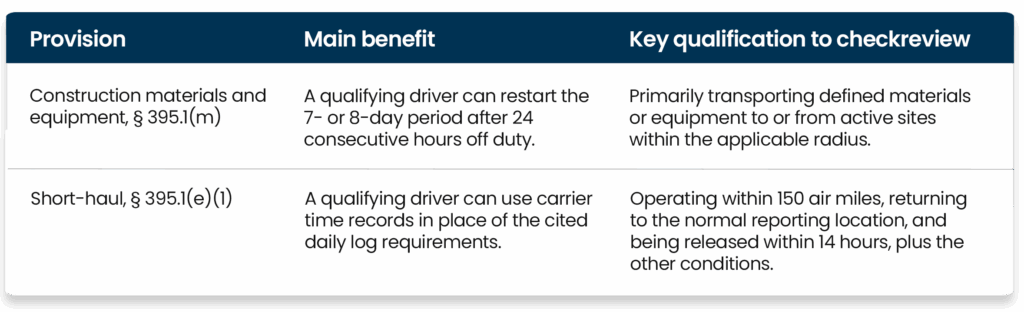
Some drivers may meet conditions for both provisions. Evaluate each rule independently rather than treating one as proof of eligibility for the other.
Does time spent working at the jobsite count as on-duty time?
Often, yes. The definition of on-duty time in § 395.2 includes driving, inspecting or servicing a commercial motor vehicle, loading and unloading, and other work performed for a motor carrier. A driver who spends an hour driving and several hours loading, operating, or working at the site should not treat the whole non-driving portion as off duty.
This is a common source of confusion for construction crews: driving time and on-duty time are different measures. Record the actual activities and evaluate how they affect the applicable limits.
A practical eligibility check for fleet managers
Before applying an exception, document the answers for each driver and assignment:
- Is the driver operating a vehicle and trip subject to federal HOS rules? Check the vehicle or combination, interstate operation, and any applicable state rules.
- What does the driver primarily transport? For the construction restart, compare the work with the definition of construction materials and equipment.
- Where is the active site? Measure the applicable air-mile radius from the driver’s normal work reporting location; check whether the state has set a lower radius for intrastate movements.
- Which exception are you using? Record the basis for a 24-hour restart separately from any short-haul time-record exception.
- Do your records support it? Verify duty and off-duty periods, reporting location, work assignments, and the records required for the exception claimed.
Even when a driver qualifies for an HOS provision, inspections, defect follow-up, and maintenance still need attention. Whip Around’s construction fleet inspection software helps teams capture vehicle and equipment inspections across jobsites, while its fleet maintenance software connects reported defects with work orders and service history. For inspection practices beyond road vehicles, see this heavy equipment inspection checklist.
The takeaway for construction fleets
Construction work alone does not create a federal HOS exemption. The relevant question is what a particular driver transports, where the trip goes, and which specific rule the operation meets. The construction materials and equipment provision can shorten the restart of the 7- or 8-day period to 24 hours. The short-haul provision can simplify certain logging requirements for drivers who meet its separate conditions. Clear schedules and accurate records help a fleet use the right rule on the right day.
Whip Around can help your team keep fleet inspections and maintenance records organized alongside those operational decisions. Book a demo to see how it supports construction vehicles and equipment.
Frequently asked questions
Are construction workers automatically exempt from FMCSA hours-of-service rules?
No. Eligibility depends on the driver, vehicle, trip, and the conditions of a specific rule. Working for a construction company or at a jobsite does not by itself create an HOS exemption.
What is the 24-hour construction HOS restart?
Under § 395.1(m), a driver used primarily to transport qualifying construction materials and equipment may end a 7- or 8-day period after at least 24 consecutive hours off duty. The transportation must meet the definition and radius conditions in § 395.2. Other applicable HOS rules still apply.
Is the construction HOS exemption 75 or 150 air miles?
They refer to different rules. The construction materials and equipment definition generally uses a 75-air-mile radius from the normal work reporting location, potentially lower in a qualifying state. The separate short-haul exception generally uses a 150-air-mile radius and has its own return, release, off-duty, and recordkeeping conditions.
Does a construction driver automatically avoid using an ELD?
No. The 24-hour construction restart alone does not remove logging requirements. A driver must qualify separately for an applicable recordkeeping or ELD exception.
Does time spent working at the construction site count toward HOS?
Work performed for the motor carrier is generally on-duty time even when the driver is not driving. Review the activities against the on-duty definition in § 395.2 and record them accurately.
Featured image idea: A dump truck delivering materials to an active construction site, with a simple clock graphic in one corner.
Suggested image alt text: Dump truck arriving at a construction site during a scheduled workday.