Construction fleets rarely lose money in one big hit. An excavator idles through lunch. A dump truck sits in the yard for a week waiting on a part nobody ordered. A weeping hydraulic hose an operator noticed on Monday fails on Thursday, halfway through a pour. Knowing how to reduce costs for construction fleets starts with finding these small, repeated leaks, because across a mixed fleet of trucks, trailers, and heavy equipment, they add up fast.
The pressure to find them is higher than usual. U.S. on-highway diesel averaged $6.20 a gallon in early October 2026, nearly $2.50 more than a year earlier, according to the U.S. Energy Information Administration. This guide breaks down where construction fleet costs come from, eight practical strategies to bring them down, and the metrics that show whether your changes are working.
Where construction fleet costs add up
Cost management for construction fleets is the practice of tracking, controlling, and reducing the total cost of owning and operating every vehicle and piece of equipment in the fleet, including fuel, maintenance, repairs, downtime, and the capital tied up in assets. For most contractors, that spend falls into a handful of buckets:
- Fuel: On-road trucks and off-road equipment, plus the fuel burned while machines idle.
- Maintenance and repairs: PM services, parts, shop labor, outside vendor repairs, and emergency field service.
- Downtime: Idle crews, missed schedules, rental equipment brought in to cover a broken-down machine, and project delays.
- Underused assets: Machines that cost money to insure, store, and maintain whether or not they are working.
- Administration: Time spent chasing paper inspection forms, reconciling fuel receipts, and piecing together service history.
The common thread is visibility. Fuel, labor, and parts costs are usually recorded somewhere, but rarely tied back to a specific asset, jobsite, or root cause. When a superintendent can’t see that one loader is burning 30% more fuel than its twin, or that the same truck has been in the shop four times this quarter, there’s no way to act on it. Every strategy below depends on closing that gap.
8 ways to reduce costs for your construction fleet
The strategies below work for fleets of any size, from a contractor running 15 pickups and a few skid steers to an enterprise fleet spread across dozens of jobsites. Start with the areas where your data is weakest, since that’s usually where the most money is hiding. None of them require overhauling your entire operation at once. Most fleets see results by fixing one workflow at a time and building from there.
1. Track operating costs by vehicle and equipment asset
Cost reduction for construction fleets starts with knowing what each asset actually costs to run. Fleet-wide totals hide the problems. A $400,000 annual maintenance budget tells you very little, but knowing that three aging dump trucks account for a third of it tells you exactly where to look.
Build a cost record for every asset that captures fuel, parts, labor, outside repairs, and downtime hours. For heavy equipment, measure cost per engine hour. For on-road vehicles, measure cost per mile. Once those numbers live in one place, you can compare like-for-like assets, spot outliers early, and assign costs to the jobs that generated them. That last piece matters for bidding: when you know what a machine really costs per hour, you can price work accurately instead of absorbing hidden equipment costs in your margins. It also changes the conversation with project managers, who are far more likely to release an underused machine or report damage promptly once equipment costs show up on their job reports.
2. Reduce fuel consumption and unnecessary idling
Idle time is one of the largest controllable fuel costs on a jobsite. Komatsu telematics data from about 75,000 North American machines showed an average idle time of 38%, according to Construction Equipment. The same report notes a 36-ton excavator running about 1,000 hours a year can idle 40% of that time and burn roughly 400 gallons doing it. At today’s diesel prices, that’s well over $2,000 per machine per year spent going nowhere. Idle hours also count toward PM intervals and warranty hours and lower resale value, so the real cost is higher than the fuel bill. Controlling construction fleet management fuel costs takes a few practical steps:
- Set idle targets and track them. Manufacturers report that fleets actively managing idle time aim for roughly 20%. Use telematics data to measure idle percentage by machine and operator.
- Turn on auto-idle shutdown where your equipment supports it, and coach operators on when to shut down rather than leaving machines running between tasks.
- Track every fuel fill. Tie fuel card transactions to specific assets so you can catch unusual fills, theft, or a machine whose consumption suddenly spikes.
- Plan site logistics. Fewer trips between jobsites, better staging, and right-sized support trucks all cut fuel burned in transit.
Whip Around tracks fuel fills and fuel costs by asset, and pulls idle time from telematics integrations with Geotab, Samsara, and Motive so fuel data and maintenance data sit side by side. For a deeper look, see our guide on how to manage fleet fuel costs.
3. Catch defects early with consistent vehicle and equipment inspections
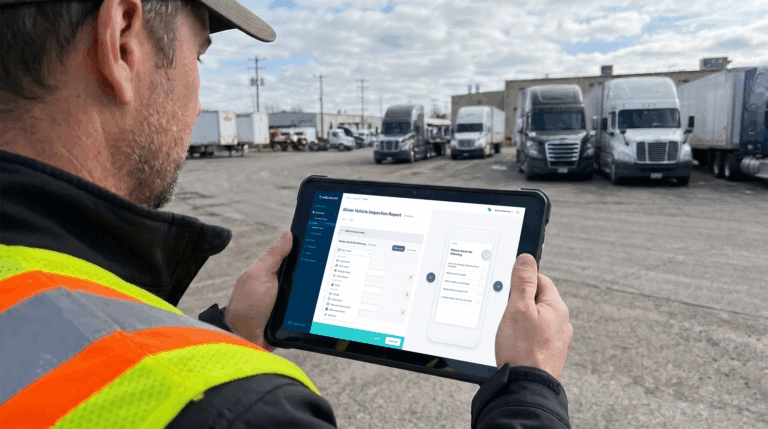
Daily inspections are the cheapest maintenance tool you have. A five-minute walkaround catches the leaking hose, worn track, or low tire pressure before it becomes a failed component, a tow, or a jobsite safety incident. The problem is consistency. Paper forms get pencil-whipped, lost in truck cabs, or turned in days late, and defects reported verbally to a foreman often never reach the shop.
Consistent construction equipment inspections need forms built for each asset type, a simple way for operators to complete them, and proof the inspection really happened. Whip Around’s mobile inspections use customizable forms for trucks, trailers, excavators, generators, and small equipment, with live photo capture so every reported defect comes with timestamped visual evidence. Failed items are flagged to the right people immediately instead of sitting on a clipboard until someone checks it. Over time, that inspection history also shows which assets, components, and jobsites generate the most defects, so you can adjust PM intervals, replace problem parts proactively, or retrain operators where the same damage keeps appearing.
4. Shift from reactive repairs to preventive maintenance
Reactive maintenance is the most expensive way to run a construction fleet. When a machine fails in the field, you pay for the repair plus the emergency service call, expedited parts, overtime, idle crews, and often a rental to keep the job moving. A planned service in the shop avoids most of those costs, and it can be scheduled around the project calendar instead of interrupting it. Consistent PM also protects warranty coverage and resale value, since buyers and dealers pay more for machines with complete, documented service records.
An effective PM program schedules service by the measure that best reflects wear on each asset: engine hours for heavy equipment, miles for on-road trucks, and calendar intervals for seasonal or low-use assets. It also splits the work sensibly. Operators handle daily tasks like greasing pins and checking fluid levels, while technicians handle oil changes, filter replacements, undercarriage checks, and component inspections at set intervals. Our guide to preventive maintenance for construction equipment covers PM schedules and checklists in detail. Whip Around lets you set PM triggers by mileage, engine hours, or date, and when connected to a telematics provider, engine hours and fault codes sync automatically so services come due on time without anyone reading hour meters by hand.
5. Shorten repair times and control parts costs
Every day a machine spends waiting in the shop is a day you’re paying for it without getting any work out of it. Repairs often stall for reasons that have nothing to do with the wrench time itself: an incomplete defect description, a technician who has to track down the machine to diagnose it, or a part that wasn’t in stock. Clear work orders with photos, notes, and service history attached let technicians diagnose faster and order the right part the first time. Prioritizing repairs by jobsite impact, so a machine holding up critical-path work goes first, keeps the most expensive downtime as short as possible.
Parts spending needs the same discipline. Without inventory tracking, shops either overstock to avoid delays or run out of common parts at the worst moment. As Yuri Popovic Jr., owner of ALC Freight, put it: “Before the inventory management, we were just buying stockpiles of brake pads, drums and other parts.” After adopting Whip Around’s inventory tools, ALC Freight cut supplies and materials expenses 53% in one year and another 48% the year after, while keeping the right parts on hand. Setting reorder thresholds for high-use parts keeps repairs moving without tying up cash on the shelf.
6. Improve equipment utilization and right-size the fleet
An idle machine still costs money. Depreciation, insurance, storage, registration, and baseline maintenance continue whether a piece of equipment works 1,800 hours a year or 300. Many contractors own more equipment than they need because utilization data is scattered across jobsites, so the full picture never comes together. The result is a yard full of machines that rarely leave it, alongside rental invoices for the same equipment class on another project.
Start by calculating utilization for each asset as operating hours divided by available hours. Volvo Construction Equipment describes 60% to 70% utilization as the widely recognized tipping point for ownership in heavy equipment. Machines that consistently fall below that range are candidates to sell, move to a busier jobsite, or replace with rentals for peak periods. Better construction equipment utilization frees up capital, reduces maintenance on assets you don’t need, and helps you avoid buying new equipment when an underused machine is already sitting on another site.
7. Reduce downtime by improving the defect-to-repair workflow
The gap between when a defect is found and when it’s fixed is where downtime grows. On paper-based systems, a defect might pass through an operator, a foreman, a phone call, and a whiteboard before a technician sees it. Each handoff adds delay, and some defects fall through entirely until the machine breaks down. Meanwhile, operators keep running equipment with known issues, which can turn a minor repair into a major one and create safety exposure on the jobsite.
Closing that gap means turning every reported defect into a trackable work order automatically, assigned to the right technician, with photos and asset history attached. That’s how Whip Around handles it: failed inspection items generate work orders without manual re-entry, and fault codes from telematics can do the same. Indiana Sign & Barricade, which runs nearly 100 trucks, forklifts, and other equipment, used this approach to cut the time to correct defects from as long as 12 to 90 days down to about two days. The result, according to the Indiana Sign & Barricade case study, was $100,000 saved in a single year from reduced downtime. As fleet manager Scott Fischer said, “our mechanics love the instant feedback they get on inspections and repairs.”
8. Use fleet data to make better repair, replacement, and spending decisions
Every construction fleet eventually faces the same question about aging equipment: keep repairing it or replace it? Without reliable data, that decision usually gets made after a catastrophic failure, when you have the least leverage and the most urgency. With complete cost and service history, you can see when an asset’s repair costs and downtime begin climbing faster than its value justifies.
Review lifecycle cost per hour or per mile for each asset, its repair frequency, its downtime trend, and its expected resale value, then plan replacements before failures force your hand. The same data shows which makes and models hold up best on your jobsites, which vendors deliver the best repair value, and which defects keep recurring and point to an operator training issue. That data also strengthens budget conversations with ownership, because replacement requests come with documented cost trends rather than a gut feeling that a machine is “getting old.” Construction fleet decisions get better when they’re built on records instead of memory.
How to measure construction fleet cost savings
Cost reduction only counts if you can prove it. Pick a baseline period, typically the previous 6 to 12 months, and track a short list of KPIs monthly so you can tie changes back to specific strategies:
- Cost per engine hour or cost per mile by asset and asset class
- Fuel consumed per engine hour and idle time percentage
- PM compliance rate, or the share of services completed on time
- Planned vs. unplanned maintenance ratio
- Average time to resolve defects, from inspection to closed work order
- Downtime hours per asset
- Utilization rate compared with your ownership threshold
- Parts spend and inventory turnover
Look for trends, not single data points. A rising planned-maintenance ratio, falling defect resolution time, and steady idle reduction usually show up before the savings appear on the P&L. One caution: when inspections improve, the number of reported defects often rises at first because issues that were always there are finally being caught. That’s a sign the program is working, and downtime and repair costs typically fall as those defects get fixed early.
Control construction fleet costs with Whip Around
Reducing construction fleet costs comes down to catching problems earlier, fixing them faster, and making decisions from real data. Whip Around brings inspections, preventive maintenance, work orders, parts inventory, fuel tracking, and reporting into one platform built for mixed fleets of vehicles and heavy equipment, with telematics integrations that turn engine hours and fault codes into maintenance action. With fixed, unlimited-user pricing, every operator, foreman, and technician can use the platform without per-seat costs adding up.
See how it works for your fleet: book a demo or start a free trial.