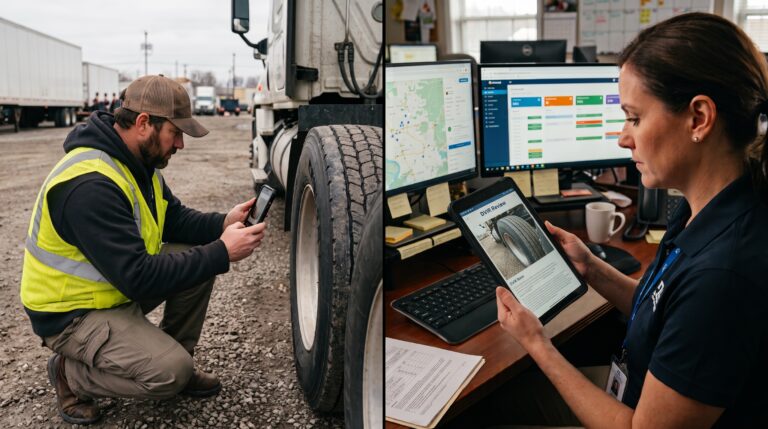
If you’re shopping for the best DVIR apps in 2026, you already know the paper clipboard version of this process doesn’t scale. Drivers lose forms, dispatchers wait hours to hear about a defect that should have been flagged immediately, and a fleet manager finds out a truck has been running with a known brake issue only after something breaks down on the highway. The harder question, once you’ve decided to go digital, is what actually separates a good digital vehicle inspection report tool from one that just moved the same paper form onto a phone screen.
Some DVIR software is genuinely built around the inspection workflow: forms that adapt to your fleet, defects that route themselves to the right person, records that hold up during a roadside stop. Other tools are an ELD’s DVIR module bolted on as an afterthought, functional enough to check a box but thin on everything past the checkbox. That distinction matters more in 2026 than it did a few years ago, now that FMCSA has formally recognized electronic DVIRs in the regulation itself rather than leaving fleets to rely on informal guidance. This guide breaks down the eight features that matter most when evaluating the best DVIR software for your fleet, and why each one earns its place on the list.
What Should the Best DVIR Software Help Your Fleet Do?
At a minimum, DVIR software needs to satisfy what 49 CFR 396.11 already requires: a driver has to inspect the vehicle, report any defect or deficiency that could affect safety or cause a mechanical breakdown, and the carrier has to get it repaired and certified before the vehicle goes back on the road. The best DVIR for fleet inspection does more than digitize that paperwork. It should make the inspection itself faster and harder to skip, get defects in front of the right person immediately instead of at end of shift, and produce a compliance record that’s actually usable when a driver, a mechanic, or an auditor needs it.
That last point matters more than it used to. Plenty of fleets already run their DVIR through whatever module their ELD provider bundled in, and it’s worth knowing where that falls short before treating it as a permanent solution. An ELD’s inspection feature is typically built to satisfy the minimum reporting requirement, not to route a defect to a shop, attach a photo as proof, or feed inspection trends into a maintenance plan. It usually can’t tell you which vehicle in your fleet fails inspection most often, or whether a driver actually walked around the truck versus tapped through a form from the driver’s seat.
None of that makes an ELD’s built-in DVIR feature non-compliant. It just means “meets the minimum” and “best for your fleet” are two different bars, and it’s worth knowing which one you’re evaluating against before you commit to a tool for the next several years. If your fleet has outgrown “technically compliant,” the eight features below are what to compare software against.
8 Features to Look for in the Best DVIR Software
1. Customizable Digital Inspection Forms and Checklists
A fixed, generic form works fine until your fleet includes a mix of straight trucks, trailers, and non-CDL vehicles that don’t all need the same inspection points. The best digital vehicle inspection software lets you build and edit forms by vehicle or asset type, add fleet-specific questions, and keep the required items front and center so nothing gets buried under items that don’t apply to that unit. A well-built digital DVIR checklist should reflect what your vehicles actually need checked, not a one-size-fits-all template borrowed from a generic freight truck.
Look for a builder that lets a fleet manager add or remove items without calling support, since inspection needs change as equipment changes. A form that can’t be edited in-house tends to just stop getting updated, which quietly defeats the purpose.
2. Simple Mobile Inspections with Offline Access
Inspections happen in yards, rural jobsites, and parking lots with no reliable signal, which makes offline capability a practical requirement, not a nice-to-have. A driver should be able to complete a full inspection on a phone or tablet with no connection and have it sync automatically once service returns, without losing any of the data entered in the meantime. If a tool only works with a strong signal, it’s going to get skipped exactly when it matters most, which is usually the remote site or early-morning yard where connectivity is worst.
The mobile experience matters as much as the offline capability. An inspection app that’s slow, confusing, or buries required fields behind multiple taps encourages drivers to rush through it, which defeats the purpose of requiring the inspection at all.
3. Required Inspection Steps, Photos, Notes, and Signatures
The best DVIR software makes it hard to rush through an inspection without actually doing it. Required fields, mandatory photo capture on flagged defects, and a signature step all work against “pencil-whipping,” the habit of checking boxes without actually looking. Photos also double as documentation: a picture of a cracked light housing or a worn tire is harder to dispute than a checked box, and it satisfies the driver certification that §396.11 and §396.13 both call for.
Notes matter too, especially for a defect that’s not visually obvious, like a soft brake pedal or an unusual noise. Software that only allows a pass/fail toggle loses that context; software that captures a short note alongside the photo gives the mechanic something to act on instead of a vague flag to investigate from scratch.
4. Real-Time Defect Reporting and Alerts
A defect found on a Tuesday morning inspection shouldn’t sit in a binder until someone flips through it Thursday afternoon. The best eDVIR solutions push a defect to dispatch or maintenance the moment it’s logged, with enough detail (what failed, where, and a photo) that someone can act on it immediately instead of playing phone tag to figure out what the driver actually meant. That speed is often the difference between catching a small issue at the yard and dealing with a breakdown on the road.
Alerts should also be configurable by severity. A worn wiper blade and a cracked brake line shouldn’t trigger the same level of urgency, and software that treats every defect identically tends to train fleet managers to tune out the alerts altogether.
5. Defect-to-Repair and Work Order Workflows
Reporting a defect is only half the compliance requirement. Under §396.13, a driver has to be able to confirm that a previously reported defect was corrected, or that correction wasn’t necessary, before operating the vehicle again. Software that automatically turns a failed inspection item into a work order closes that loop without someone manually re-typing the defect into a separate maintenance system. That single step is often the difference between a defect getting fixed and a defect getting forgotten.
It also creates a cleaner audit trail. When the work order is generated directly from the failed inspection item, there’s a documented line from “defect found” to “repair completed” that a paper process, or two disconnected systems, rarely produces on its own.
6. Digital DVIR Records and Inspection History for Compliance
This is also the feature that just got a lot more official. On February 19, 2026, FMCSA published a final rule amending 49 CFR 396.11 and 396.13 to explicitly state that DVIRs may be created and maintained in electronic format, provided the system meets the electronic signature standards in 49 CFR 390.32. The rule took effect March 23, 2026. It doesn’t change what has to be inspected or documented, only the format the record can take, but it removes any lingering ambiguity about whether a fully digital DVIR record holds up next to a paper one.
The best DVIR software keeps that record retrievable and organized, not just stored, so it’s ready the moment a roadside inspector or auditor asks for it. That means being able to pull a specific vehicle’s inspection history by date, not digging through a shared drive or a stack of scanned PDFs to find the one report that matters.
7. Fleet-Wide Reporting and Inspection Analytics
One inspection tells you about one vehicle. A fleet’s worth of inspection data, aggregated, tells you which vehicles fail most often, which defect types keep recurring, and which drivers or locations need attention. Reporting and analytics turn DVIR data from a compliance record into an early warning system for maintenance planning, surfacing the truck that’s failed the same brake check three months running before it becomes a bigger repair bill.
Look for reports you can actually export and share, not just a dashboard locked inside the app, since a lot of that data eventually needs to go into a maintenance review or a conversation with a shop.
8. Integrations with Maintenance, Telematics, and Fleet Systems
DVIR data is more useful connected to everything else you already run. Integrations with telematics providers like Geotab, Samsara, or Motive can pull fault codes and engine data into the same workflow as driver-reported defects, while a connection to your maintenance system means a flagged defect becomes a scheduled repair without manual re-entry. The best DVIR for fleet inspection isn’t a system that operates in isolation from the rest of your fleet’s data.
This is also where a lot of “best DVIR” tools quietly fall short. A standalone inspection app that can’t pass data anywhere else creates its own kind of silo, just a digital one instead of a paper one. Before committing to a platform, it’s worth checking what it actually connects to today, not what’s listed as “coming soon.”
How Digital DVIR Software Improves Pre-Trip Inspections and Fleet Safety
FMCSA crash research has consistently pointed to brakes and tires as recurring, preventable factors in large truck crashes, which is exactly what a properly completed DOT pre-trip inspection checklist is designed to catch before a vehicle leaves the yard. A paper process depends entirely on a driver’s diligence and a dispatcher’s follow-through to translate that inspection into an actual repair. Digital DVIR software shortens that chain: a defect logged on a phone reaches maintenance in real time, with a photo attached, instead of waiting for a paper form to physically make its way to an office.
The compliance side matters just as much as the safety side. A digital inspection history means a fleet manager can verify inspections are actually happening across every truck, not just assume they are because no one’s complained. And because FMCSA has now made electronic DVIRs explicit under the February 2026 rule, fleets that already made the switch have regulatory clarity, and fleets still relying on paper have one less reason to wait.
There’s also a driver-side benefit that’s easy to overlook. A driver who’s confident the defect they report will actually get seen, rather than disappearing into a stack of paper, is more likely to report it thoroughly in the first place. That’s a cultural shift as much as a technology one, but the software either supports it or works against it.
Bring Inspections, Defects, and Maintenance Together With Whip Around
Whip Around’s inspection platform is built around the workflow described above, not just the compliance form. Fleets can create custom digital inspection forms for any vehicle or asset type, require photo capture on flagged items, and route a failed inspection straight into a work order through defect-to-work-order automation, so nothing waits on someone remembering to follow up. AI Inspections Pro adds an extra layer on top, automatically reviewing inspection photos to flag defects a driver might miss and keeping records consistent across the fleet.
Every inspection is stored in the cloud and fully searchable, giving fleet managers visibility into whether inspections are happening, not just whether they were technically completed. Whip Around also integrates with telematics partners including Geotab, Samsara, and Motive, so fault codes and driver-reported defects feed into the same maintenance workflow instead of living in separate systems. If you want to see how it handles inspections, defect tracking, and compliance recordkeeping together, book a demo or start a free trial.
Frequently Asked Questions About DVIR Software
What is DVIR software? DVIR software is a digital tool that replaces the paper Driver Vehicle Inspection Report process. It lets drivers complete required pre-trip and post-trip inspections from a mobile device, log any defects they find with photos and notes, and route those defects to maintenance for repair, all while keeping a digital record for compliance.
What is the difference between a DVIR app and pre-trip inspection software? The terms are often used interchangeably, but technically a DVIR is the specific compliance report required under 49 CFR 396.11 when you’re required to complete and sign one, while a pre-trip inspection is the safety check a driver performs before operating the vehicle. The best DVIR software combines both into one flow, so the pre-trip inspection a driver already has to do automatically generates the DVIR record the regulation requires.
Can DVIRs be completed electronically? Yes. This was already common practice, and it’s now explicit in the regulation. FMCSA’s February 19, 2026 final rule amended 49 CFR 396.11 and 396.13 to state that DVIRs may be created and maintained in electronic format, as long as the system meets the electronic signature requirements in 49 CFR 390.32. The rule took effect March 23, 2026.
What features should I look for in an eDVIR solution? Look for customizable inspection forms, mobile access that works offline, required photos and signatures, real-time defect alerts, automatic defect-to-work-order routing, retrievable digital compliance records, fleet-wide reporting, and integrations with your telematics and maintenance systems. For more on what a DVIR actually needs to include and what is a DVIR in the first place, and how it differs from ELD-based inspection reporting, see our related guides.