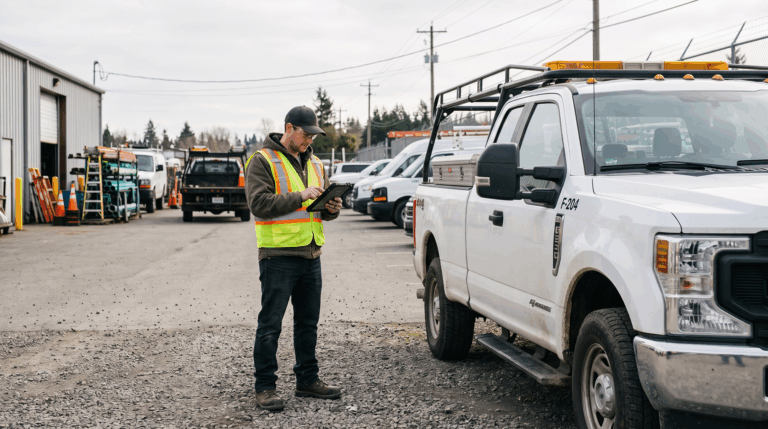
Many fleets assume that if their drivers don’t need a CDL, they don’t need to worry about DOT. Then a landscaping crew’s one-ton pickup gets pulled over towing a loaded trailer across a state line, and the officer asks for a medical card, a DVIR and a USDOT number. And none of them are in the truck.
Vehicles between 10,001 and 26,000 lbs sit in a gray zone. They’re too light to need a CDL but heavy enough to count as commercial motor vehicles under federal rules. That’s why we’ve created this guide that explains the DOT requirements for non-CDL vehicles: when you need a USDOT number, what drivers need (including a DOT medical card), which rules don’t apply and how to keep a mixed fleet compliant.
What Counts as a Non-CDL Commercial Motor Vehicle?
A non-CDL commercial motor vehicle is a vehicle used in interstate commerce with a gross vehicle weight rating (GVWR) or gross combination weight rating (GCWR) of 10,001 to 26,000 lbs, whose driver doesn’t need a CDL. FMCSA uses the rating or the actual weight, whichever is greater. If a truck is rated at 9,900 lbs but pulls a trailer, the combined rating of truck and trailer can push it over 10,001 lbs.
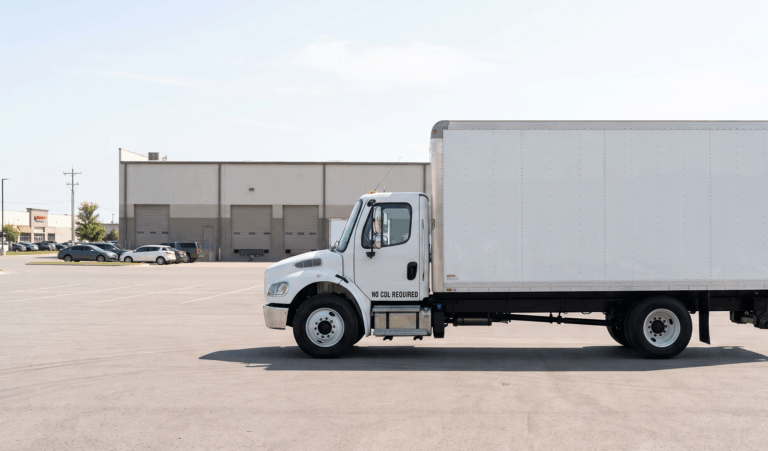
Common examples include box trucks, stake-bed and service trucks, landscaping and construction trucks, and heavy-duty pickups towing equipment trailers. There are two exceptions. A vehicle under 26,001 lbs still requires a CDL if it hauls hazardous materials that require placards, or if it’s designed to carry 16 or more people, including the driver.
10,001 lbs DOT Requirements at a Glance
Here’s how the main FMCSA requirements apply to non-CDL commercial vehicles operating in interstate commerce:
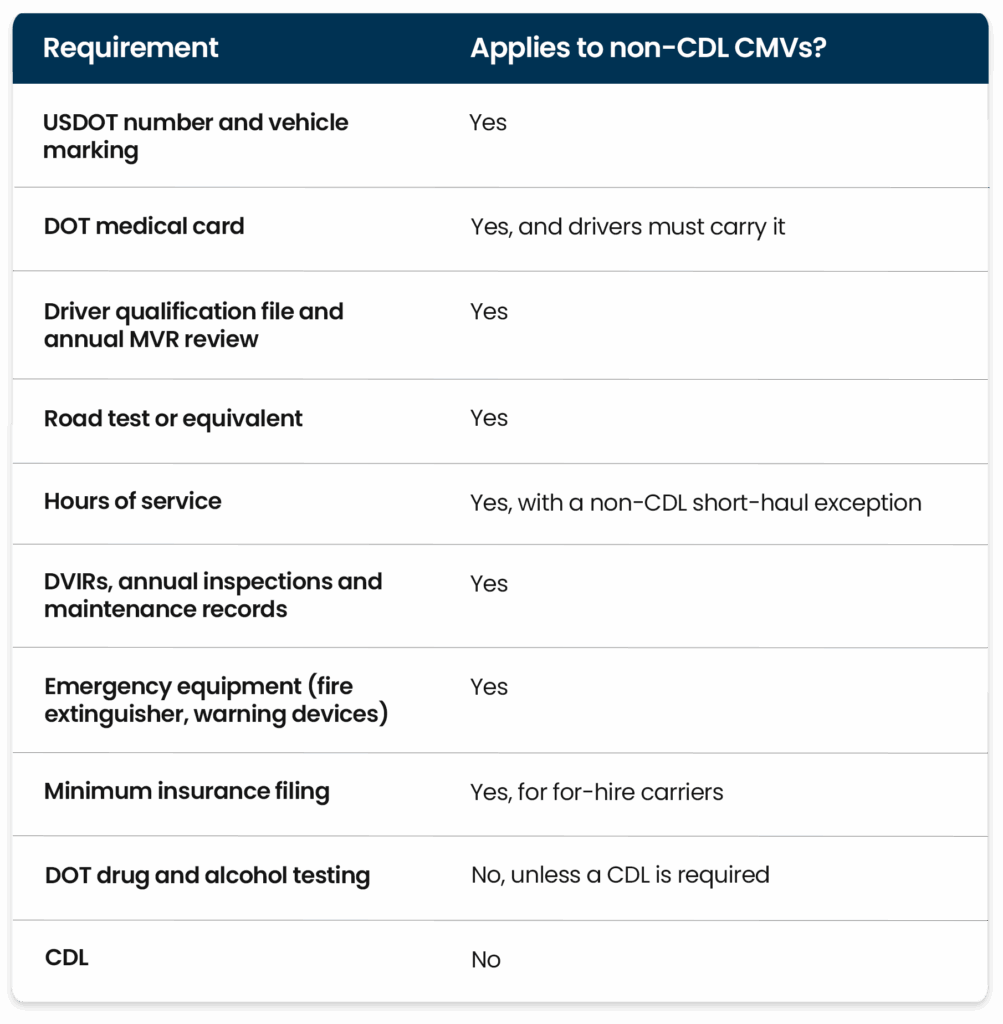
In short, almost every FMCSA safety rule applies at 10,001 lbs. The CDL itself and federal drug and alcohol testing are the main exceptions.
Do I Need a DOT Number for a Pickup Truck?
You need a USDOT number for a pickup truck if you use it for business in interstate commerce and its GVWR, GCWR or actual weight is 10,001 lbs or more. Many heavy-duty and dually pickups are rated near or above that line on their own, and towing a trailer often pushes the combined rating over it. The GVWR and GCWR are on the manufacturer’s label on the driver’s door jamb.
Interstate commerce is broader than crossing state lines yourself. It can include trips within one state that are part of a longer interstate shipment. Your state may also require a USDOT number for purely intrastate operations: FMCSA lists 39 jurisdictions that do. Vehicles with a USDOT number must also display the carrier’s name and number on both sides. For more on registration, see our guide on whether your delivery fleet needs a USDOT number.
Driver Requirements for Non-CDL CMV Drivers
Non-CDL drivers of commercial vehicles face most of the same qualification rules as CDL drivers. These three areas cause the most confusion.
DOT Medical Card for Non-CDL Drivers
Yes, non-CDL drivers need a DOT medical card. FMCSA requires a medical certificate for anyone operating a vehicle rated at 10,001 lbs or more in interstate commerce. The exam must be done by a medical examiner listed on FMCSA’s National Registry. A certificate is valid for up to 24 months, and drivers with conditions that need closer monitoring may get a shorter one.
There’s one key difference from CDL drivers. CDL holders file their medical certificate with their state licensing agency, but non-CDL drivers must carry the original or a copy of their current certificate whenever they’re on duty (49 CFR 391.41). Whip Around’s document management software stores medical cards and licenses on the driver’s phone and alerts managers before they expire.
Driver Qualification Files and Road Tests
Motor carriers must keep a driver qualification (DQ) file for every non-CDL CMV driver, just as they do for CDL drivers. The file includes the employment application, motor vehicle records, the annual MVR review, medical certification and road test documentation. Our post on managing a mixed CDL and non-CDL fleet covers what goes in a DQ file in detail.
Non-CDL drivers also need to pass a road test before driving a CMV (49 CFR 391.31). The test must cover at least a pre-trip inspection, turning, and backing and parking. A CDL can count as the equivalent of a road test, which is why this requirement catches many non-CDL fleets off guard.
Drug and Alcohol Testing
Federal DOT drug and alcohol testing under 49 CFR Part 382 applies only to drivers who need a CDL. Non-CDL CMV drivers aren’t subject to DOT testing or the Drug and Alcohol Clearinghouse. Many companies still test non-CDL drivers under their own company policy, separate from the DOT program.
Hours of Service for Non-CDL Drivers
Hours of service rules apply to non-CDL CMV drivers, including the 11-hour driving limit, the 14-hour window and the 60/70-hour weekly limit. However, many local operations qualify for the non-CDL short-haul exception in 49 CFR 395.1(e)(2).
To qualify, drivers must stay within a 150 air-mile radius of their normal work reporting location and return there at the end of each shift. They can’t drive after the 14th hour on duty on 5 days in any 7-day period, or after the 16th hour on 2 days in that period. Instead of logs, the carrier keeps time records for 6 months showing when each driver started, how long they were on duty and when they were released. See our breakdown of the short-haul exemption for more detail.
Vehicle Requirements: Inspections, Maintenance and Equipment
Non-CDL commercial vehicles have the same vehicle requirements as heavier trucks. Drivers must complete a DVIR at the end of any day a defect is found or reported, and review the last DVIR before driving. Each vehicle and trailer needs a DOT annual inspection, and carriers must keep inspection and maintenance records for every vehicle. Power units also need a fire extinguisher and warning devices like reflective triangles.
Non-CDL fleets often struggle most with these records, especially when light-duty trucks, heavy trucks and equipment share one paper system. Belknap Landscape faced that problem with about 85 assets across four facilities, ranging from light-duty vehicles to commercial trucks and construction equipment. According to its DOT compliance case study, after moving to Whip Around’s digital inspections the team caught 10,826 defects before they became breakdowns and reached a 1.2-day median work order resolution time.
What About Intrastate Non-CDL Vehicles?
The federal rules above apply to interstate commerce. Vehicles that operate only within one state follow that state’s rules. Most states adopt the federal regulations for intrastate carriers, but some use different weight thresholds, exempt certain vehicles or set their own medical and hours of service standards.
If your fleet runs only in-state, check with your state’s DOT or the state police commercial vehicle unit. Industries with heavy local operations, like landscaping and construction, should confirm both the federal and state rules for each vehicle class.
Non-CDL DOT Compliance Checklist
Use this list to check non-CDL DOT compliance for each vehicle and driver:
- Check every vehicle’s GVWR and GCWR, including when it tows a trailer.
- Register for a USDOT number if you operate CMVs in interstate commerce or your state requires one, and mark vehicles on both sides.
- Get every CMV driver a DOT medical card from a National Registry examiner, and make sure they carry it.
- Build a DQ file for each driver, including a road test and an annual MVR review.
- Track hours of service, or document that drivers meet the non-CDL short-haul exception.
- Complete DVIRs and annual inspections, and keep maintenance records for every vehicle.
- Equip each power unit with a fire extinguisher and warning devices.
Whip Around’s fleet compliance software covers the inspection, maintenance and document parts of this list in one place. It also handles preventive maintenance scheduling for annual inspections and service intervals.
Frequently Asked Questions
Do non-CDL drivers need a DOT medical card?
Yes. Drivers of vehicles rated at 10,001 lbs or more in interstate commerce need a DOT medical card, whether or not they need a CDL. Non-CDL drivers must carry the original or a copy while on duty.
Do I need a DOT number for a pickup truck?
You do if the truck is used for business in interstate commerce and its GVWR, GCWR or actual weight is 10,001 lbs or more, including when it tows a trailer. Many states also require USDOT numbers for intrastate commercial vehicles.
Do non-CDL drivers need drug and alcohol testing?
Not under federal DOT rules. Part 382 testing applies only to drivers who need a CDL. Companies can still require testing under their own policies.
Do non-CDL drivers need an ELD?
Not if they qualify for the non-CDL short-haul exception and the carrier keeps time records. Drivers who don’t meet the exception and must keep logs on more than 8 days in any 30-day period generally need an ELD.
Does a 26,000 lb box truck need DOT compliance?
Yes, if it’s used in interstate commerce. A box truck rated at 26,000 lbs doesn’t need a CDL, but it is a commercial motor vehicle that needs a USDOT number, a medically certified driver, DVIRs and an annual inspection. Our box truck inspection checklist covers what to check every day.
Keep Non-CDL Vehicles Compliant
DOT requirements for non-CDL vehicles start at 10,001 lbs, not 26,001. If your trucks fall between those weights, plan for USDOT registration, medical cards, DQ files, hours of service and full inspection and maintenance records, even though your drivers don’t need a CDL.
If your non-CDL trucks still run on paper inspections, book a demo to see how Whip Around keeps DVIRs, maintenance records and driver documents audit-ready across your whole fleet. You can also start a free trial and have drivers completing digital inspections this week.