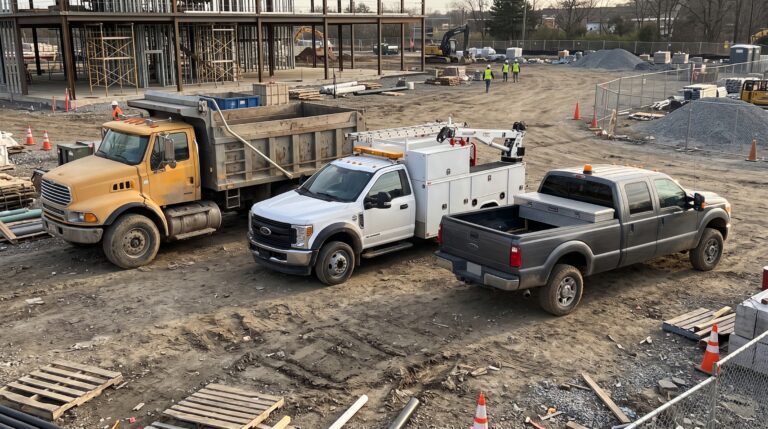
A construction company may send a heavy dump truck, a medium-duty service truck, a pickup towing a trailer, and an excavator to the same jobsite. The people operating them can have very different licensing and recordkeeping requirements. Treating every vehicle as a CDL truck creates unnecessary work; assuming every non-CDL vehicle is outside DOT rules creates a different problem.
The short answer: CDL and non-CDL construction fleet compliance starts with classifying each vehicle and trip. A vehicle can be subject to federal motor carrier rules even when its driver does not need a CDL. For a DOT-regulated non-CDL driver, requirements can still include a driver qualification file, medical qualification, hours-of-service records, inspections, and maintenance. CDL-required drivers also bring CDL-specific obligations, including the applicable drug and alcohol testing rules. State and intrastate requirements may differ.
Here is a practical way to sort a mixed fleet before deciding which records each driver and vehicle needs.
First, separate CDL requirements from DOT coverage
There are two questions to answer for every truck and combination:
- Is it a commercial motor vehicle under the federal safety rules? For interstate transportation of property on a highway, the 49 CFR § 390.5 definition generally reaches a vehicle or combination with a gross vehicle or combination weight rating—or actual gross weight—of 10,001 pounds or more, whichever is greater. Other passenger and placarded hazardous-material criteria also exist.
- Does operating it require a CDL? CDL vehicle groups have different thresholds. Under 49 CFR § 383.91, Group B includes a single vehicle rated 26,001 pounds or more. Group A includes a combination rated 26,001 pounds or more when the towed vehicle is rated over 10,000 pounds. Group C covers certain smaller vehicles carrying qualifying passenger loads or hazardous materials.
That gap between 10,001 and 26,001 pounds is why non-CDL vehicle compliance matters to construction fleets. A service truck can fall under federal motor carrier safety rules without crossing the usual Class B CDL threshold. Check the truck and trailer together: adding a trailer can change how a combination is classified.
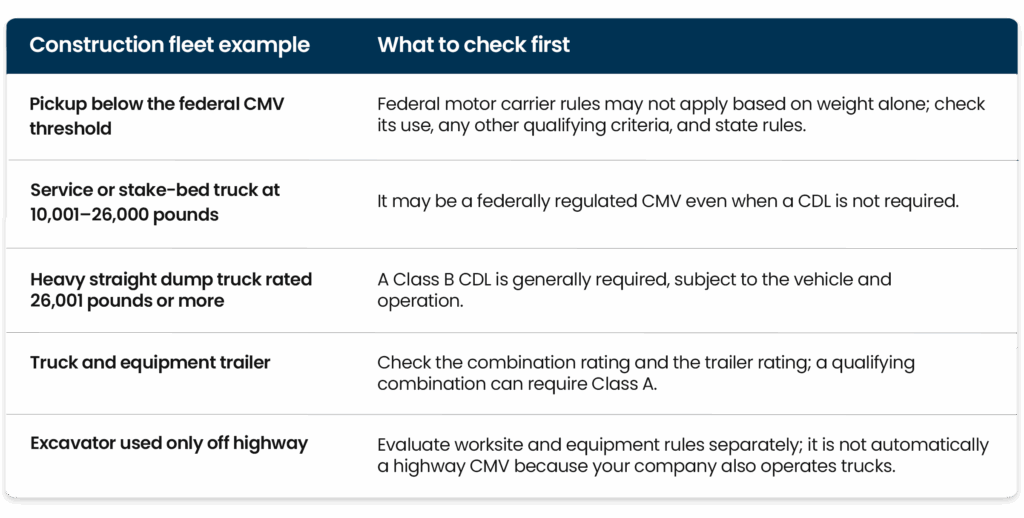
These are starting points, not a substitute for checking the actual vehicle ratings, cargo, route, and applicable state requirements.
CDL requirements for dump trucks and equipment trailers
The CDL requirements for dump trucks depend on the vehicle, not the word “dump.” A heavy straight dump truck rated 26,001 pounds or more generally falls in Class B. A smaller dump truck may not require a CDL on weight alone, yet it can still meet the federal CMV threshold for other safety requirements. If it tows a trailer, assess the full combination and the trailer’s rating for Class A.
Keep a vehicle profile with the truck’s GVWR, any relevant GCWR, trailer GVWR, and assigned use. Then match approved drivers to the equipment they actually operate. A driver who has always taken the straight truck may need a different credential before hauling a heavy equipment trailer.
For a broader look at organizing trucks and equipment across jobsites, see Whip Around’s guide to construction fleet management software.
Driver qualification files construction fleets need to maintain
A common mixed fleet mistake is maintaining driver qualification files only for CDL holders. Under 49 CFR § 391.51, a motor carrier must maintain a qualification file for each driver to whom the federal driver qualification rules apply. That includes drivers of qualifying non-CDL CMVs, subject to applicable exceptions.
The file can include the employment application, licensing-agency driving records, a road-test certificate or permitted equivalent, annual driving-record review, and medical qualification documentation. The medical-document process differs for CDL and non-CDL drivers: for a non-CDL driver, the file generally includes a copy of the medical examiner’s certificate and the required verification note; for a CDL holder, the carrier generally uses the licensing state’s CDLIS motor vehicle record for medical status. FMCSA’s driver qualification file guide provides a useful document-by-document review.
Build a roster by driver and assigned vehicle class. Track license, medical, and other document expiration dates, then check the file whenever a crew member moves from a pickup to a regulated service truck or from that truck to a CDL-required dump truck. Whip Around Wallet can store licenses, medical certificates, and other documents with expiration alerts. The carrier still needs to verify that each driver’s complete qualification file meets the applicable rule.
Which obligations are CDL-specific?
Federal drug and alcohol testing under 49 CFR Part 382 generally applies to drivers subject to CDL requirements. A non-CDL driver of a regulated CMV is not automatically in the Part 382 testing program solely because the vehicle exceeds 10,001 pounds. Conversely, a construction driver who operates a CDL-required vehicle needs the relevant CDL-specific program and credentials.
Do not use that testing distinction as a shortcut for every other rule. Driver qualification, HOS, and vehicle inspection requirements may still apply to a non-CDL CMV. Create separate checks for the license class, driver file, testing program, and assigned vehicle.
Non-CDL vehicle compliance construction teams can overlook
For a qualifying highway CMV, the inspection and maintenance process matters regardless of whether the driver holds a CDL. Under 49 CFR Part 396, applicable duties include vehicle inspection, repair, and maintenance. A driver must review the vehicle’s condition before driving; reported defects need appropriate follow-up, and CMVs generally require a periodic inspection at least once in the preceding 12 months. § 396.11 sets the driver vehicle inspection report requirements, including an exception for a property-carrying driver when no defect or deficiency was discovered or reported.
The operational risk is easy to picture: a non-CDL service truck gets overlooked because the team associates DVIRs and annual inspections with the big dump trucks. Whip Around’s digital fleet inspections can use forms tailored to different vehicles, while fleet maintenance software links reported defects, work orders, and service history. For equipment-specific checks, see this heavy equipment inspection checklist.
HOS is another separate check. A driver of a federally regulated non-CDL CMV may be subject to hours-of-service rules; being non-CDL does not itself create an HOS exemption. Depending on the work pattern, a driver might qualify for a specific short-haul or other provision, but the fleet needs to verify its conditions and keep the required records. Whip Around’s article on the short-haul exemption explains that distinction.
A workable mixed fleet DOT compliance process
Start with one inventory of vehicles and trailers. Record ratings and actual use, where each unit operates, and who is authorized to drive it. Then maintain a matching driver roster that identifies the required license class, applicable qualification documents, medical status, and any CDL-specific testing obligations.
Next, apply the right inspection form and service schedule to each asset. Make it easy for a field crew to report a defect from the jobsite and for the shop to see whether it was corrected before the vehicle returns to work. Whip Around’s construction solution brings inspections and maintenance records together for vehicles and equipment; its fleet compliance software helps organize DVIR and repair documentation. Those records support the process, while your team determines which federal and state rules apply to each operation.
Review the matrix whenever you add a trailer, move a driver into a different truck, cross state lines, or change the kind of work the vehicle does. Mixed fleet DOT compliance stays manageable when those changes trigger a classification check instead of waiting for an audit.
Frequently asked questions
Do non-CDL construction drivers need driver qualification files?
If they drive a CMV subject to federal driver qualification rules, generally yes. CDL status alone does not decide whether § 391.51 applies. Check the vehicle, trip, and any applicable exception.
Does a 20,000-pound construction truck require a CDL?
Its weight alone generally does not meet the Class B threshold, but it may still be a federally regulated CMV. A trailer, passenger use, or placarded hazardous-material transportation can change the licensing analysis. Confirm the vehicle and combination ratings and state rules.
Does every dump truck driver need a CDL?
No. A dump truck’s rating and whether it tows a qualifying trailer matter. A straight dump truck rated at 26,001 pounds or more generally requires a Class B CDL; a qualifying combination can require Class A.
Are non-CDL construction trucks exempt from DVIRs and annual inspections?
No blanket exemption follows from being non-CDL. If the vehicle is subject to federal Part 396, its applicable inspection, defect, maintenance, and periodic inspection requirements still need to be met. The details of when a driver must prepare a DVIR depend on § 396.11.
Is every worker who drives to a jobsite subject to federal DOT rules?
No. First determine whether the vehicle and operation fall under the federal CMV rules, then assess driver and vehicle obligations. State requirements may apply even where a federal threshold is not met.
Featured image idea: A heavy dump truck, a medium-duty service truck, and a pickup with a trailer lined up at a construction yard.
Suggested image alt text: Mixed construction fleet with a dump truck, service truck, and pickup towing a trailer.