Every commercial vehicle in your fleet carries a hard deadline you can’t push back: the annual DOT inspection. Miss the 12-month window and that truck or trailer is out of service, whether you’ve got a load booked or not. For fleet managers already stretched thin, the real question isn’t whether the inspection has to happen. It’s who’s allowed to do it, what it actually has to cover, and whether it’s worth paying an outside shop when you already have qualified people on staff. Getting this wrong doesn’t just risk a failed inspection. It puts your DOT fleet compliance status, your CSA score, and your vehicle’s availability on the line. Here’s what the regulation actually requires, who’s qualified to sign off, and how to keep the paperwork audit-ready.
What Is a DOT Annual Inspection?
A DOT annual inspection, formally called a periodic inspection under 49 CFR 396.17, is a comprehensive mechanical inspection that every commercial motor vehicle must pass at least once every 12 months. It covers major systems, brakes, steering, tires, lighting, coupling devices, and more, and it must be documented on a report that meets federal recordkeeping standards.
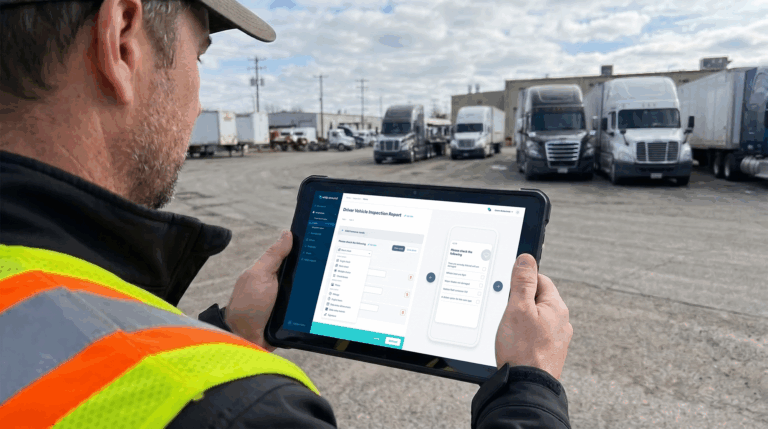
This is not the same thing as the daily inspections your drivers already perform. A DOT pre-trip inspection happens before every trip and is meant to catch obvious defects before a vehicle leaves the yard. A DVIR documents that daily check and any defects the driver found. The annual inspection is a deeper, once-a-year audit of the vehicle’s mechanical condition, and it has to be signed off by someone who meets a specific federal qualification standard, not just whoever’s driving that day.
Fleets sometimes assume these three things (pre-trip checks, DVIRs, and the annual inspection) satisfy the same requirement. They don’t. A driver’s clean DVIR history doesn’t exempt a vehicle from its periodic inspection, and a passed annual inspection doesn’t remove the daily pre-trip and post-trip obligation. Both have to happen, on their own schedules, with their own records.
DOT Annual Inspection Requirements
The core rule lives in 49 CFR 396.17, with the specific inspection items spelled out in Appendix A to Part 396. Here’s what that means in practice.
Which Vehicles Need an Annual DOT Inspection?
The requirement applies to commercial motor vehicles operated in interstate commerce, generally those with a gross vehicle weight rating over 10,000 pounds, vehicles designed to transport eight or more passengers for compensation (or 15 or more not for compensation), and any vehicle required to display hazardous materials placards. For the full breakdown of which vehicles and operations fall under federal inspection rules, see our guide to FMCSA inspection requirements.
Combination vehicles don’t get a single inspection for the whole rig. Each segment, the power unit, every semitrailer, and any converter dolly, is treated as its own vehicle and needs its own passing inspection and its own report.
How Often Is a DOT Annual Inspection Required?
At least once every 12 months. That’s a rolling window measured from the date of the last passing inspection, not a calendar-year deadline. A vehicle inspected on March 3 needs its next inspection completed by March 3 of the following year, regardless of when your fiscal year resets or when other vehicles in your fleet are due. Many states run their own periodic inspection programs that satisfy this federal requirement, so it’s worth confirming how your state’s program lines up with the federal interval before assuming every vehicle follows the same schedule.
What Must Be Checked During the Inspection?
The inspection has to cover every component listed in Appendix A to Part 396, the Minimum Periodic Inspection Standards. That list runs across roughly a dozen major systems:
- Brake system (service brakes, parking brake, drums or rotors, hoses, air or hydraulic components, and warning devices)
- Coupling devices (fifth wheels, pintle hooks, drawbars, safety chains and cables)
- Exhaust system
- Fuel system
- Lighting devices and reflectors
- Safe loading (cargo securement and body condition)
- Steering mechanism
- Suspension
- Frame
- Tires
- Wheels and rims
- Windshield glazing and wipers
Buses add motorcoach seat attachment to the list, and trailers add rear impact guards. A quick note if you’ve read a summary that references “Appendix G”: that’s outdated. Appendix G was redesignated as Appendix A in the current version of Part 396, so any 2026 reference to inspection standards should point to Appendix A, not Appendix G.
Who Is Qualified to Perform a DOT Annual Inspection?
This is where most of the confusion (and most of the search traffic on this topic) comes from, so it gets its own section below. In short: under 49 CFR 396.19, an inspector has to understand the standards in Part 393 and Appendix A, know how to identify a defective component, and be proficient with the inspection methods, tools, and procedures involved. Qualification comes from either completing a state- or federally-sponsored inspection training program (or holding a state or Canadian provincial inspector certification), or from at least one year of combined training and hands-on experience, such as working as a mechanic or inspector in commercial vehicle maintenance.
What Records and Proof of Inspection Must You Keep?
Once a vehicle passes, you need to be able to prove it, both to your own maintenance team and to a roadside inspector. Federal rules under §396.21 require the original or a copy of the inspection report to be kept for 14 months from the inspection date, and either the report itself or a sticker/decal with the inspection date, carrier name and address, and vehicle identification has to be accessible on the vehicle or available digitally for roadside enforcement.
Use this quick-reference checklist as the backbone of your own annual DOT inspection form or as a gut check on one you already use:
- Motor carrier name, address, and USDOT number
- Vehicle identification (VIN, unit number, license plate)
- Date of inspection and inspector’s name and signature
- Each Appendix A component category, with pass/fail noted for every item checked
- Description of any defects found and the corrective action taken
- A certification statement that the vehicle passed inspection in accordance with §396.17
If you’re still tracking this on paper or in a spreadsheet across multiple locations, it’s worth reading up on fleet document management before your next audit. Storing inspection reports, certificates, and decals in one searchable place is a lot less painful than digging through a filing cabinet when a roadside inspector or auditor asks for proof.
Can I Do My Own Annual DOT Inspection?
Yes. Motor carriers, owner-operators, and in-house mechanics are all permitted to perform their own annual DOT inspections, provided the person actually signing off meets the qualified-inspector standard under §396.19. Owning the truck, or having someone on staff who’s good with a wrench, doesn’t automatically satisfy that requirement.
The qualification comes down to one of two paths: completing a recognized training program or provincial/state certification, or documenting at least one year of relevant training and experience. That experience can come from manufacturer-sponsored training, prior work as a mechanic or inspector at a garage or fleet shop, or time spent as a government vehicle inspector. Whichever path applies, you’re required to keep evidence of that individual’s qualifications on file for as long as they’re performing inspections for you, plus one additional year after they stop.
The risk isn’t in doing your own inspections. It’s in signing off on one without being able to prove the inspector meets the standard. If a roadside enforcement officer or auditor can’t verify your inspector’s qualifications, that inspection doesn’t count, no matter how thorough the work actually was. Fleets without a clearly qualified inspector on staff are often better off using a licensed third-party inspection station rather than taking on that documentation risk.
What Should an Annual DOT Inspection Form Include?
Beyond the checklist items above, your inspection form is really a legal record, so it needs to hold up to scrutiny months later. At minimum, it should identify the vehicle and carrier, record the exact date of inspection, list every Appendix A category with a clear pass or fail result, describe any defects found, and carry a signed certification from the qualified inspector confirming the vehicle meets the standard. If a defect was corrected before the vehicle went back into service, the form should note the repair and the date it was completed, not just the original failure.
Whether that form is a paper carbon copy, a fillable PDF, or a digital inspection built into your fleet software, the content requirements don’t change. What changes is how easy that record is to find later. A digital form tied to the vehicle’s profile means you’re not relying on someone remembering which folder the March inspection went into.
How to Prepare Your Vehicle for an Annual DOT Inspection
The vehicles that sail through their annual inspection are almost never the ones that get a last-minute once-over. They’re the ones with a maintenance history that’s already caught most of the Appendix A items long before the inspector shows up. A few things worth doing ahead of time:
Review the vehicle’s preventive maintenance and repair history and close out any open work orders first. Whip Around’s preventive maintenance scheduler lets you set service triggers by mileage, engine hours, or calendar date, so a vehicle’s PM work is already current instead of surfacing as a surprise failure during the annual check.
Walk the vehicle against the Appendix A list yourself (brakes, tires, lighting, steering, frame) a few days ahead of the scheduled inspection, so anything that needs attention gets fixed on your timeline instead of the inspector’s. Pull together the vehicle’s documentation, including its prior inspection report, registration, and any outstanding recall notices, so nothing holds things up on inspection day.
What Happens If Your Vehicle Fails the Inspection?
A vehicle with a defect that meets federal out-of-service criteria can’t be dispatched until that item is repaired and the vehicle passes a follow-up inspection. Less severe defects still need to be documented and corrected, with the repair and completion date noted on the inspection record, even if the vehicle wasn’t placed out of service outright.
This is where a paper-based process tends to fall apart. A failed item that lives on a clipboard can sit for days before anyone assigns the repair. When a failed inspection item automatically generates a work order instead, as it does with Whip Around’s defect-to-work-order automation, the repair gets assigned and tracked the same day it’s found, and the corrected record is right there when you need to show it.
Keep DOT Inspection Records Organized With Whip Around
Whether your annual inspections are performed in-house or at a certified shop, the paperwork is what actually protects you at the roadside or in an audit. Whip Around gives fleets a digital inspection workflow that connects pre-trip DVIRs, preventive maintenance schedules, and annual inspection records in one place, plus Wallet for storing registration, insurance, and inspection certificates so they’re accessible from the field, not buried in an office filing cabinet.
Staying compliant with 49 CFR Part 396 comes down to three things: knowing what has to be inspected, confirming the person signing off is actually qualified, and keeping the proof organized for 14 months and counting. Get those three right and the annual inspection stops being a fire drill and becomes just another item on the maintenance calendar. If you want to see how Whip Around handles inspections, PM scheduling, and compliance recordkeeping together, book a demo or start a free trial.
Frequently Asked Questions About DOT Annual Inspections
How much does a DOT annual inspection cost? Pricing varies widely by vehicle type, shop, and region. Industry estimates generally put a basic annual inspection somewhere in the range of $50 to $150, with costs running higher for larger commercial vehicles, trailers with extensive brake work, or shops that bundle the inspection with other maintenance.
How long is a DOT annual inspection good for? Twelve months from the date it was performed, not from the start of a calendar year. Track the actual inspection date for each vehicle rather than assuming every unit in your fleet is due at the same time.
Is an annual DOT inspection the same as a roadside DOT inspection? No. A roadside inspection is an unannounced enforcement check, typically a Level I through Level VI inspection, performed by a law enforcement or DOT officer during a stop. It doesn’t fulfill the annual periodic inspection requirement, and passing a roadside inspection doesn’t reset your 12-month annual inspection clock.
Do trailers need their own annual DOT inspection? Yes. Every segment of a combination vehicle, including each trailer and any converter dolly, is treated as a separate vehicle under 49 CFR 396.17 and needs its own passing inspection and its own inspection report.