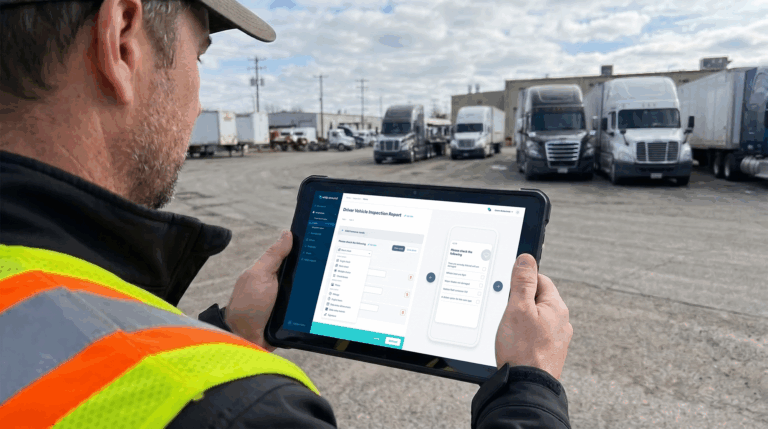
A technician spends three hours on a repair, but the work order shows 45 minutes because nobody logged the rest of the time. Multiply that gap across every job, every technician, every week, and it adds up to a real number that most fleets can’t actually see. Untracked technician labor doesn’t show up as a line-item loss. It shows up as repair costs that never quite make sense, shop schedules that always feel behind, and no reliable way to know which jobs are actually efficient. This article covers where untracked labor hides in a maintenance shop, what it costs a fleet in real terms, and what an accurate labor tracking process looks like.
What Is Untracked Technician Labor, and Why Does It Matter?
Untracked technician labor is repair and maintenance time that goes unrecorded against a work order. When labor hours aren’t captured accurately, a fleet manager sees incomplete data. The repair cost on the invoice reflects parts and a rough estimate of time, not what actually happened in the bay. That gap makes it hard to answer basic questions: is this repair efficient, is this shop keeping pace, and is a given asset actually worth repairing again.
Where Untracked Labor Hides in a Maintenance Shop
Labor time doesn’t usually go missing all at once. It leaks out in small, routine ways that add up fast.
Diagnostic time before a work order even opens
A technician often spends real time diagnosing a fault code or a driver-reported issue before a formal work order exists to log hours against. That diagnostic time frequently goes unrecorded entirely, even though it’s a genuine cost of the repair.
Interruptions and job switching
Shop floors rarely run one job at a time. A technician pulled off a repair to handle an urgent breakdown, then back to the original job an hour later, is unlikely to log that switch accurately after the fact. The clock keeps running even when the paperwork doesn’t reflect it.
Manual time entry after the fact
When technicians log hours at the end of a shift instead of in real time, rounding and memory gaps creep in. A job that ran long gets remembered as “about two hours.” Across a shop with several technicians, those small rounding errors compound into a labor picture that’s consistently, quietly wrong.
The Real Cost of Not Tracking Labor
Untracked labor isn’t a minor bookkeeping issue. It affects some of the biggest cost decisions a fleet makes.
Unplanned repairs already cost 3 to 9 times more than the same job done as planned maintenance, according to industry benchmarks, and without accurate labor data, fleets can’t tell how much of that premium is coming from the repair itself versus inefficient shop time. Fleet downtime costs U.S. businesses an estimated $50 billion or more per year, and a shop that doesn’t know its true repair times has no reliable way to identify where that downtime is actually originating.
There’s also a decision-making cost. Repair-versus-replace calculations depend on knowing the true cost of keeping an aging asset running, parts and labor together. If labor is consistently undercounted, older vehicles can look cheaper to keep repairing than they actually are, which is exactly backwards from what the data should be showing.
What Accurate Labor Tracking Looks Like
Fixing this isn’t about asking technicians to fill out more paperwork. It’s about capturing time in a way that fits how repair work actually happens.
Time tied directly to the work order
Labor hours should live with the work order itself, not a separate timesheet system that has to be reconciled later. When time and repair are recorded in the same place, there’s no second step where the connection between them can get lost.
Real-time start and stop tracking
Logging time as it happens, rather than reconstructing it at the end of a shift, is what closes the gap between actual hours worked and hours recorded. A technician starting and stopping a timer against a specific job produces far more accurate data than end-of-day recall.
Labor cost rolled into total repair cost automatically
Once labor hours are captured, they should combine with parts cost automatically to produce a true total repair cost, not a number a fleet manager has to calculate by hand from two different sources.
Visibility across every technician and shop
A fleet running multiple shops needs to see labor data in one place to compare performance fairly. Without that, one shop’s technicians might look less productive than another’s simply because their time is being tracked less consistently, not because the work is actually slower.
How Whip Around Connects Labor to the Work Order
This is where Whip Around’s fleet maintenance software is built to close the gap. Work orders in Whip Around carry the full picture of a repair, from the original defect through parts used and labor logged, so technicians are recording time against the same job they’re already tracking, not a separate system. Parts inventory tracking sits alongside labor in the same work order, which means the total repair cost, parts and labor together, is calculated automatically instead of pieced together after the fact.
That data feeds directly into Whip Around’s fleet reporting software, giving fleet managers real repair cost and maintenance cost tracking across every asset and shop, not a rough estimate assembled at month end. Combined with telematics data from integration partners like Geotab, Samsara, and Motive, that repair history also becomes the foundation for asset maintenance ROI decisions, since a repair-versus-replace call is only as good as the labor and parts data behind it.
Building a Labor Tracking Process Technicians Will Actually Use
The best labor tracking process is the one that doesn’t feel like extra work on top of the repair itself.
Make time entry part of closing the work order, not a separate step. If logging labor requires opening a different app or filling out a different form, it will get skipped under pressure. Time capture needs to live inside the same workflow a technician is already using to close out the job.
Track cost per repair, not just hours logged. Hours alone don’t tell a fleet manager much without cost attached. Pairing labor time with the parts cost on the same work order is what turns raw hours into a number that actually informs a budget or a repair-versus-replace decision.
Review labor trends by technician and shop monthly. A single job running long isn’t a pattern. The same job type consistently running long at one shop, or with one technician, is worth a closer look, and that pattern only becomes visible once labor data is consistent enough to compare.
What Accurate Labor Data Actually Buys a Fleet
Untracked technician labor doesn’t announce itself. It just quietly erodes the accuracy of every repair cost figure a fleet relies on, from budgeting to the decision to keep an aging asset running. Fleets that tie labor directly to the work order, in real time, are the ones with repair cost data they can actually trust and act on.
If your shop’s repair costs never quite add up, it may be a labor tracking gap rather than a parts or vendor problem. Book a demo to see how Whip Around connects labor, parts, and repair cost in one place, or start a free trial to try it with your own shop.