Your truck passed its state inspection last month and the sticker is on the windshield, so you’re covered for DOT, right? Maybe. Whether a state inspection satisfies the federal annual inspection depends on which state did it, what kind of inspection it was and where the vehicle is registered.
Getting this wrong is a common audit finding. It’s also easy to miss, because the two inspections look alike from the shop floor. This guide covers the DOT inspection vs. state inspection question: what each one is, when a state inspection counts as a DOT inspection, which states run an equivalent program and how to keep the records that prove it.
DOT Inspection vs. State Inspection: The Short Answer
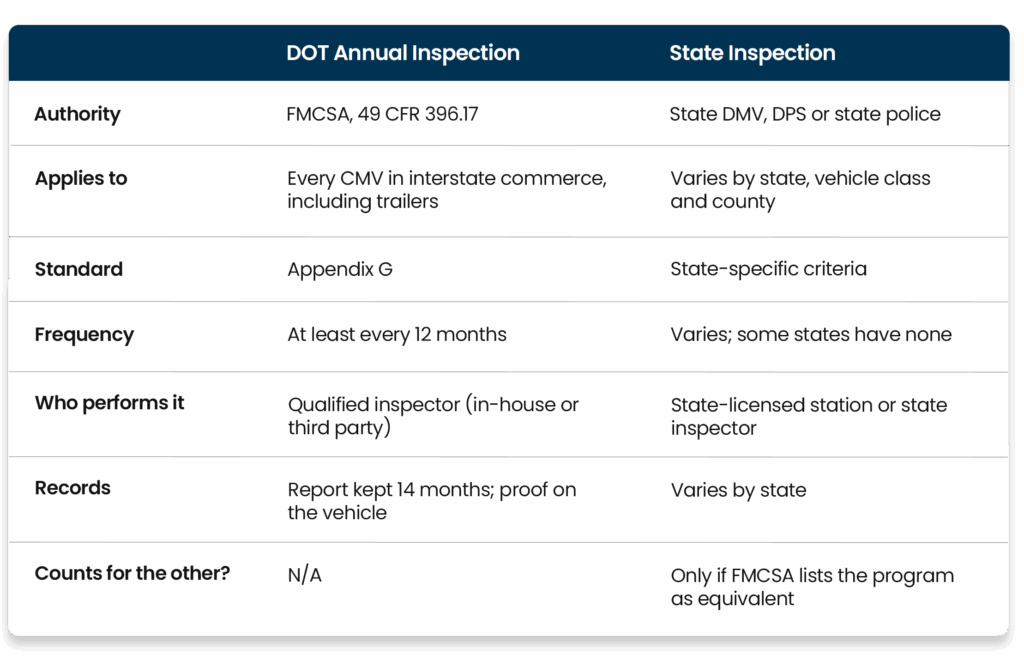
A DOT annual inspection is the federal periodic inspection required by 49 CFR 396.17. Every commercial motor vehicle (CMV) operated in interstate commerce must pass it at least once every 12 months, using the standards in Appendix G to the FMCSA regulations. A state inspection is a safety or emissions inspection required by the state where a vehicle is registered, and the rules vary widely from state to state.
A state inspection counts as a DOT annual inspection only when FMCSA has found that the state’s program is at least as effective as the federal standard. If the state’s program isn’t on that list, you still need a separate DOT annual inspection.
What Is a DOT Annual Inspection?
The DOT annual inspection, also called the periodic inspection, is a full mechanical safety check of a CMV and every trailer it pulls. It covers brakes, coupling devices, exhaust, the fuel system, lighting, steering, suspension, frame, tires, wheels and rims, windshield wipers and the other components listed in Appendix G. The inspector has to be qualified under 49 CFR 396.19, which means trained and experienced enough to identify defective components.
The motor carrier keeps the inspection report for 14 months. Proof of a passing inspection, either a copy of the report or a decal, travels with the vehicle. Many carriers do this inspection in-house with qualified mechanics. Our guide to DOT annual inspection requirements covers inspector qualifications and what the form should include.
What Is a State Inspection?
A state inspection is whatever the registration state requires before a vehicle can be registered or stay on the road. Some states run thorough commercial safety programs. Others check only emissions, apply only to certain vehicle classes or have no periodic inspection at all.
State programs also change. Texas, for example, ended safety inspections for most non-commercial vehicles in 2025, but the Texas Department of Public Safety says all commercial vehicles still need a passing safety inspection. Changes like that are why it’s worth rechecking annual vehicle inspection rules by state every year, especially if your fleet has assets registered in more than one state.
Does a State Inspection Count as a DOT Inspection?
Sometimes. Under 49 CFR 396.23, a vehicle inspected under a mandatory state program that FMCSA has found “as effective as” the federal periodic inspection meets the 396.17 requirement. If the state’s program isn’t on FMCSA’s list, or only partly meets the standard, the carrier still has to complete a full DOT annual inspection.
Watch for a few common traps. An emissions-only check isn’t a safety inspection, so it won’t satisfy 396.17. A clean roadside inspection doesn’t count either: FMCSA guidance states that a violation-free CVSA Level I or Level V inspection “is not equivalent to the Federal periodic inspection requirements.” For how the roadside levels differ, see our breakdown of the 6 levels of DOT inspection.
What If My Vehicle Is Registered in a State With an Equivalent Program?
FMCSA guidance says that if your registration state requires every registered vehicle to go through its inspection program, you must use that program to meet the federal requirement. That holds even if the vehicle rarely operates in that state.
If the state exempts vehicles that are registered there but based elsewhere, you have more options. You can use a self-inspection, a third-party inspection or an inspection in any state whose program FMCSA has found comparable.
Do Other States Have to Accept My State’s Inspection?
Yes, if your state’s program is federally approved. FMCSA guidance says a state must accept another state’s periodic inspection when that program meets the federal standards in Appendix G. So a truck inspected under Pennsylvania’s approved program doesn’t need a second annual inspection to run through Ohio.
Which States Have an Equivalent Inspection Program?
According to FMCSA’s published list, as compiled by J.J. Keller, these jurisdictions have a state equivalent inspection program:
- U.S.: Alabama (LPG Board only), California, Connecticut, District of Columbia, Hawaii, Illinois, Louisiana, Maine, Maryland, Massachusetts, Michigan, Minnesota, New Hampshire, New Jersey, New York, Ohio, Pennsylvania, Rhode Island, Texas, Utah, Vermont, Virginia, West Virginia and Wisconsin
- Canada: all 10 provinces and the Yukon Territory
- Mexico: the NOM-068 program
Arkansas (buses) and Oklahoma have been removed from the list. Every state not listed either has no commercial periodic inspection program or has one FMCSA hasn’t found comparable. Before you rely on a state inspection, confirm with the state agency that your vehicle class is covered and that the inspection was done under the commercial program, not a passenger-car program.
Side-by-Side: DOT Annual Inspection vs. State Inspection
How to Stay Compliant With Both
If your fleet crosses state lines, the safest approach is to track both inspections for every asset. For each vehicle, note the registration state, whether that state’s program is equivalent and which inspection satisfies 396.17. Then schedule both by due date so neither one lapses.
Whip Around’s fleet compliance software handles that tracking. You can set annual inspection reminders by date in the preventive maintenance scheduler, build a custom form based on Appendix G for in-house annual inspections, and store reports and decals with each asset’s history. When an auditor asks for proof of a periodic inspection, you can pull it up in seconds instead of searching through 14 months of paper. Our DOT audit checklist covers the rest of what auditors look for.
Strong inspection records also pay off at the roadside. Eppler Towing & Recovery runs 63 tow trucks plus more than 110 other vehicles. According to its case study, the company has had fewer issues found during DOT roadside inspections, and a higher carrier rating, since moving to digital inspections.
Frequently Asked Questions
Is a DOT inspection the same as a state inspection?
No. A DOT annual inspection is a federal requirement for CMVs in interstate commerce, based on Appendix G. A state inspection follows that state’s own rules. The two are interchangeable only when FMCSA has found the state’s program equivalent.
Can I do my own DOT annual inspection?
Yes, as long as the person doing it meets the inspector qualifications in 49 CFR 396.19. Many fleets use in-house mechanics. If your vehicle’s registration state requires all registered vehicles to go through its own program, you must use that program instead.
Does a passed roadside inspection count as my annual inspection?
No. FMCSA guidance says a violation-free CVSA Level I or Level V roadside inspection does not satisfy the periodic inspection requirement.
How long do I keep DOT annual inspection records?
Keep the inspection report for 14 months from the inspection date. Keep proof of the inspection on the vehicle, either a copy of the report or a decal.
Do intrastate vehicles need a DOT annual inspection?
The federal rule applies to CMVs in interstate commerce. Many states adopt the federal regulations for intrastate carriers, sometimes with different weight thresholds, so check your state’s commercial vehicle rules. If you run a mixed fleet, our post on DOT annual inspection requirements for construction vehicles walks through how the rule applies to each unit.
Keep Every Inspection on Record
The DOT inspection vs. state inspection question comes down to one check: is your state’s program on FMCSA’s equivalency list, and was your vehicle inspected under it? If not, schedule a separate DOT annual inspection and keep the report for 14 months.
If tracking annual inspections across states and assets is eating up your team’s time, book a demo to see how Whip Around keeps due dates, reports and decals in one place. Or start a free trial and set up your first annual inspection reminders today.