A skid steer that shifts three inches on a trailer deck is a violation waiting for a roadside inspector to find it. A skid steer that shifts three feet is a headline. The DOT tie-down requirements for heavy equipment exist because construction machinery, unlike palletized freight, is heavy, top-heavy, and often missing the flat surfaces that make strapping straightforward. Getting the tie-down count, the working load limit math, and the attachment points right isn’t optional paperwork, it’s what keeps a wheel loader on the trailer instead of in the next lane. This guide covers what actually applies under FMCSA inspection requirements and 49 CFR 393.130: how many tiedowns you need, how to calculate working load limit correctly, what changes for skid steers and compact equipment, and how to inspect the load before and during transport.
What Are the DOT Tie-Down Requirements for Heavy Equipment?
Heavy equipment securement is governed primarily by 49 CFR 393.130, a commodity-specific rule that applies once a piece of equipment crosses a weight threshold. Below that threshold, general cargo securement rules apply instead. Which set of rules governs changes the math, so it’s worth separating the two clearly before getting into tie-down counts or WLL.
Heavy Equipment Weighing 10,000 Lbs or More
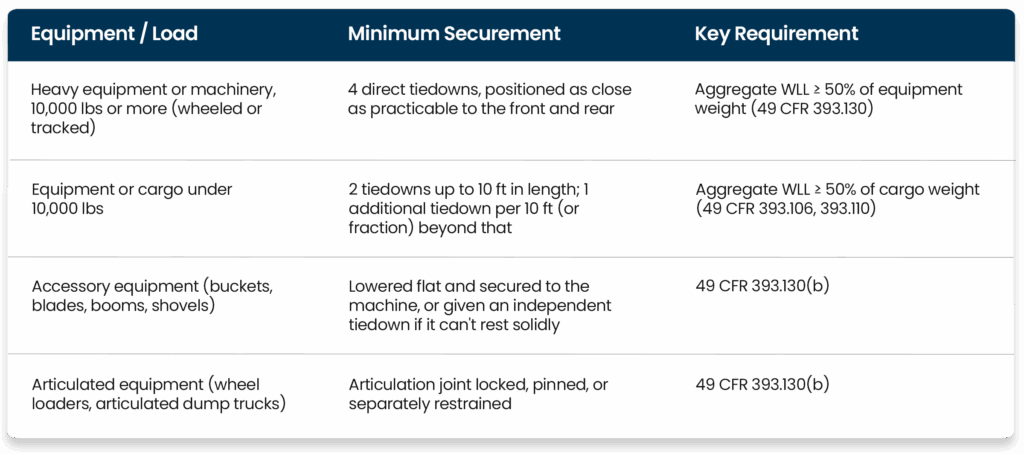
Section 393.130 applies to “heavy vehicles, equipment and machinery which operate on wheels or tracks… which individually weigh 4,536 kg (10,000 lb.) or more,” a category that covers most wheel loaders, excavators, dozers, and larger skid steers and compact track loaders. For equipment at or above that 10,000-lb mark, the rule requires a minimum of four tiedowns, affixed as close as practicable to the front and rear of the vehicle, arranged to restrain against movement in the lateral, forward, rearward, and vertical directions. That four-tiedown minimum is fixed. Unlike general cargo, §393.130 doesn’t add more tiedowns as the equipment gets longer; it adds requirements around working load limit instead, which is where most of the miscalculation happens.
Equipment Weighing Less Than 10,000 Lbs
Equipment that weighs less than 10,000 lbs individually doesn’t fall under §393.130 at all. It’s secured under the general cargo rules in 49 CFR 393.106 and 393.110, the same ones that apply to any article of cargo. Under those rules, the minimum tiedown count is based on length rather than a flat four: one tiedown for an article 5 feet or less and 1,100 lbs or less, two tiedowns for anything longer than 5 feet up to 10 feet, and two tiedowns for the first 10 feet plus one additional tiedown for every 10 feet (or fraction of it) beyond that. In practice, many fleets still use four tiedowns on sub-10,000-lb equipment as a matter of standard practice, since compact machinery shifts easily and the regulatory minimum is just that, a minimum.
Working Load Limit Requirements and How to Calculate WLL
Working load limit (WLL) is the maximum load a tiedown, chain, strap, or anchor point is rated to hold. Under 49 CFR 393.106, the aggregate WLL of the securement system used on an article of cargo must be at least half the weight of that article. That’s the part most fleets know. What trips people up is how each tiedown is counted toward that aggregate, and it’s the detail that made the popular version of this calculation wrong.
Here’s the actual rule: a tiedown that runs directly from an anchor point on the trailer to an anchor point on the equipment counts at only one-half of its own rated WLL toward the aggregate. A tiedown that runs from one anchor point, over or around the equipment, and attaches to an anchor point on the opposite side of the trailer counts at its full rated WLL. Heavy equipment is almost always secured with direct, corner-to-corner tiedowns rather than tiedowns wrapped across the load, so in the typical case, each chain or strap you use only contributes half its rating to your aggregate WLL total.
A worked example: Say you’re transporting a 12,000-lb compact track loader with four direct tiedowns, one at each corner. The required aggregate WLL is half the equipment’s weight, or 6,000 lbs. Because each direct tiedown only counts at half its rated WLL, the math is 4 tiedowns × (0.5 × WLL per tiedown) ≥ 6,000 lbs, which works out to a minimum WLL rating of 3,000 lbs per tiedown, not 1,500 lbs. Dividing the required aggregate evenly across the tiedown count, without applying that 50% rule, under-rates the chain by half.
Tie-Down Points, Chains, Straps, and Securement Devices
Use the equipment manufacturer’s designated tie-down or lashing points whenever they’re provided; they’re engineered to handle securement loads in a way the frame elsewhere may not be. Chains, synthetic webbing, and other rated tiedown devices are all acceptable under §393.130, as long as each device is rated for the WLL your calculation requires, properly attached, and tensioned so it can’t work loose in transit. Federal rule does not mandate a specific chain grade for heavy equipment; §393.130 doesn’t reference Grade 70 chain at all. What it requires is that the tiedown’s WLL meets the math above, and unmarked welded steel chain defaults to a Grade 30 working load rating unless it’s tagged otherwise. Many carriers standardize on Grade 70 chain because it delivers a higher WLL for a given chain size, which makes it easier to hit the required rating with fewer or lighter tiedowns, but that’s an operational choice, not a federal mandate.
Edge protection is required wherever a tiedown would otherwise rub against a sharp edge or corner of the equipment, since abrasion or cutting reduces the effective WLL of the chain or strap over the course of a trip. Any chain, strap, binder, or attachment hardware that’s frayed, cracked, corroded, or otherwise damaged should come out of service immediately rather than get used “one more haul.”
Buckets, Booms, Blades, and Other Attachments
Accessory equipment, buckets, blades, booms, and hydraulic shovels, must be completely lowered and secured to the machine before transport. If an attachment can rest flat and solid against the trailer deck, lowering and securing it there typically satisfies the requirement. If it can’t sit flush, or if it could still shift or swing independently, it needs its own separate tiedown rather than relying on the main equipment tiedowns to hold it in place. Articulated equipment, wheel loaders and articulated dump trucks in particular, needs the articulation joint restrained (locked, pinned, or independently tied down) so the frame can’t pivot in transit, a requirement §393.130 states explicitly alongside the four-tiedown rule.
DOT Tie-Down Requirements for Skid Steers
Skid steers and compact track loaders sit right at the edge of the 10,000-lb line, and that line matters more than it might seem. Most skid steers weigh somewhere between 6,000 and 12,000+ lbs depending on the model and attachments, so some units fall under §393.130’s flat four-tiedown, front-and-rear rule while lighter ones technically fall under the general cargo rules with a lower minimum. Rather than checking the spec sheet on every unit, most fleets standardize on four independent tiedowns for every skid steer or compact track loader regardless of weight, since it satisfies the stricter standard automatically and compact equipment’s short wheelbase makes it prone to shifting.
Beyond the tiedown count, skid steer securement has a few equipment-specific details worth locking in. Lower the bucket or attachment fully flat against the trailer deck; if it won’t sit flush, it needs a separate, independent tiedown rather than sharing the load with the main tiedowns. Attach tiedowns only to the frame or the manufacturer’s designated tie-down points, never to the bucket, blade, or boom alone, since those components aren’t rated to carry securement loads. Set the parking brake and lower any stabilizers or outriggers before securing the load. If the unit has a frame lock or travel lock (common on skid steers to prevent the loader arms from moving), engage it before the tiedowns go on. A construction equipment inspection checklist built around these steps makes it easier for drivers and loaders to run the same sequence every time instead of relying on memory.
Heavy Equipment Tie-Down Requirements at a Glance
How to Inspect Heavy Equipment Tie-Downs Before and During Transport
Cargo securement isn’t a one-time check at the yard. Under 49 CFR 392.9, a driver has to confirm the load is properly secured before driving, then re-examine it within the first 50 miles of the trip and make any needed adjustments. After that, the driver has to reexamine securement whenever there’s a change of duty status, or every 3 hours of driving time, or every 150 miles, whichever comes first.
For heavy equipment specifically, that inspection should cover the same points every time: are all four tiedowns still tensioned, is any chain or strap showing wear where it crosses an edge, is the accessory equipment still flat and secure, and has anything shifted since the last check. Building that sequence into a standard heavy equipment inspection checklist means a driver or loader isn’t reconstructing the requirement from memory at a truck stop. It also gives you a documented record if a roadside inspector asks how the load was checked, not just whether it was.
Common Heavy Equipment Tie-Down Mistakes That Can Put You Out of Compliance
A handful of mistakes account for most of the load-securement violations and out-of-service orders on heavy equipment hauls:
- Using fewer than four tiedowns on equipment at or above 10,000 lbs, often because the crew assumed the general cargo length-based rule applied instead of §393.130’s flat minimum.
- Sizing chains or straps by dividing the required aggregate WLL evenly across the number of tiedowns, without accounting for the rule that direct tiedowns count at only half their rated WLL.
- Leaving a bucket, blade, or boom raised, or resting it on the deck without securing it, instead of lowering it flat and tying it down independently if needed.
- Attaching tiedowns to a bucket, blade, or other loose attachment rather than the frame or a manufacturer-designated tie-down point.
- Skipping edge protection where a chain or strap crosses a sharp corner, which lets abrasion quietly reduce the tiedown’s effective WLL over the course of a haul.
- Continuing to use chain, webbing, or binders that are visibly frayed, cracked, or corroded because replacing them wasn’t scheduled.
- Skipping the 50-mile and periodic re-inspection under §392.9, then discovering a loosened tiedown only after something has already shifted.
Most of these come down to maintenance and training gaps, not a misunderstanding of the rule, which is exactly what regular preventive maintenance for construction equipment and standardized inspections are built to catch first.
Build Heavy Equipment Tie-Down Checks Into Your Fleet Inspections With Whip Around
Tie-down compliance is only as good as the documentation behind it. Whip Around lets fleets build custom digital inspection forms for heavy equipment and trailers, so a securement check is built into the same pre-trip inspection drivers are already doing, not a separate process. Forms can require photos of tie-down points, chains, and accessory equipment before dispatch, creating a visual record of how a load was secured, not just a checked box. When a driver flags a damaged chain, worn strap, or missing tiedown, that defect is logged immediately and can route straight into a work order instead of sitting on a clipboard.
That inspection history stays searchable, so fleet managers get visibility into whether tie-down checks are actually happening across every truck and every load, not just an assumption that they are. If you want to see how Whip Around handles heavy equipment inspections, securement documentation, and defect tracking together, book a demo or start a free trial.
Heavy Equipment Tie-Down Requirements FAQs
How many tiedowns are required for heavy equipment over 10,000 lbs? A minimum of four, positioned as close as practicable to the front and rear of the equipment, restraining it against lateral, forward, rearward, and vertical movement. This minimum is fixed under 49 CFR 393.130 and doesn’t increase with the equipment’s length the way general cargo tiedown counts do.
What are the DOT tie-down requirements for a skid steer? It depends on the unit’s weight. Skid steers and compact track loaders at or above 10,000 lbs fall under §393.130’s four-tiedown rule; lighter units technically fall under the general cargo rules. Most fleets use four independent tiedowns on every skid steer regardless of weight, along with a fully lowered bucket, frame-only attachment points, and an engaged travel lock where equipped.
Can you use straps instead of chains to tie down heavy equipment? Yes. Federal regulation doesn’t require chain specifically or mandate a minimum chain grade for heavy equipment. Any tiedown device, chain, synthetic webbing, or another rated securement device, is acceptable as long as it’s rated for the working load limit your calculation requires, in good condition, and properly attached and tensioned.
What WLL do I need for heavy equipment tiedowns? The aggregate working load limit of your securement system must equal at least 50% of the equipment’s weight. Because each direct tiedown only counts at half its own rated WLL toward that aggregate, the individual rating you need per tiedown is higher than a simple even split of the required aggregate. For four direct tiedowns, each one’s rated WLL should be at least the equipment’s total weight divided by four.