A municipal contract renewal often comes down to proof, not performance. A hauler can be completing routes on time, keeping trucks compliant, and resolving missed pickups quickly, and still struggle to demonstrate it if that evidence lives in paper logs, scattered spreadsheets, and a shop foreman’s memory. Municipal contract SLAs are specific and measurable, and municipalities increasingly expect contractors to produce records on demand, not just assurances. This article covers what municipalities actually track, why proving SLA performance is often harder than meeting it, and how connected fleet data gives waste and recycling fleets the records they need when a contract is on the line.
What Is a Municipal Contract SLA, and Why Does Fleet Data Matter?
A municipal contract SLA (service-level agreement) is a set of measurable performance standards, typically route and pickup completion rates, missed pickup response times, and vehicle safety and compliance history, that a waste or recycling contractor must meet to retain a municipal contract. Fleet data is what turns “we met the SLA” into something a hauler can actually document and hand to a municipal contract manager during a review.
The SLA Metrics Municipalities Actually Track
Most municipal waste and recycling contracts measure performance against a similar set of core metrics, even when the exact thresholds vary by jurisdiction.
Route and pickup completion rates
The most basic SLA metric is simple: did the scheduled route get completed, and were pickups made on the days residents and businesses expect. Falling short here, even occasionally, is usually the first thing a municipality flags in a performance review.
Missed pickup resolution time
A missed pickup isn’t automatically a violation on its own. How quickly it gets identified and resolved usually is. Municipalities frequently set a specific window, often 24 to 48 hours, for a missed pickup to be corrected before it counts against the contract.
Vehicle safety and compliance history
Municipal contracts commonly require proof of ongoing DOT compliance, including current DVIRs and maintenance records, not just a one-time inspection at contract signing. A pattern of safety violations can put a contract at risk independent of route performance.
Environmental and incident reporting
Spills, leaks, and other environmental incidents typically carry their own reporting requirements under a municipal contract, separate from routine route data, and are often weighted heavily in renewal decisions.
Why Proving SLA Performance Is Harder Than Meeting It
Many waste and recycling fleets are actually hitting their SLA targets day to day. The harder problem is producing evidence of that performance in a form a municipality will accept.
Data spread across paper logs, driver memory, and separate systems
Route completion might live in a dispatch system, DVIR records in a filing cabinet, and maintenance history in yet another spreadsheet. When a municipality asks for a combined performance picture, someone has to manually assemble it from three or four disconnected sources.
No easy way to produce records during an audit or renewal review
Contract reviews and audits often come with short turnaround windows. A fleet that can’t quickly pull organized inspection and maintenance records looks less compliant than it actually is, simply because the proof isn’t accessible fast enough.
Heavy-cycle vehicles and corrosive environments complicate uptime claims
Waste and recycling vehicles, compactors and roll-offs especially, run heavy-cycle duty in corrosive environments that accelerate wear well beyond typical fleet vehicles. Demonstrating consistent uptime under those conditions requires maintenance records detailed enough to show the pattern, not just a pass/fail inspection log.
The Cost of Falling Short on an SLA
Fleet downtime already costs U.S. businesses an estimated $50 billion or more per year, and for a municipal contractor, downtime isn’t just an internal cost, it’s a missed route that shows up directly against the SLA. Unplanned repairs, which typically run 3 to 9 times more than planned maintenance according to industry benchmarks, are also the repairs most likely to pull a truck out of rotation mid-route, turning a mechanical issue into a contract compliance issue. Repeated SLA shortfalls are commonly cited by municipalities as a leading factor in contract non-renewal, which makes documented performance as important as the performance itself.
How Connected Fleet Data Supports SLA Compliance
The fix isn’t more paperwork. It’s making the data that already exists easier to pull together and act on before it becomes a compliance gap.
Route completion and pickup data tied to specific trucks and drivers
When completion data rolls up by vehicle and route, a fleet can spot a pattern, like one truck consistently running behind, before it turns into a string of missed pickups that shows up in a quarterly review.
DVIR and compliance records ready for audit at any time
Digital inspection records that are searchable and complete mean a fleet can produce compliance history on demand instead of scrambling to reconstruct it when a municipality asks.
Maintenance history showing uptime and repair response time
A documented maintenance record, tied to each vehicle’s actual duty cycle, is what backs up an uptime claim with evidence rather than an estimate.
Reporting that matches SLA metrics, not just internal KPIs
The most useful fleet data for a municipal contract is data structured around the metrics the contract actually measures, not just whatever a fleet happens to track internally.
How Whip Around Helps Waste & Recycling Fleets Meet Contract SLAs
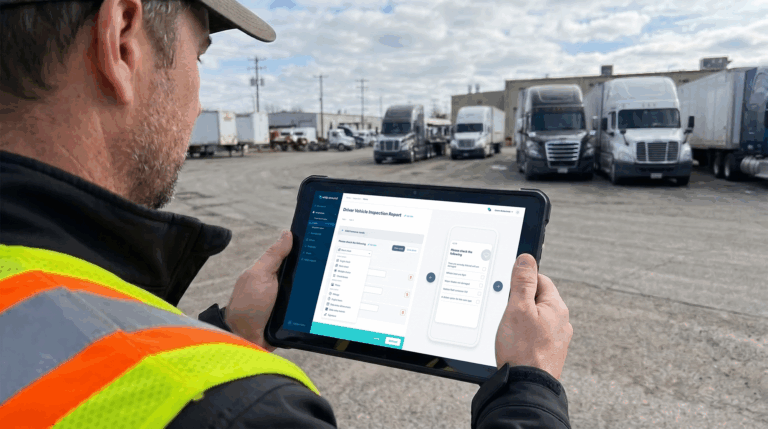
Whip Around’s waste fleet management software is built around the operating reality of residential routes, roll-offs, and compactors running heavy-cycle duty in corrosive conditions. Digital DVIRs capture inspection data in a searchable, cloud-based record, so compliance history is available on demand rather than sitting in a binder somewhere in a yard office. When a defect is flagged, it becomes a work order automatically through Whip Around’s fleet maintenance software, building a documented repair trail that supports uptime and safety claims when a contract review asks for them.
That data rolls up into Whip Around’s fleet reporting software, giving fleet managers a single place to pull compliance and maintenance history in the format a municipal contract manager expects, instead of assembling it by hand from separate systems. Combined with Whip Around’s fleet compliance software, that means a fleet can respond to an audit request or renewal review with organized records in minutes rather than days.
Building an SLA-Ready Reporting Process
A few practices make the difference between a fleet that’s meeting its SLA and one that can actually prove it.
Standardize inspection and route data across every truck. If reporting formats differ by yard or by driver, building a fleet-wide compliance picture takes far longer than it should. Consistency across the fleet is what makes an audit-ready record possible in the first place.
Make audit-ready reports pull automatically, not manually. A report that has to be built by hand every time a municipality asks for one is a report that’s late, incomplete, or both. Reports pulled directly from live inspection and maintenance data are accurate the moment they’re generated.
Review SLA metrics before the municipality does. Tracking route completion, missed pickup resolution time, and compliance history internally, on the same cadence a municipality reviews them, means a fleet catches a slipping metric early enough to fix it, rather than finding out during a formal review. That kind of proactive tracking is also where the ROI of asset maintenance software becomes concrete for a municipal contractor, since avoiding a single missed contract renewal typically outweighs years of software cost.
Meeting the SLA and Proving It Are Two Different Jobs
Waste and recycling fleets running municipal contracts are often doing the operational work well. The gap that puts contracts at risk is usually the ability to document that performance quickly and completely when it matters. Fleets that connect route, inspection, and maintenance data into one system are the ones walking into a contract review with answers instead of a scramble.
If your fleet’s SLA data still lives across separate logs and spreadsheets, it’s worth seeing what a connected record looks like before your next contract review. Book a demo to see how Whip Around brings inspection, maintenance, and compliance data together, or start a free trial to try it with your own fleet.