A driver loads at 6 a.m., waits two hours at the dock, hits traffic outside the city and realizes at 7 p.m. that they’re out of hours 40 miles from the yard. Most fleets have lived some version of that day. Hours of service rules decide how long drivers can drive and work, and getting them wrong leads to violations, out-of-service orders and higher CSA scores.
That’s why we’ve put together this guide that explains the FMCSA hours of service rules for property-carrying drivers: the 11-hour rule, the 14-hour rule, the 30-minute break rule, the 60/70-hour limit and the 34-hour restart. It also covers the sleeper berth split, the main exceptions, the different limits for passenger carriers and what’s changing in 2027.
What Are the Hours of Service Rules?
Hours of service (HOS) rules are the federal limits on how long commercial motor vehicle drivers can drive and stay on duty before they must rest. FMCSA sets them in 49 CFR Part 395. They apply to most CMV drivers in interstate commerce, and their goal is to prevent fatigue-related crashes.
For property-carrying drivers, four limits work together every day: an 11-hour driving limit, a 14-hour on-duty window, a 30-minute break after 8 hours of driving and a weekly cap of 60 or 70 hours. A driver has to stay within all four at once. Most drivers track them with an electronic logging device (ELD).
The Hours of Service Rules at a Glance
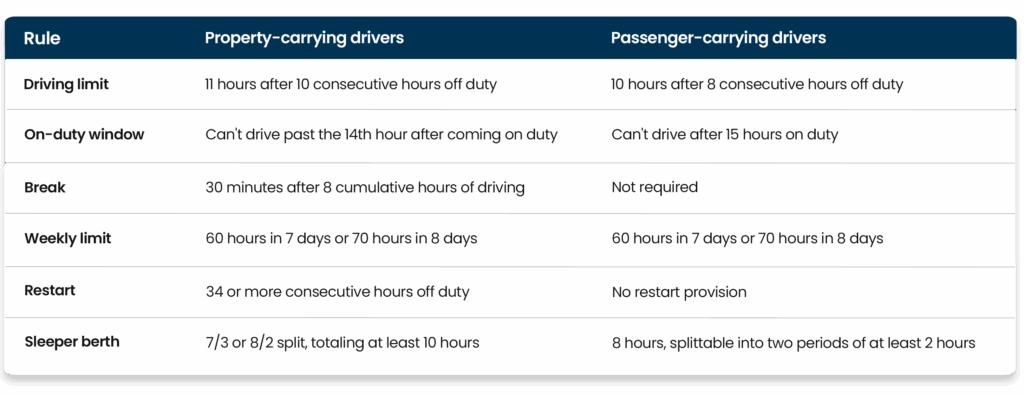
Source: FMCSA Summary of Hours of Service Regulations
The 11-Hour Rule
Under the 11 hour rule, a property-carrying driver can drive a maximum of 11 hours after 10 consecutive hours off duty. Only driving time counts toward the 11 hours. Loading, fueling, paperwork and inspections count as on-duty time, not driving time.
Once a driver reaches 11 hours of driving, they can’t drive again until they take another 10 consecutive hours off. They can still do on-duty work, like helping unload, as long as they don’t drive.
The 14-Hour Rule
The 14 hour rule sets a driving window, not a work limit. A driver can’t drive past the 14th consecutive hour after coming on duty, following 10 consecutive hours off. The clock starts at the first on-duty activity, such as a pre-trip inspection, and keeps running through lunch, breaks and detention time.
This is the rule that catches most fleets. Off-duty time doesn’t pause the 14-hour clock, except for qualifying sleeper berth periods (covered below). If a driver starts at 6 a.m., they can’t drive after 8 p.m., even if a long wait at a shipper means they’ve only driven 7 hours. They can keep doing non-driving work after hour 14, but they can’t get behind the wheel.
The 30-Minute Break Rule
Under the 30 minute break rule, a driver must take a 30-minute break after 8 cumulative hours of driving without at least a 30-minute interruption. Since the 2020 HOS update, any 30 consecutive minutes of non-driving time counts. That includes off-duty time, sleeper berth time, on-duty not-driving time or a combination of these.
In practice, a 30-minute fuel stop or a half hour at a dock can satisfy the break, as long as it’s logged correctly and the driver isn’t driving. The break still counts against the 14-hour window, so it doesn’t add time to the day. Drivers who qualify for the short-haul exception don’t need to take the break at all.
Example: How the 11-Hour, 14-Hour and 30-Minute Rules Work Together
A driver comes on duty at 6:00 a.m. and does a 15-minute pre-trip inspection. They drive from 6:15 a.m. to 2:15 p.m., which is 8 hours of driving, then spend 45 minutes on duty but not driving at a delivery. Those 45 minutes satisfy the 30-minute break.
They drive again from 3:00 p.m. to 6:00 p.m., bringing them to 11 hours of driving. That ends their driving for the day, even though their 14-hour window doesn’t close until 8:00 p.m. They can still finish post-trip paperwork and their DVIR on duty before going off duty for 10 hours.
The 60/70-Hour Rule and the 34-Hour Restart
The 70 hour rule caps how much a driver can work over a rolling period. A driver can’t drive after 60 on-duty hours in 7 consecutive days, or 70 on-duty hours in 8 consecutive days. Carriers that don’t run vehicles every day of the week use the 60-hour/7-day limit, and carriers that run every day can use 70 hours/8 days. All on-duty time counts toward the limit, not just driving.
Because the limit rolls, the hours from the oldest day drop off each day. A driver can also reset the clock to zero with a 34-hour restart, which means taking 34 or more consecutive hours off duty. Once the restart is complete, the driver has the full 60 or 70 hours available again.
The Sleeper Berth Provision
Drivers with a sleeper berth can split their required 10 hours off duty into two periods instead of one. One period must be at least 7 consecutive hours in the sleeper berth. The other must be at least 2 hours, in or out of the sleeper berth. Together they have to total at least 10 hours, so a 7/3 or 8/2 split works.
The key benefit is that neither qualifying period counts against the 14-hour window. That lets drivers rest through heavy traffic or a long wait without burning their driving window. The math gets complicated fast, so most fleets rely on their ELD to calculate available hours after a split.
Common Hours of Service Exceptions
Several exceptions change how the rules apply. These are the ones fleets use most often:
- Short-haul exception: Drivers who stay within a 150 air-mile radius of their normal work reporting location and return within 14 hours don’t need to keep logs or take the 30-minute break. They keep time records instead. See our breakdown of the short-haul exemption’s impact on carriers.
- Adverse driving conditions: When drivers run into unexpected conditions like snow or a road closure, they can extend both the 11-hour driving limit and the 14-hour window by up to 2 hours.
- Industry-specific exemptions: Some construction, agricultural and oilfield operations have their own provisions. Our post on whether construction crews qualify for an HOS exemption walks through one common case.
Each exception comes with conditions. On any day a driver doesn’t meet them, the standard rules apply.
How Fleets Track Hours of Service
Most drivers who keep records of duty status must use an ELD, which records driving time automatically and shows each driver how many hours they have left. Carriers must keep HOS records and supporting documents for 6 months. HOS violations also carry extra weight in a compliance review: when FMCSA rates the operational factor of your DOT safety rating, a pattern of Part 395 violations scores double.
Your ELD handles the clock, but inspections and maintenance shape how drivers spend their hours. A pre-trip inspection is on-duty time, and an unexpected breakdown can eat hours of a driver’s 14-hour window. Whip Around’s fleet compliance software keeps DVIRs quick and thorough and routes defects to repair before the next dispatch. It also integrates with ELD and telematics providers like Samsara, Geotab and Motive, so your inspection, maintenance and HOS data sit side by side instead of in separate systems.
What’s Changing: FMCSA’s Hours of Service Pilot Programs
FMCSA is testing two pilot programs that could add flexibility. A split duty period pilot would let drivers pause the 14-hour clock for up to 3 hours. A flexible sleeper berth pilot would allow splits like 6/4 or 5/5. According to industry reporting, each pilot is limited to about 256 drivers, and FMCSA expects a full launch in 2027.
These pilots apply only to enrolled drivers. For everyone else, the hours of service rules in this guide still apply, and any permanent change would require a separate rulemaking.
Frequently Asked Questions
What is the 11-hour rule?
The 11-hour rule limits property-carrying drivers to 11 hours of driving after 10 consecutive hours off duty. Only driving time counts toward the limit.
Does the 14-hour clock stop for breaks?
No. The 14-hour window keeps running through breaks, meals and off-duty time. The only exception is the split sleeper provision: a qualifying sleeper berth period of at least 7 hours and its paired 2-hour period don’t count against the window.
Does on-duty time count as the 30-minute break?
Yes. Since September 2020, any 30 consecutive minutes of non-driving time counts toward the break. That includes on-duty not-driving time, like fueling or waiting at a dock.
How does the 70-hour rule reset?
The 70-hour limit rolls daily, so hours from more than 8 days ago drop off. Drivers can also reset it to zero by taking 34 or more consecutive hours off duty.
Do hours of service rules apply to passenger carriers?
Yes, but the limits are different. Passenger-carrying drivers can drive 10 hours after 8 hours off and can’t drive after 15 hours on duty. They aren’t required to take a 30-minute break.
Keep Drivers Moving Within Their Hours
Hours of service rules come down to four limits working together: 11 hours of driving, a 14-hour window, a 30-minute break after 8 hours of driving and a weekly cap of 60 or 70 hours. Fleets that plan routes, inspections and maintenance around those limits avoid violations and lose fewer hours to breakdowns.
If your drivers lose hours to paper inspections or surprise breakdowns, book a demo to see how Whip Around works alongside your ELD to keep trucks ready to roll. You can also start a free trial and have your drivers completing faster digital DVIRs this week.