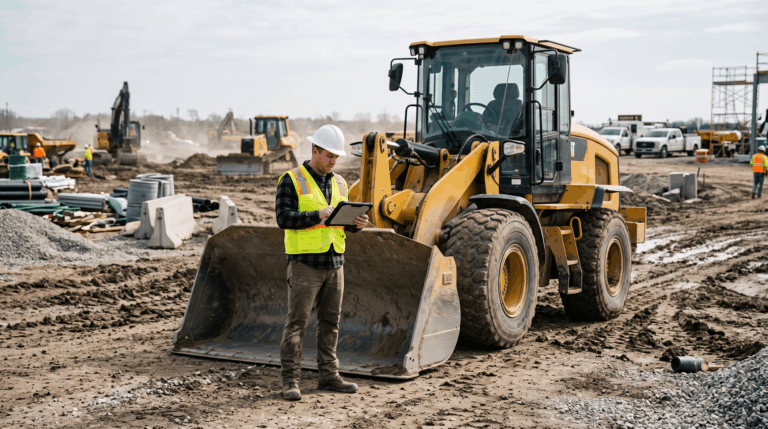
An excavator that throws a hydraulic fault on Tuesday morning costs you more than a repair. It stalls the crew waiting on it, pushes back the next phase of the project, and may force a last-minute rental. Most fleets already collect the data that could have warned them. The fault code was logged, the operator noted a slow boom on last week’s inspection, and the engine hours were well past the last service. The problem is that those signals sat in separate systems and nobody connected them in time.
Predictive fleet maintenance closes that gap. This guide explains what it is and how it compares to preventive and reactive maintenance. It covers the seven steps to put it to work, the data it relies on, and how automated scheduling turns predictions into real uptime gains.
What is predictive fleet maintenance?
Predictive fleet maintenance is a maintenance strategy that uses real-time and historical data from vehicles and equipment to identify developing problems and schedule repairs before a component fails. It doesn’t wait for a fixed interval or a breakdown. Instead, the fleet acts on the asset’s actual condition: diagnostic trouble codes, engine hours, sensor readings, driver inspection findings and repair history.
The goal is to do the right repair at the right time. Fix a component too early and you waste parts and labor. Fix it too late and you pay for a tow, an emergency repair and lost productivity. Predictive maintenance fleet management narrows that window. It gives fleet managers and shop foremen an early, evidence-based reason to pull an asset in while the repair can still be scheduled around the work. Fleet predictive maintenance applies to on-road vehicles and off-road equipment alike, from service trucks and tractors to excavators, loaders and forklifts.
Predictive vs. preventive vs. reactive fleet maintenance
Most fleets use a mix of all three approaches. They differ in what triggers the work and how much control you have over when it happens. A strong fleet maintenance strategy uses preventive maintenance as the foundation and adds prediction for the assets and components where a failure is costly.
Reactive maintenance
Reactive maintenance means fixing an asset after it breaks down. It needs almost no data or planning. It also costs the most per repair, because the downtime is unplanned and usually comes with towing, overtime and rush parts. It only makes sense for low-cost, non-critical assets where a failure won’t hold up operations.
Preventive maintenance
Preventive maintenance follows a fixed schedule based on mileage, engine hours or the calendar. It relies on meter readings and service records, and it makes downtime planned and costs predictable. The tradeoff is some over-servicing, since parts may be replaced or inspected before they need it. It’s the right approach for routine PMs and service required for compliance.
Predictive maintenance
Predictive maintenance responds to the asset’s actual condition. Repairs happen when telematics, DTCs, inspection findings or service history show a problem developing. Downtime is planned and targeted, and overall costs drop, although it takes an upfront investment in data and software. It pays off most on critical, high-utilization vehicles and equipment, where every hour of unplanned downtime costs the most.
How to use predictive fleet maintenance to maximize fleet uptime
Predictive maintenance is not a single tool you switch on. It is a workflow that moves information from the asset to the shop and back again. The seven steps below follow that flow, from collecting the right data to refining your strategy based on what actually breaks. You don’t need to roll out every step across the whole fleet at once. Many fleets start with their most critical, highest-utilization assets, prove the value there, and expand.
1. Bring vehicle, equipment, and maintenance data together
Prediction depends on context. A single fault code means little on its own. The same code on a truck that is 2,000 miles past its last service, with a driver-reported leak last week, tells a clear story. Start by connecting your telematics data, inspection records and service history in one place, so every signal is tied to the right asset.
For most fleets, this means pairing a telematics provider with maintenance software instead of choosing between them. The first step is understanding how telematics and maintenance software work together. Whip Around integrates with telematics providers like Geotab, Samsara and Motive. Fault codes, engine hours and mileage sync directly into each asset’s maintenance record.
2. Monitor the signals that indicate developing maintenance problems
Not every data point deserves attention. Focus on the signals that usually come before a failure:
- recurring or escalating DTCs
- rising coolant or oil temperatures
- battery voltage drops
- abnormal idle time
- declining fuel economy
- driver-reported issues like pulling, vibration or slow hydraulics
Driver and operator inspections are one of the most underused predictive signals. Telematics can’t see a cracked hose, a worn tire, or a small leak under a loader. A consistent DVIR process captures those early warnings with photos and notes. That gives your shop a human view of asset condition to go with the machine data. When the same defect shows up on three inspections in a row, that trend matters as much as any fault code.
3. Turn condition data into maintenance triggers and priorities
Data only helps uptime if it leads to a decision. Set clear rules for what happens when a signal appears. A critical engine fault on a haul truck might take it out of service immediately. A minor emissions code might wait for the next scheduled PM.
Prioritize by two factors: how severe the issue is and how important the asset is. A developing problem on the only excavator assigned to a critical jobsite should jump the queue ahead of the same issue on a backup pickup. Writing these rules down keeps triage consistent no matter who reviews the alerts that day. It also helps new shop staff and dispatchers make the same call an experienced fleet manager would.
4. Automate maintenance scheduling and work order creation
Many predictions die in the gap between “we saw a problem” and “someone is fixing it.” Manual handoffs, missed emails and paper forms all slow the response. Automation closes the gap. When a fault code syncs or a driver fails an inspection item, the work order should be created and assigned without anyone retyping the details.
In Whip Around’s fleet maintenance software, failed inspection items and synced fault codes can automatically generate work orders. PM schedules run on mileage, engine hours or calendar dates. Pair those triggers with a clear fleet maintenance schedule so planned and predicted work go into the same queue.
5. Schedule repairs around asset availability and operational demands
Predicting a failure is only half the job. The repair still has to happen at a time that doesn’t disrupt operations. Work with dispatchers, superintendents and project managers to schedule repairs during natural gaps: overnight, between jobs, during weather delays, or when a backup asset is available.
For construction fleets, this ties directly to how assets are deployed across jobsites. Tracking construction equipment utilization shows which machines are idle, which are overcommitted, and where you have room to rotate an asset into the shop. Planned downtime during a slow window costs far less than unplanned downtime in the middle of a concrete pour.
6. Track completed work and use maintenance history to improve future decisions
Every closed work order adds to what you know about your fleet. Record what was found, what was replaced, how long the repair took and what it cost. Over time, this history shows which components fail on which assets, how long parts actually last, and which warning signs turned out to be accurate.
Closing the loop matters as much as opening the work order. A defined defect resolution process makes sure every reported issue is fixed, deferred with a reason, or confirmed as not needing repair. Open defects that quietly disappear are a common source of repeat breakdowns and compliance gaps.
7. Review recurring failures and refine your maintenance strategy
Set a regular cadence, monthly or quarterly, to review repeat failures, cost per asset, and downtime by cause. Look for patterns. If one model of skid steer keeps needing hydraulic work at 1,800 hours, add that inspection to the PM schedule before that point. If a fault code never leads to a real problem, lower its priority.
This review is where predictive maintenance pays off most. Each cycle tightens your intervals, sharpens your triggers and makes your parts planning more accurate. Fleet reporting that breaks down maintenance cost, defect trends and downtime by asset makes these reviews faster and more objective.
What data and technology does predictive fleet maintenance rely on?
Predictive fleet maintenance draws on several data sources, and the most accurate programs combine them:
- Telematics devices report location, mileage, engine hours and idle time.
- Diagnostic trouble codes from the engine control module flag issues with the engine, transmission, emissions and other systems.
- Equipment sensors on heavy machinery may track hydraulic pressure, temperature and vibration.
- Meter readings drive usage-based service intervals.
- Driver and operator inspections catch visible wear, leaks and damage that sensors miss.
For mixed construction fleets, the ISO 15143-3 (AEMP 2.0) telematics standard makes it easier to pull hours, fault codes and location from equipment built by different manufacturers into one system.
Service history and recurring defect data turn those inputs into patterns, showing what usually happens after a given warning sign on a given asset type. Maintenance software ties it all together. It stores the asset record, receives telematics and inspection data, creates work orders, tracks parts and labor, and produces the reports you use to refine the program. AI and machine learning can add another layer by spotting patterns across large data sets. The foundation, though, is clean, connected data and a reliable workflow for acting on it.
How predictive maintenance improves fleet uptime
Proactive maintenance improves fleet uptime in two ways: it turns unplanned downtime into planned downtime, and it shortens the time an asset spends out of service. When you catch a problem early, you choose when the asset comes off the road and can order parts in advance. The repair is usually smaller too, because the failure hasn’t spread to other components. A worn bearing replaced on schedule is a short job. A seized bearing that destroys a hub on the highway means a tow, a multi-day repair and a missed delivery.
The U.S. Department of Energy’s Operations and Maintenance Best Practices Guide cites industry research on the gains. It found that a working predictive maintenance program can cut maintenance costs by 25% to 30%, eliminate 70% to 75% of breakdowns, and reduce downtime by 35% to 45%. Results vary by fleet and asset type, but the pattern holds: fewer surprises, more available assets and lower repair costs. Predictive maintenance for fleet vehicles also extends asset life, because components are replaced before a failure damages the parts around them. It supports safety and DOT compliance by catching defects before an unsafe vehicle goes on the road. For construction fleets, pairing prediction with solid construction equipment preventive maintenance keeps machines on the jobsite and projects on schedule.
What is the impact of automated maintenance scheduling on fleet uptime?
Automated maintenance scheduling and predictive maintenance are related, but they aren’t the same thing. Prediction tells you that something needs attention. Automation makes sure that information reaches the right person and becomes scheduled work without anyone doing it by hand. A fleet can have excellent condition data and still lose uptime if alerts sit in an inbox for three days. Automation is what turns that information into action fast enough to matter.
The uptime impact shows up in a few specific ways:
- No missed PMs: automated reminders based on real meter readings mean services aren’t skipped because someone forgot to check an odometer.
- No handoff delay: work orders created automatically from failed inspections and fault codes remove the wait between detection and repair.
- Better shop planning: technicians, parts and bays can be lined up before the asset arrives.
- More wrench time: for fleets with limited shop staff, less paperwork means technicians spend more time on actual repairs.
Put simply, prediction decides what needs attention, and automation decides how fast it gets done. Fleets that invest in one without the other usually leave uptime on the table.
Turn fleet maintenance data into action with Whip Around
Predictive fleet maintenance doesn’t require a data science team. It requires connected data, clear triggers, and a workflow that carries every issue from detection to resolution without losing it. Most fleets already have the raw ingredients in their telematics, driver inspections and service records. The opportunity is bringing them together.
Whip Around connects driver and operator inspections, telematics fault codes, PM schedules and work orders in one maintenance workflow. The shop sees issues as soon as they’re reported, and every repair is tracked back to the asset. It works across trucks, trailers, heavy equipment and other assets, which makes it a practical fit for construction fleets running mixed equipment across multiple jobsites. To see how it works with your fleet, book a demo or start a free trial.
FAQs about predictive fleet maintenance
What is the difference between predictive and preventive fleet maintenance?
Preventive maintenance follows a fixed schedule based on mileage, engine hours or time. Predictive maintenance uses real-time condition data like fault codes, sensor readings and inspection findings to schedule repairs when an asset shows signs of a developing problem. Most fleets use preventive maintenance as a baseline and add predictive triggers for critical assets.
Can predictive maintenance prevent all fleet breakdowns?
No. Some failures, such as tire punctures, collision damage or sudden electrical faults, give little or no warning. Predictive maintenance cuts breakdowns significantly by catching the problems that do show early signs. It works best alongside preventive maintenance and consistent pre-trip inspections.
What fleet data is needed for predictive maintenance?
The most useful data includes diagnostic trouble codes, engine hours, mileage, telematics readings, driver and operator inspection findings, service history and recurring defect records. Equipment sensor data, such as hydraulic pressure or temperature, adds more precision for heavy machinery.
How does proactive maintenance improve fleet uptime?
Proactive maintenance fixes problems before they cause failures, which turns long, unplanned downtime into shorter, scheduled downtime. It also lets you order parts in advance and plan repairs around operations, so assets spend less total time out of service.
How can I maximize uptime for my construction equipment fleet?
Combine consistent operator inspections with telematics data from your equipment, schedule PMs by engine hours, and automate work orders so issues reach the shop quickly. Track equipment utilization so you can schedule repairs during idle periods. Review recurring failures regularly to refine service intervals.
Does predictive fleet maintenance require AI?
No. Many fleets run effective predictive programs using rules-based triggers tied to fault codes, meter readings and inspection findings. AI can help find patterns across large data sets, but connected data and a reliable maintenance workflow matter more than the algorithm.
How does automated maintenance scheduling reduce downtime?
Automated scheduling removes the delay between finding a problem and fixing it. PM reminders fire based on actual usage, failed inspections and fault codes create work orders immediately, and shops can plan labor and parts ahead of time. The result is fewer missed services and shorter repair cycles.