A wellsite doesn’t sit still. Trucks move between yards and locations, tools get loaded and unloaded a dozen times a week, and equipment gets handed off between crews who may never see each other in person. When nobody has a clear answer to “where is it and what shape is it in,” operators end up paying for it twice — once in downtime, once in replacement costs for gear that was never actually lost, just unaccounted for.
Asset tracking in oil and gas is the practice of monitoring the location, condition, and usage of vehicles, tools, tanks, trailers, and other field equipment across wellsites, yards, and remote locations. Done well, it connects location data to maintenance records, inspection history, and compliance documentation so operations, maintenance, and HSE teams are working from the same picture. It’s also a core piece of any oil and gas fleet management software evaluation, since tracking is only useful if it ties back into how maintenance and compliance actually get managed. This guide covers where oil and gas asset tracking pays off, the technologies used to do it, and how to build a process around it instead of just buying a tool and hoping it sticks.
7 Asset Tracking Use Cases for Oil and Gas Operations
Oil and gas fleets run more than trucks. A single operation might be responsible for pickups, water trucks, trailers, generators, pumps, hoses, and hand tools spread across multiple sites — often in locations with no fixed address and limited connectivity. Asset tracking earns its keep when it solves specific, recurring problems rather than just producing a map with dots on it.
The use cases below cover the situations that come up most often for fleet managers, operations managers, maintenance leads, and HSE staff working in oil and gas. Each one is a discrete problem with its own data requirements, which is why a real oil and gas fleet tracking approach needs to combine several types of tracking rather than relying on one.
1. Track equipment across yards, rigs, and remote sites
Equipment moves constantly between yards, wellsites, and third-party locations, and it’s rarely the same person moving it each time. Without a shared system, “where’s the pump we used on the last job” becomes a phone tree instead of a lookup.
GPS and RFID-based tracking give every truck, trailer, and piece of powered equipment a location history that any authorized person can check without calling around. For remote pads outside cellular range, satellite-connected trackers keep that visibility intact instead of going dark the moment a truck leaves cell coverage.
2. Prevent theft, loss, and unauthorized movement
Remote sites, overnight yards, and unattended lay-down areas make oilfield equipment a target, and high turnover on job sites makes it easy for gear to walk off without anyone noticing until it’s needed. Geofencing addresses this directly: if a tagged asset crosses a set perimeter or moves during hours it shouldn’t, the system flags it immediately instead of waiting for someone to notice it’s missing during the next inventory count.
This matters most for high-value, portable equipment — generators, pumps, welding rigs, and tools, that doesn’t have a VIN or a GPS unit built in the way a truck does.
3. Monitor asset utilization
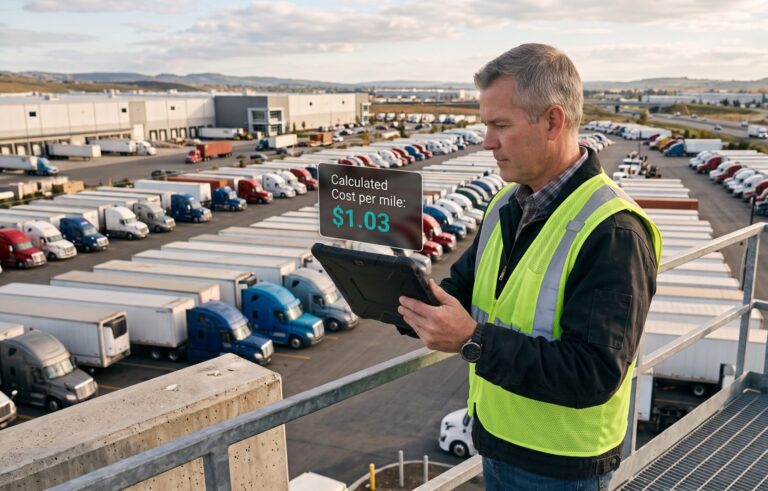
Not every asset in the yard is working. Idle trailers, underused equipment, and vehicles sitting at the wrong site all quietly inflate a fleet’s footprint without adding capacity. Tracking utilization — hours in use, distance traveled, time idle at a location — gives operations managers the data to answer a basic but often unanswerable question: do we actually need to buy or rent more of this, or do we just need to move what we already have?
Utilization data also supports crew productivity conversations. If a piece of equipment is booked solid but showing low actual runtime, that’s a scheduling problem, not an equipment problem. Over a full season, that distinction can be the difference between approving a new equipment purchase and simply redistributing what’s already sitting idle at another site.
4. Connect inspections to each asset
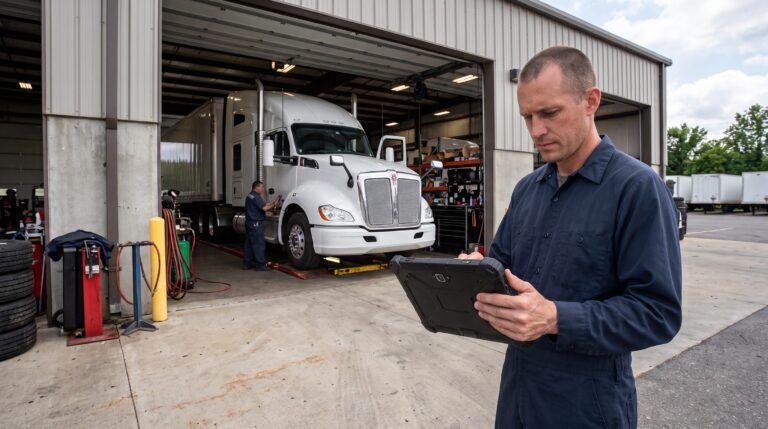
Inspection records are only useful if they’re tied to the specific asset they describe, and paper checklists rarely survive the trip from wellsite to office intact. When inspections live in a mobile app tied to an asset’s ID, every pre-trip and post-trip check, defect note, and photo builds a permanent, searchable record, for a truck, a trailer, or a piece of equipment that never touches a road.
This is where Whip Around’s digital inspection workflows are built specifically for oil and gas conditions: field crews complete inspections from a phone or tablet, attach photos of damage or wear, and a failed item can automatically generate a work order instead of sitting on a clipboard until someone remembers to follow up.
5. Schedule preventive maintenance based on real usage
Calendar-based maintenance schedules don’t account for the fact that one water truck might run twice the hours of another sitting at a different site. Tying preventive maintenance triggers to actual engine hours, mileage, or usage data (rather than a fixed date) means service happens when the equipment actually needs it.
Industry estimates suggest unplanned maintenance can cost three to nine times more than planned service, largely because it happens at the worst possible time: mid-job, on a remote site, with a rental or standby unit as the only backup. Preventive maintenance programs tied to real usage data have been shown to reduce unplanned downtime by as much as 45%.
6. Track repairs, downtime, and out-of-service assets
When equipment goes down, the cost isn’t just the repair — it’s the job that didn’t get done, the crew that sat idle, and the standby unit that had to be brought in. Tracking downtime and repair history at the asset level shows which equipment is chronically unreliable, how long assets typically sit out of service, and where repair costs are concentrated.
That history also protects against buying the same problem twice. An asset with a long repair log and rising costs is a candidate for replacement, not another rebuild — but only if someone can actually see that pattern instead of relying on memory. Fuel typically makes up 25–35% of total fleet operating costs in oil and gas, and a chronically underperforming asset often drags fuel efficiency down along with reliability, compounding the case for retiring it.
7. Keep safety and compliance records organized
HSE and compliance teams need proof, not just process: inspection dates, calibration certificates, hazard area ratings, and repair history tied to each asset and available on demand. In hazardous environments, that documentation isn’t optional paperwork — it’s what stands between an operation and a serious incident or violation.
Digital recordkeeping tied to individual assets makes audits faster and supports a broader fleet safety program by surfacing patterns, like a specific asset type failing inspections more often than others — that a filing cabinet full of paper never will.
Asset Tracking Technologies Used in Oil and Gas
No single technology covers every asset type or environment in oil and gas. Trucks need different tracking than hand tools, and a wellsite with no cell coverage needs different infrastructure than a yard with steady connectivity. Most operators end up running a mix, matched to the asset and the site.
GPS tracking
GPS units installed on trucks, trailers, and larger equipment provide continuous location data over cellular networks. It’s the standard choice for powered, road-going assets and gives fleet managers real-time location plus historical route data for every vehicle in the fleet.
Satellite tracking
Satellite-connected devices keep assets visible on remote pads and pipeline routes where cellular coverage is unreliable or nonexistent. They typically report location less frequently than cellular GPS to conserve power and bandwidth, but they close the visibility gap that stops most GPS systems cold once a truck leaves cell range.
RFID and Bluetooth tags
RFID and Bluetooth tags track smaller, non-powered assets — tools, hoses, valves, and equipment components — that don’t justify a full GPS unit. Passive RFID tags are inexpensive and durable enough for repeated exposure to dirt, moisture, and rough handling, and intrinsically safe versions are rated for use in explosive atmospheres like wellheads and processing areas.
Barcode and QR code scanning
Barcode and QR labels give every asset a scannable ID that ties directly into inspection and maintenance records. A technician scans the code during a check-in, check-out, or inspection, and that action logs automatically against the asset’s history — no manual data entry, no mismatched paperwork between the field and the office.
Telematics and IoT sensors
Telematics devices and IoT sensors go beyond location to report engine hours, fault codes, fluid levels, and temperature — the data that actually drives maintenance decisions. Combining oil and gas telematics data with inspection and work order records is what turns raw sensor output into a maintenance trigger instead of just another dashboard nobody checks.
GPS Location Data Alone Does Not Solve the Asset Problem
Knowing where an asset is doesn’t tell you whether it’s safe to use, when it was last serviced, or whether it failed its last inspection. A GPS pin on a map answers one question and leaves the ones that actually affect uptime and safety unanswered.
This is the gap that catches a lot of operators after they’ve already invested in tracking hardware. A truck showing up on a location dashboard every 30 seconds is still a liability if its last inspection flagged a brake issue that never got resolved, or if its preventive maintenance is three weeks overdue. Location data with no connection to inspection records, work orders, or compliance documentation just tells you where the problem is — it doesn’t tell you that there is one.
The fix isn’t more location precision. It’s connecting the location layer to the operational layer: inspections, defects, work orders, and compliance records all tied to the same asset ID. That combination is what actually reduces breakdowns, missed service, and unclear repair history — the problems fleet and maintenance managers are usually trying to solve when they start looking at tracking in the first place.
Operators who treat GPS as the whole solution tend to find out the gap the hard way — a truck that looks fine on a location dashboard shows up at a site with an expired inspection or a fault code nobody acted on. Closing that gap doesn’t require ripping out existing telematics or GPS hardware. It requires layering inspection, maintenance, and compliance data on top of the location data that’s often already being collected and underused.
How to Build an Oil and Gas Asset Tracking Process
A tracking system is only as good as the process wrapped around it. Before choosing hardware, it helps to work through a few steps:
Start with an asset inventory. List every vehicle, trailer, and piece of equipment worth tracking, and note which ones are powered, which are portable, and which operate outside cell coverage — that determines whether they need GPS, satellite, RFID, or a barcode.
Match tracking method to asset type and site conditions. A yard truck doesn’t need satellite tracking. A pump sitting on a remote pad for weeks probably does. Matching the method to the actual use case avoids overpaying for hardware precision nobody needs, or underpaying and losing visibility the moment an asset leaves the yard.
Standardize inspections at the asset level. Every asset — vehicle or not — should have a digital inspection tied to its ID, with photos and defect notes stored where maintenance and HSE teams can both see them.
Connect defects to work orders automatically. A failed inspection item that has to be manually re-entered into a maintenance system is a failed inspection item that sometimes never makes it there at all.
Set maintenance triggers based on real usage. Mileage, engine hours, or calendar intervals — whichever fits the asset — should generate a reminder before something breaks, not after.
Keep compliance documentation attached to the asset, not stored separately. Calibration certificates, hazard ratings, and inspection history should be pullable in seconds during an audit, not reconstructed from email threads and a filing cabinet.
Keep Oil and Gas Assets Visible, Available, and Ready for Work with Whip Around
Tracking where an asset is only solves part of the problem oil and gas operators actually have. The harder question is whether that asset is safe, current on maintenance, and ready to go out on the next job — and that requires inspection records, work orders, and compliance documentation tied to the same asset ID as its location data.
Whip Around brings that layer together. Field crews run digital inspections from a phone or tablet on trucks, trailers, and non-vehicle equipment alike, with photo documentation and automatic defect-to-work-order routing so a flagged issue doesn’t sit unresolved. Preventive maintenance schedules can be set by mileage, engine hours, or calendar date, and every inspection, work order, and compliance record is stored and searchable — which is exactly what an HSE audit or a maintenance manager tracing a repeat failure needs. Oil and gas operators like Lone Star Corporation have used the platform to bring that kind of visibility to fleets spread across multiple remote sites.
None of this requires replacing GPS or telematics hardware already in the field. It means giving that location data somewhere to go, into an inspection record, a work order, or an audit-ready compliance file, so an asset showing up on a map is also an asset you know is safe, current on maintenance, and ready for the next job.
If your team already has location tracking in place and is missing the inspection, maintenance, and compliance layer that turns that data into action, book a demo to see how Whip Around fits alongside your existing systems, or start a free trial to try it with your own fleet.