A forklift that looked fine yesterday can fail today. A cracked fork, a slow leak, a worn brake — none of it is visible from across the warehouse, and none of it shows up unless someone checks. That’s why OSHA doesn’t treat the daily forklift inspection as a suggestion. It’s a standing requirement, and skipping it is one of the fastest ways to turn a routine shift into an incident report.
In 2024, forklifts and other powered industrial trucks were connected to 84 work-related deaths in the U.S., according to the National Safety Council, along with thousands of nonfatal injuries serious enough to require days away from work. A large share of that toll traces back to the same handful of causes: worn components that went unnoticed, defects that got reported too late, or an inspection that was skipped entirely. A consistent forklift inspection checklist, completed before every shift, is still the most reliable way to catch problems before they become accidents — and to prove, in writing, that your operation is doing its part. Below is a printable forklift inspection checklist you can put to use immediately, followed by a full breakdown of what OSHA requires, how to run the inspection step by step, and what to do when a forklift doesn’t pass.
Printable Forklift Inspection Checklist
Use this daily forklift inspection checklist as your baseline. It covers the visual walk-around, the power system check, and the functional test that OSHA expects before a forklift is put into service. Adjust it to match your specific truck’s operator manual and manufacturer specifications.
Visual walk-around (key off):
- Forks, heel, and retaining pins for cracks or bends
- Mast, carriage, and lift chains for damage or excessive slack
- Tires and wheels for cuts, chunking, or loose lug nuts
- Overhead guard and load backrest extension
- Data/capacity plate — clean, legible, matches attachments
- Hydraulic hoses and undercarriage for fluid leaks
Power system check (key off):
- Electric: battery restraints, cable condition, electrolyte level
- Propane: tank mounting, relief valve orientation, hose condition
- Internal combustion: engine oil, coolant, belts, hoses, air filter
Functional test (key on):
- Service and parking brake performance
- Steering response
- Horn, headlights, and backup alarm
- Hydraulic lift and tilt controls through full range
- Seatbelt and seat presence switch
Every item that fails goes in the notes section, with the forklift tagged and removed from service until it’s cleared. More on that process below.
Download Printable Forklift Inspection Checklist – Click Here
What OSHA Requires Before a Forklift Is Used
OSHA’s standard for powered industrial trucks, 29 CFR 1910.178(q)(7), requires that every forklift be examined before it’s placed in service each shift. If a forklift runs around the clock, it has to be inspected after each shift, not once a day. The standard also requires that any forklift found to be unsafe be taken out of service until it’s repaired.
Contrary to a common misconception, OSHA does provide inspection references for this — the agency publishes sample daily checklists for both electric and internal combustion powered industrial trucks, broken out by engine-off and engine-on checks. They’re a useful starting point, but most operations still need to adapt them to their specific truck models, attachments, and site conditions, which is why a documented, repeatable OSHA forklift inspection checklist matters more than the source document itself.
The stakes for skipping this are concrete. As of 2026, OSHA’s maximum penalty for a serious or other-than-serious violation is $16,550 per violation, and willful or repeat violations can run up to $165,514 per violation. Those figures didn’t change from 2025 — OSHA didn’t apply an inflation adjustment for 2026 — but they’re still very much in effect, and a missing or incomplete inspection record is one of the easier things for an inspector to flag.
One clarification worth making: items like fire extinguishers, spill kits, and general PPE are frequently lumped into “forklift safety checklists,” but OSHA treats these as workplace- or hazard-specific requirements, not blanket forklift equipment. Whether you need them depends on your facility, the materials you’re handling, and your existing hazard communication program — not on the forklift itself.
The inspection requirement doesn’t stand alone, either. Under 29 CFR 1910.178(l), OSHA requires that anyone operating a forklift complete formal training and an evaluation before running the truck unsupervised, plus a refresher evaluation at least once every three years or after specific triggers, like a near-miss, an accident, or a supervisor observing unsafe operation. An operator who’s certified but has never been walked through what a proper daily inspection looks like on this specific truck is still a gap, training and the daily checklist are meant to work together, not substitute for each other.
5 Steps to Complete a Daily Forklift Inspection
A thorough daily forklift inspection checklist takes most operators five to ten minutes once it’s routine. Breaking it into five steps keeps the process consistent from operator to operator and shift to shift.
Step 1: Record the Forklift and Inspection Details
Start by logging the basics: forklift ID or asset number, date and time, operator name, and hour meter or odometer reading. This is what turns a one-off inspection into part of a documented record — the piece OSHA and your insurance carrier will ask for after any incident. Paper logs work, but they’re easy to lose or backfill after the fact. A digital form, completed on a phone or tablet before the operator ever touches the key, closes that gap and ties the record to a timestamp automatically. This step matters just as much as the mechanical checks that follow. It’s the difference between a real inspection process and a formality, and the same logic applies to daily equipment inspections across any piece of material-handling equipment, not just forklifts.
The hour meter reading is worth taking seriously beyond the inspection record itself. If your preventive maintenance schedule is set by engine hours, this is the number that determines whether a forklift is due for service — logging it inconsistently, or only when someone remembers, is a common reason PM intervals slip without anyone noticing.
Step 2: Complete the Visual Walk-Around
With the engine off, walk the full perimeter of the truck. Check the forks for cracks, bends, or worn heels, and confirm the retaining pins are secure. Inspect the mast and lift chains for damage, rust, or slack. Look at tire condition and wheel lug nuts, check the overhead guard and backrest for structural integrity, and confirm the data plate is legible and matches the attachments currently on the truck. Scan underneath for pooling hydraulic fluid, oil, or coolant, a leak you can see today is a breakdown you’ll be dealing with next week if it’s ignored.
“Excessive slack” on a lift chain isn’t a judgment call you should be making from memory, check it against the manufacturer’s specified tolerance, and treat any chain with visible rust, kinks, or uneven links as a fail rather than something to monitor. The same goes for tire wear: cuts and chunking that expose the tire’s internal cord structure are a stop-use condition, not a note for next week.
Step 3: Inspect the Battery, Fuel, or Propane System
This step depends on how the forklift is powered. Electric trucks need a check of battery restraints, cable and connector condition, and electrolyte levels. Propane trucks require confirming the tank is properly mounted and secured, the relief valve is correctly oriented, and hoses and fittings show no signs of wear or leaks. Internal combustion trucks need engine oil, coolant, belts, hoses, and air filter checked before startup. Skipping this step is how slow leaks and loose connections turn into an engine-bay fire or a stalled truck in the middle of a shift.
If your facility charges electric forklifts on-site, this is also where a quick check of the charging area matters: cables in good condition, connectors fully seated, and the area itself clear of the ventilation and housekeeping issues that turn a battery room into its own hazard. It’s a facility-level check rather than a forklift-specific one, but it belongs in the same daily rhythm.
Step 4: Test the Controls and Safety Devices
Now start the engine and run the functional tests. Confirm the service brake and parking brake hold, steering responds without excessive play, and the horn, headlights, and backup alarm all work. Raise and tilt the mast through its full range, watching for shuddering, drift, or unusual noise. Test that the seatbelt latches and that the seat presence switch disables travel when the operator isn’t seated, these interlocks exist specifically to prevent unintended movement, and a disabled one defeats the purpose of the whole inspection.
None of this requires a load test or a full duty cycle, the point is to confirm every safety-critical system responds correctly, not to simulate a shift’s worth of work before the shift starts. If any control feels sluggish, delayed, or inconsistent compared to how the truck normally handles, that’s a fail, even if the system technically still functions.
Step 5: Record Defects and Inspection Results
Every item, pass or fail, gets documented, not just the failures. If something doesn’t check out, note exactly what’s wrong, tag the forklift, and route it to maintenance before it’s used again. A useful defect note names the specific component, describes what’s wrong in plain terms, and includes a photo where possible — “left fork tip bent, approx. 1 inch” gives a technician something to act on; “forks bad” doesn’t. A completed, signed inspection record is what proves the process actually happened, and it’s the record that feeds directly into whatever comes next: a maintenance work order, a parts request, or a scheduled repair.
What to Do When a Forklift Fails an Inspection
A failed inspection should trigger an immediate, specific response: the operator tags the forklift out of service, reports the defect through whatever channel your operation uses: a supervisor, a maintenance ticket, a digital defect report, and the truck stays parked until a qualified technician clears it. None of this should depend on memory or a verbal heads-up at the end of a shift.
Keep the inspection records themselves, too, not just the defect reports. OSHA doesn’t set one universal retention period for daily forklift checklists the way it does for some training and medical records, but keeping at least a year of history is standard practice and gives you a defect pattern to look back on, useful both for an OSHA inspector asking whether the process is followed consistently and for your own maintenance planning.
It’s worth being clear about where the daily inspection ends and maintenance begins. The operator’s pre-shift check is a visual and functional screen, it’s designed to catch obvious, shift-to-shift problems, not to diagnose or repair them. Scheduled maintenance is a separate process, completed by qualified technicians at intervals set by mileage, engine hours, or calendar date, following the manufacturer’s service specifications. A forklift maintenance checklist covers things a daily inspection isn’t meant to catch: internal wear patterns, fluid analysis, calibration, and component life-cycle tracking.
The two processes should feed each other. If the same defect shows up on inspection reports week after week, that’s a signal for your maintenance schedule, not just a repeat repair ticket — it usually means an interval needs adjusting or a part needs replacing before it fails outright. This kind of pattern is exactly what a documented equipment preventive maintenance program is built to catch, and it’s the same logic that feeds into a broader equipment safety program looking at incident trends across your whole fleet, not just one forklift.
Manage Forklift Inspections and Repairs With Whip Around
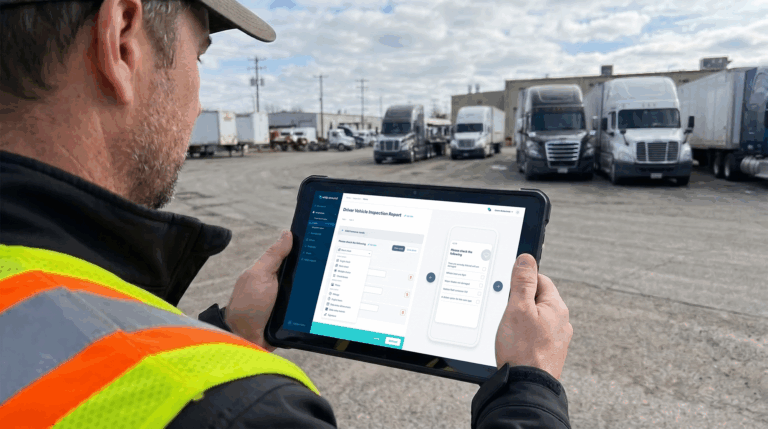
Running this process on paper works until it doesn’t, until a form goes missing, a defect gets reported verbally and never logged, or nobody can say when a forklift was last inspected. Whip Around replaces the clipboard with a mobile inspection form that operators complete on a phone or tablet before they start the truck, built around the same checklist categories covered above and customized to your specific forklift types and attachments.
When an operator flags a failed item, Whip Around can automatically generate a maintenance work order from that defect, so it moves straight to your shop instead of sitting in an inbox or a notebook. AI Inspections Pro can also review submitted photos for defects a rushed walk-around might miss, and every inspection, pass or fail, is stored and searchable, which matters when you need to show an OSHA inspector or your insurance carrier that the process is actually being followed. Documents like operator certifications and inspection records can be stored in Wallet, so they’re on hand without digging through a filing cabinet.
For fleets already running Geotab, Samsara, or Motive, engine hours and fault codes pulled through those integrations can trigger the preventive maintenance schedule directly, so the hour meter reading an operator logs during the daily inspection is the same number driving when the forklift is due for its next scheduled service, instead of two separate records that have to be reconciled by hand.
None of this replaces a scheduled preventive maintenance program, but it does connect the two: recurring defects surfaced in daily inspections roll directly into the fleet maintenance process your shop is already tracking.
Make Every Forklift Inspection Lead to Action
A forklift inspection checklist is only useful if it changes what happens next. The goal isn’t a completed form, it’s a forklift that’s confirmed safe to operate, or one that’s tagged, reported, and off the floor until it’s fixed. Build the habit around those five steps, keep the record for every shift, and treat a failed inspection as the start of a maintenance process rather than the end of a checklist.
If you’re ready to move that process off paper, see Whip Around in action or start a free trial to see how inspections, defect reports, and work orders can run from one platform.