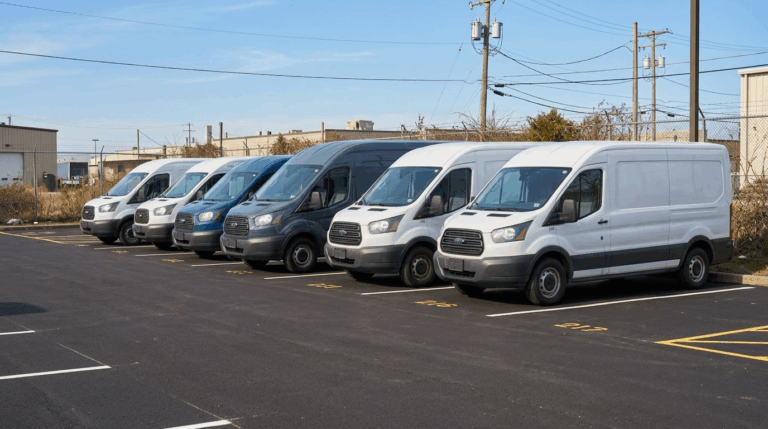
Your drivers make local stops, your trucks are smaller than semis, and none of them needs a commercial driver’s license. Does that mean your delivery business can skip a USDOT number?
The short answer: A delivery fleet generally needs a federal USDOT number if it operates a vehicle or vehicle combination with a gross vehicle weight rating (GVWR), gross combination weight rating (GCWR), actual gross vehicle weight, or actual gross combination weight of 10,001 pounds or more, whichever is greater, in interstate commerce. Certain hazardous-materials operations can also trigger registration. A fleet that operates entirely within one state may still need a USDOT number under that state’s rules. FMCSA’s USDOT number guidance explains the federal threshold and identifies states with intrastate registration requirements.
The tricky part for delivery fleets is that local stops do not always mean intrastate commerce. Here’s how to work through the question for your vehicles and routes.
What is a USDOT number?
A USDOT number identifies a motor carrier in FMCSA’s safety records. FMCSA uses it to track information from inspections, crash investigations, audits, and compliance reviews. It belongs to the carrier; it is not a separate number assigned to each delivery truck. It also is not the same as a commercial driver’s license (CDL) or operating authority (often called an MC number). FMCSA’s overview describes its purpose.
When does a delivery fleet need a federal USDOT number?
For ordinary cargo delivery, start with two questions: Does a vehicle or vehicle-and-trailer combination reach the 10,001-pound threshold? Is it operating in interstate commerce? If the answer to both is yes, the carrier generally needs a federal USDOT number. FMCSA assesses rated or actual weight, whichever is greater. Check the vehicle manufacturer’s weight rating as well as the weight of the loaded vehicle or combination.
For example, a delivery truck rated at 12,000 pounds that carries goods across a state line generally falls within the federal rule, even if it weighs less than 10,001 pounds on a particular trip. A van rated below 10,001 pounds is not automatically outside the rule if its actual loaded weight or a vehicle-and-trailer combination reaches the threshold.
Hazardous materials require a separate check. FMCSA states that intrastate carriers transporting types and quantities of hazardous materials that require a federal safety permit must obtain a USDOT number. If your deliveries include regulated hazardous materials, review the applicable hazmat requirements rather than relying on the ordinary cargo weight test alone.
If every stop is in one state, is the route intrastate?
Sometimes, but not necessarily. Interstate commerce includes transportation between states and transportation between two points in one state when that movement is part of trade or transportation that originated or will end outside the state. The shipment’s overall movement matters, not just the driver’s route on a map. FMCSA defines interstate commerce here.
Imagine a delivery company picking up goods at an in-state distribution center and making only in-state stops. If those deliveries are part of a continuous shipment that began in another state, they may be interstate commerce. Whether a particular warehouse stop ends the interstate movement depends on the shipment’s facts, including the shipper’s intent. FMCSA discusses that distinction in its guidance on an in-state leg of an interstate movement.
If your routes are entirely within one state and the shipments are genuinely intrastate, federal interstate registration may not apply under the ordinary cargo rule. Your state may still require registration.
Do local delivery vans need a USDOT number?
There is no single answer for every van. Work through these common situations:
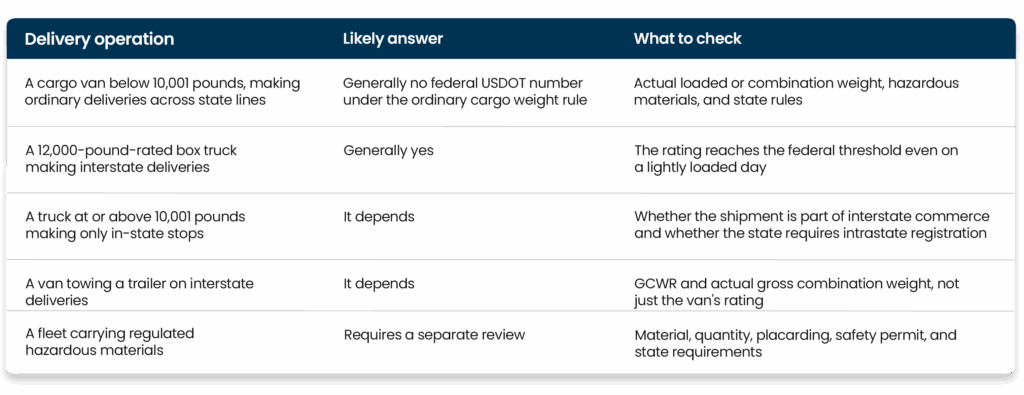
These are illustrations, not a substitute for checking the specific vehicle, shipment, and jurisdiction against FMCSA’s rules.
What if your delivery fleet never crosses state lines?
Check your state transportation agency before deciding you do not need a number. FMCSA lists numerous states that require certain intrastate commercial motor vehicle operators to obtain USDOT numbers and directs carriers to their state agency for the applicable rules. Requirements and thresholds can differ by state. A number issued for state compliance also does not, by itself, answer whether a particular route is interstate commerce.
Is a USDOT number the same as a CDL or MC number?
No. The requirements answer different questions. A USDOT number identifies the carrier; a CDL is a driver credential; operating authority concerns permission to conduct certain for-hire interstate transportation. A delivery business can need a USDOT number even when its drivers do not need CDLs. FMCSA also explains that a qualifying private motor carrier transporting its own goods needs a USDOT number but generally does not need an MC number.
That means delivering your own products does not automatically exempt your business from USDOT registration. For a broader look at fleet registrations, see Whip Around’s guide to DOT licenses and permits.
How to check your fleet before applying
- List every delivery vehicle and trailer. Record GVWR, GCWR where applicable, and typical maximum actual loaded weights. Recheck vehicles when you add trailers or change equipment.
- Map where shipments begin and end. Include the movement before your driver picks up a load at a warehouse, not only the last-mile route.
- Identify hazardous-materials loads. Check the specific material and quantity against applicable federal and state rules.
- Review every state where you operate. Check the responsible state agency’s intrastate registration rules, even if drivers stay within state lines.
- Use FMCSA’s registration guidance. If registration is required, FMCSA directs new applicants to its Motus registration system. Registered carriers should also keep their information current, including the biennial update.
Once you know which rules apply, build a routine for inspections, defect follow-up, and record access. Whip Around’s trucking and delivery solution helps teams manage vehicle inspections and maintenance across routes. Explore our fleet compliance software and digital vehicle inspections to keep vehicle records organized as the fleet grows. A USDOT number is one part of compliance; it does not replace your operational safety requirements.
Frequently asked questions
Does a delivery van under 10,001 pounds need a DOT number?
Generally, a van below the federal weight threshold does not need a federal USDOT number solely for ordinary cargo delivery, even if it crosses state lines. Confirm its actual loaded and combination weights, hazardous-materials status, and any state registration requirements.
Do Amazon-style or other last-mile delivery fleets need USDOT numbers?
The business model or last-mile label does not decide. Evaluate the carrier’s vehicles and combinations, the shipment’s interstate character, hazardous-materials exposure, and state rules. Even a route with only local stops may be part of an interstate shipment.
Can I need a USDOT number without a CDL?
Yes. The federal USDOT cargo threshold starts at 10,001 pounds for qualifying interstate operations, while CDL rules use different criteria. Review the vehicle and driver requirements separately.
Does a USDOT number mean every driver must complete a DVIR after every trip?
No. Registration and inspection-report rules are separate. Federal rules for property-carrying commercial motor vehicles generally require a written end-of-day driver vehicle inspection report when a defect or deficiency is found; drivers also have pre-operation duties. Review 49 CFR Part 396 for the applicable rule and see Whip Around’s DVIR overview for background.