TL;DR: To improve fleet efficiency, find where your fleet loses time and money, then fix the processes behind those losses. Standardize inspections, get defects repaired faster, automate preventive maintenance and shorten downtime. Control parts, cut idling, right-size the fleet, tighten routes and hold drivers accountable. Then connect your fleet data so decisions are based on facts instead of guesswork.
You can improve fleet efficiency by reducing downtime, controlling operating costs, and getting more productive work out of every vehicle, driver, and technician. In practice, that means fixing the processes that waste time: inspections that never reach the shop, work orders that sit unassigned, PMs that get missed, and data spread across five different places. Most fleets don’t have an equipment problem. They have a handoff problem.
That matters more than ever. According to the American Transportation Research Institute, the average cost of operating a truck hit a record $2.336 per mile in 2025. With costs that high, small process gaps add up quickly. This guide covers how to measure fleet efficiency, where wasted time and money usually hide, and 10 practical ways to fix them.
What is fleet efficiency?
Fleet efficiency is how well a fleet turns its vehicles, equipment, drivers, and maintenance resources into productive work at the lowest practical cost. An efficient fleet keeps assets available and in use, controls fuel and maintenance spending, minimizes downtime, and completes jobs safely with as little wasted time, mileage, and labor as possible.
Efficiency is not the same as spending less. A fleet that skips maintenance to save money this quarter will pay for it in breakdowns and lost work next quarter. Real efficiency comes from removing waste while protecting uptime and safety. That waste includes unplanned repairs, idle assets, duplicate data entry and slow approvals.
How to measure fleet efficiency and identify where you’re losing time and money
You can’t improve what you don’t measure. Start with a short list of metrics that show where time and money leak out of your operation. Track them by asset, location and asset type so patterns are easy to spot. The table below covers the metrics most fleets should watch and the warning sign to look for with each one.
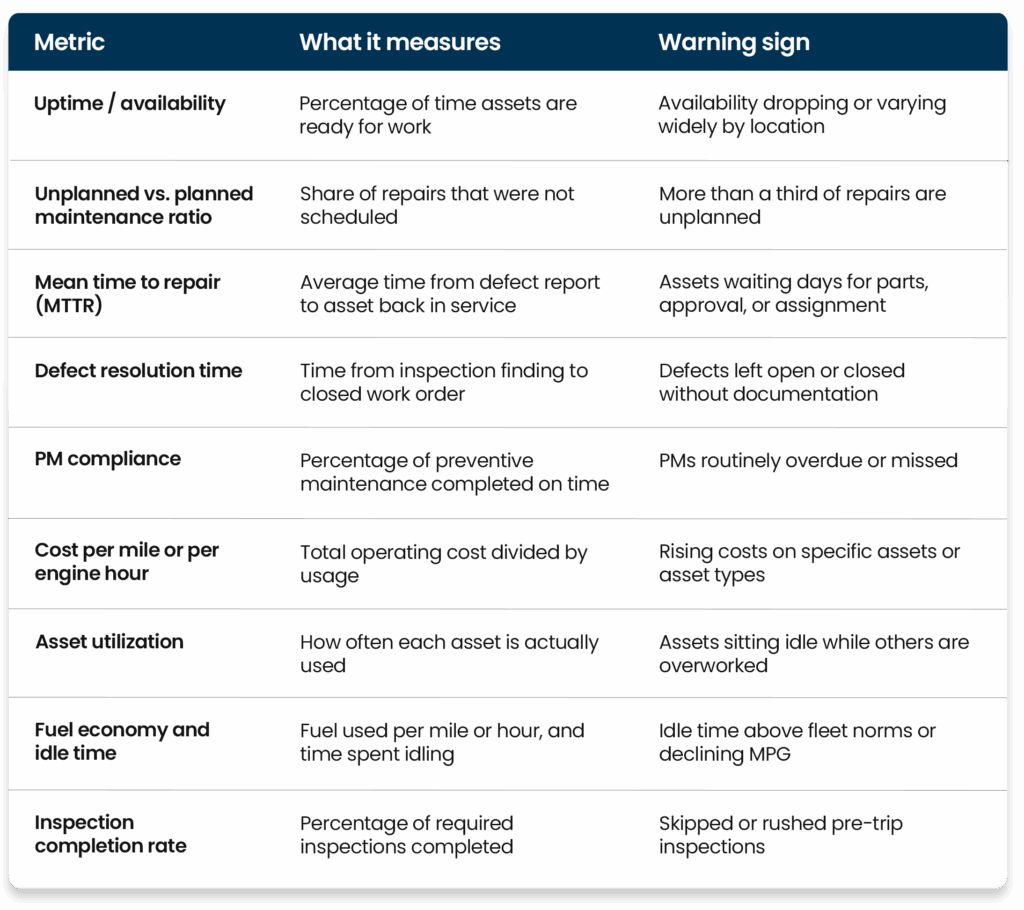
Once you have a baseline, look for the biggest gaps. If MTTR is high, the problem is likely in your repair workflow. If utilization is low, you may have too many assets. The metrics tell you which of the strategies below to tackle first.
10 ways to improve fleet efficiency
The strategies below roughly follow the way work flows through a fleet. They start with a driver’s inspection, move through maintenance and repair, then cover how assets are used on the road and how data ties it all together. You don’t need to do all 10 at once. Start where your metrics show the biggest losses.
1. Standardize vehicle and equipment inspections
Inspections are the first line of defense against breakdowns, but only if they’re done the same way every time. Paper forms and inconsistent checklists lead to skipped items, illegible notes, and defects that never reach the shop. Standardize inspection forms by asset type so each person sees the items that matter for that machine. A driver checking a box truck and an operator checking a skid steer shouldn’t be working from the same list.
Digital DVIRs make standardization easier to enforce. Drivers complete required items on their phone, attach photos of defects, and submit in minutes. Managers can see who completed inspections and who skipped them. Clean, consistent inspection data is the foundation for every other strategy on this list. It also keeps you ready for DOT audits, since every completed inspection is time-stamped and stored.
2. Turn reported defects into repairs faster
A defect report that sits in a pile or an inbox is wasted information. Every hour between “driver reported it” and “technician is working on it” is an hour of risk and lost productivity. The fix is a clear maintenance work order process that defines who reviews defects, how they’re prioritized, and how quickly they move to repair.
Automation closes most of the gap. In Whip Around, failed inspection items can automatically generate work orders with the driver’s notes and photos attached. The shop doesn’t have to re-enter anything or chase down details. Strong fleet work order management also means every defect is repaired, deferred with a documented reason, or confirmed as not needing repair, so nothing quietly disappears.
3. Automate preventive maintenance scheduling
Preventive maintenance is one of the most reliable ways to improve fleet maintenance efficiency, but only when PMs actually happen on time. Spreadsheets and wall calendars depend on someone remembering to check them, and missed services turn into bigger repairs later.
Automated scheduling based on real mileage, engine hours or calendar intervals removes that dependency. Reminders go out before service is due, and work orders can be created automatically. A solid fleet maintenance strategy uses automated PMs as the baseline. It then adds condition-based triggers for critical assets through predictive fleet maintenance.
4. Reduce unnecessary vehicle downtime
Once an asset needs attention, the goal is to get it back in service as fast as possible. Much of the time an asset spends “down” isn’t repair time at all. It’s waiting: for someone to review the defect, for approval, for parts, for a technician, or for someone to mark the job complete.
Map out where your assets actually spend their downtime and attack the waiting. Set approval thresholds so routine repairs don’t need a manager’s sign-off. Batch minor repairs with scheduled PMs so an asset comes in once instead of three times. Use mobile work orders so technicians can close jobs from the bay, and notify dispatch the moment an asset is ready. Tracking MTTR by stage shows exactly which step is slowing you down.
5. Improve parts and inventory management
Few things stall a repair like a missing part. When a technician has diagnosed the problem but can’t finish because a filter or sensor is out of stock, that time is simply lost, and rush orders often cost more. On the other hand, overstocking ties up cash and shelf space in parts that may never be used.
Track parts usage against work orders so you know what you actually use, by asset type and by season. Set reorder points for high-use parts, and stage parts ahead of scheduled PMs so they’re ready when the asset arrives. Over time, your repair history becomes a forecast of what you’ll need next. Linking parts to specific work orders also gives you a true cost per repair. That makes it easier to decide when an asset is worth fixing and when it’s time to replace it.
6. Reduce fuel waste and excessive idling
Fuel is one of the largest line items in any fleet budget, and idling is one of the easiest places to cut it. According to the U.S. Department of Energy’s Alternative Fuels Data Center, more than 6 billion gallons of gasoline and diesel are lost to idling every year.
Use telematics data to find the vehicles and drivers with the highest idle time, then set clear idling policies and follow up. Keep vehicles properly maintained, since underinflated tires, dirty air filters and overdue services all hurt fuel economy. Fuel management software helps you track fill-ups and fuel costs by asset so you can spot outliers quickly.
7. Improve vehicle utilization and right-size the fleet
Every asset in your fleet costs money whether it’s working or not, through insurance, registration, depreciation and maintenance. Low utilization suggests you may be paying for more vehicles or equipment than you need. Uneven utilization means some assets are wearing out while others sit.
Review utilization by asset at least quarterly. Rotate heavily used assets with underused ones to spread wear, and consider selling, consolidating, or renting instead of owning assets that rarely move. Right-sizing isn’t just about cutting. Sometimes the data shows that one more asset would eliminate costly rentals or overtime. Factor maintenance cost per asset into these decisions too. An older truck that spends more time in the shop than on the road often costs more than a replacement would.
8. Optimize routes and reduce unnecessary mileage
Every unnecessary mile adds fuel cost, wear and driver time. Inefficient routes often come from habit, last-minute changes, or not knowing where vehicles actually are. Route planning tools and GPS data can show where drivers backtrack, take longer routes than needed, or make extra trips.
Group jobs by location, schedule deliveries and service calls so drivers don’t crisscross the same area, and review route data regularly for patterns. Lower mileage also stretches maintenance intervals, which means fewer PMs and less downtime over the life of each asset. For field service and construction fleets, smarter routing also means crews spend more of the day on the jobsite and less of it in the truck.
9. Improve driver accountability and operating habits
Drivers have a direct effect on fuel use, wear and tear, and safety. Harsh braking, rapid acceleration, speeding and excessive idling all increase costs. So do skipped or rushed pre-trip inspections, which let small problems grow into roadside breakdowns.
Set clear expectations, measure them, and share the results. Track inspection completion rates alongside driving behavior from telematics, and recognize drivers who consistently do it right. Accountability works best when drivers understand why it matters and see that their reports lead to real repairs. When a driver flags a soft brake pedal and sees it fixed by the next shift, they keep reporting. When reports vanish, drivers stop reporting, and you lose your earliest warning that something is wrong.
10. Connect fleet data instead of managing information in silos
Many fleets have plenty of data. The problem is that it lives in separate places: telematics in one system, inspections on paper, work orders in a spreadsheet, and fuel in a card portal. Nobody sees the whole picture, and decisions get made on partial information.
Connecting telematics and maintenance software is one of the highest-impact steps you can take. Whip Around integrates with telematics providers like Geotab, Samsara and Motive. Fault codes, engine hours and mileage flow into each asset’s maintenance record alongside inspections, work orders and costs. With fleet reporting built on connected data, you can track every metric in the table above without stitching spreadsheets together.
How AI is changing fleet efficiency
AI is making fleet operations faster by taking on repetitive review work that used to eat up managers’ and technicians’ time. The most practical uses today include:
- Inspection review: AI can scan inspection photos and flag likely defects, so managers focus on the issues that matter instead of reviewing every report by hand.
- Defect triage: AI can help sort reported issues by severity and suggest priorities for the shop.
- Predictive maintenance: Machine learning can spot patterns in fault codes, engine hours and repair history that signal a component is likely to fail.
- Route and fuel optimization: AI-driven tools can adjust routes based on traffic, job locations and vehicle data to reduce mileage and idling.
- Reporting and insights: AI can surface cost outliers and recurring failures that would take hours to find manually.
AI-powered fleet inspections are a good example of AI that produces measurable results without hype. Whip Around’s AI Inspections Pro reviews inspection photos and history to flag defects and inconsistencies that a busy reviewer might miss. AI works best on top of clean, connected data and a reliable workflow. It speeds up good processes, but it can’t fix broken ones.
Improve fleet efficiency with Whip Around
Improving fleet efficiency comes down to removing waste from the handoffs between inspection, maintenance and operations. When defects reach the shop instantly, PMs happen on time, parts are ready, and everyone works from the same data, assets spend more time working and less time waiting.
Whip Around connects digital inspections, work orders, preventive maintenance, telematics data and reporting in one maintenance workflow, so you can see where time and money are being lost and fix it. To see how it fits your fleet, book a demo or start a free trial.
FAQs about improving fleet efficiency
What is the difference between fleet efficiency and fleet productivity?
Fleet productivity measures how much work your fleet completes, such as jobs finished, deliveries made or hours worked. Fleet efficiency measures what it costs in time, fuel, labor and maintenance to complete that work. A fleet can be highly productive but inefficient if it gets its output through overtime, extra vehicles or frequent emergency repairs.
How can you improve fleet maintenance efficiency?
Standardize digital inspections and turn defects into work orders automatically. Schedule preventive maintenance based on real mileage and engine hours, and keep commonly used parts in stock. Track mean time to repair and PM compliance so you can see where repairs slow down and fix those steps.
What is the most important fleet efficiency metric?
No single metric fits every fleet, but asset uptime or availability is one of the most useful starting points. It reflects how well your maintenance, repair and operations processes work together. Pair it with cost per mile or per engine hour to see whether you’re getting that uptime at a reasonable cost.
How can a small fleet improve efficiency?
Small fleets should start with the basics: digital inspections, a simple PM schedule based on mileage or engine hours, and a clear process for getting defects repaired. With fixed, unlimited-user pricing, every driver and technician can use the software without per-seat costs adding up.