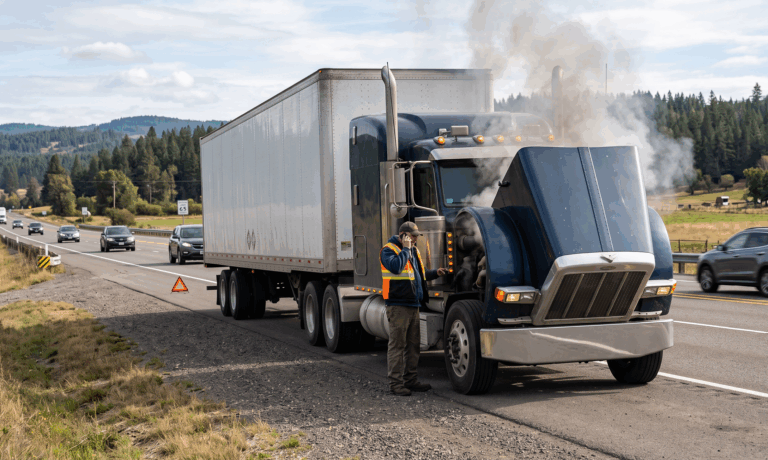
A driver climbs into the cab, starts the engine, and pulls out of the yard without walking around the truck first. Twenty minutes later, a low air-pressure warning lights up on the interstate — the kind of problem a two-minute brake check would have caught before the truck ever left the lot. A daily truck inspection checklist exists to prevent exactly this: a defect found on the road instead of before dispatch, with a driver, a load, and a DOT auditor all depending on the outcome.
For CDL drivers, this walkaround isn’t optional. FMCSA rules require it before every trip. For fleet managers, it’s the cheapest defect-catching tool in the operation, far cheaper than a roadside breakdown or an out-of-service order. This truck inspection checklist covers every system a driver needs to check daily, explains how a pre-trip inspection differs from a post-trip inspection, a DVIR, and the annual DOT inspection, and shows how to build a process the whole fleet can actually follow.
Download the Daily Truck Inspection Checklist
Download Checklist – Click Here
Below is a printable, driver-ready version of this daily truck inspection checklist. Keep a copy on the visor, laminate one for the glovebox, or save it to a phone so drivers always have it on hand, a checklist that lives in a binder in the office doesn’t get used in the yard at 5 a.m.
Paper checklists work, but they create a second problem: someone still has to collect them, read the handwriting, and act on what’s written down. Fleets that move this checklist into Whip Around’s mobile inspection forms get the same daily truck inspection checklist in a driver’s pocket, with photo capture on flagged items and a timestamped record that doesn’t get left in a truck door pocket. If a driver marks a defect, the report reaches a fleet manager immediately instead of at the next shift change.
Complete Daily Truck Inspection Checklist
A thorough truck daily inspection checklist walks the same path a driver would walk around the vehicle: cab first, then engine compartment, then the running gear, then the exterior, then coupling and cargo, then safety equipment. This order matters, it’s the sequence FMCSA’s vehicle inspection requirements are built around, and it keeps drivers from skipping systems because they’re out of habit rather than out of a plan.
Cab, Controls, and Required Documents
Before starting the engine, check that the seat belt latches and holds, the horn sounds, and the parking brake sets and releases cleanly. Confirm the steering wheel has no more than a couple inches of play and that gauges: oil pressure, air pressure, coolant temperature, voltage — read normal once the engine is running.
Required paperwork belongs in this step too: current registration, proof of insurance, the medical certificate, and the last DVIR on file. A truck with a mechanically sound cab and missing documentation still fails a roadside inspection, so treat the paperwork check as part of the walkaround, not an afterthought.
Engine Compartment, Fluids, and Visible Leaks
With the hood up, check engine oil, coolant, power steering fluid, and windshield washer fluid levels. Look under the truck for fresh drips (oil, coolant, or fuel) rather than relying on dashboard warnings alone, since a slow leak can develop well before a gauge moves.
Inspect belts and hoses for cracking, fraying, or soft spots, and check the battery for corrosion at the terminals and a secure hold-down. A battery that shifts in its tray on rough roads is a defect worth flagging even if the truck starts fine that morning.
Brakes, Steering, and Suspension
Test the service brakes and parking brake for firm, even response, and listen for air leaks around lines and fittings on air-braked trucks. Watch the low air-pressure warning buzzer and light during startup — if it doesn’t activate, that’s a defect, not a quirk.
Check steering linkage for looseness and suspension components: springs, shackles, U-bolts — for cracks or missing hardware. A truck that pulls to one side or feels loose in the wheel almost always traces back to one of these systems, and catching it during the walkaround beats catching it in traffic.
Tires, Wheels, and Rims
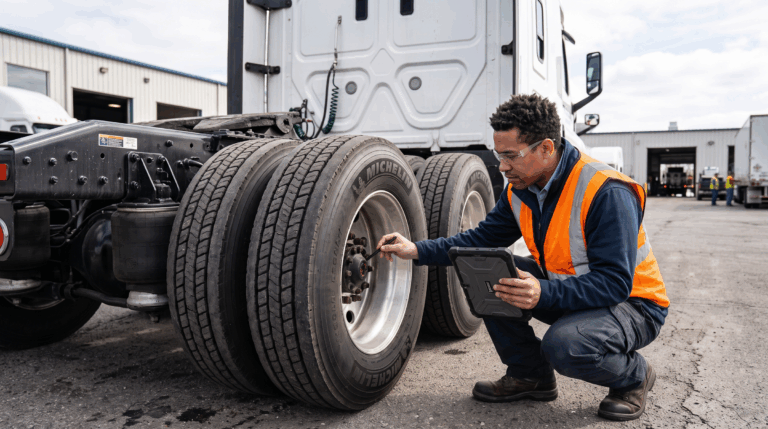
Check tread depth and look for uneven wear patterns, which often point to alignment or suspension issues rather than the tire itself. Inspect sidewalls for cuts, bulges, or exposed cord, and confirm tire pressure meets the manufacturer’s spec, underinflated tires run hotter and fail more often.
On the wheels themselves, look for missing or loose lug nuts, rust trails around the hub (a sign a lug nut is backing off), and cracks in the rim. Mismatched dual tires — one worn significantly more than its pair — should also get flagged for service.
Lights, Mirrors, Windshield, and Exterior Components
Cycle through headlights, marker lights, turn signals, brake lights, and hazards, and confirm reflectors and reflective tape are intact and visible. A single burned-out marker light is a common reason for a roadside stop, and it takes seconds to catch during a walkaround.
Check mirrors for secure mounting and a clear, unobstructed view, and inspect the windshield for cracks or chips that sit in the driver’s direct line of sight. Confirm wiper blades clear the glass fully without streaking, since a driver caught in rain with worn wipers has a visibility problem, not just a maintenance one.
Coupling Devices, Trailer, and Cargo
For combination vehicles, check that the fifth wheel is locked, the kingpin is properly seated, and the safety latch is engaged. This is one of the most safety-critical checks on the entire truck inspection checklist. Inspect the trailer’s electrical connection, air lines, and glad hands for secure, leak-free connections.
Confirm cargo is secured according to load-securement rules, with straps, chains, or binders tight and in good condition, and that trailer doors latch and lock properly. A shifted or improperly secured load changes how the truck handles long before it becomes a visible problem.
Safety and Emergency Equipment
Confirm the fire extinguisher is charged and mounted, reflective triangles or flares are on board and in usable condition, and a spare fuse kit is present if the truck requires one. These items are required equipment, and their absence is flagged the same way a mechanical defect would be during a roadside inspection.
Check that the first aid kit is stocked and accessible, and that any required placards ( hazmat or otherwise) are correct for the current load. This is a short section, but it’s one drivers rush through most often, which is exactly why it belongs on a truck safety inspection checklist explicitly.
When to Inspect the Truck and What to Do With Defects
A pre-trip inspection happens before the truck moves. This is the walkaround described above, and under 49 CFR 396.13, a driver must be satisfied the vehicle is safe to operate and must review the prior DVIR before getting underway. A post-trip inspection happens at the end of the day’s work, after the last drop or the last mile of a route, and it’s where most DVIRs actually get written.
If a driver finds a defect that affects safety — brakes, steering, lights, coupling devices, and the other systems above — that finding has to go on a written report. What is a DVIR and how it differs from a routine checklist entry matters here: a DVIR is the specific document that creates a paper trail from defect to repair to certification, and it’s what an auditor or roadside inspector will ask to see. Not every defect requires one, knowing when a truck defect requires a DVIR versus a minor note for the shop is part of training drivers correctly.
Once a defect is reported, the carrier is responsible for repairing anything likely to affect safety before the truck goes back into service, then certifying that the repair happened or that repair wasn’t necessary. Skipping that certification step is one of the more common compliance gaps fleets run into, particularly with paper-based systems where a report can sit in a truck door pocket for days before anyone reviews it.
Daily Truck Checklist vs. DVIR and Annual DOT Inspection
Drivers and fleet managers often use “inspection” loosely, but the daily truck inspection checklist, the post-trip inspection, the DVIR, and the annual DOT inspection are four distinct things with different rules, different timing, and different documentation requirements.
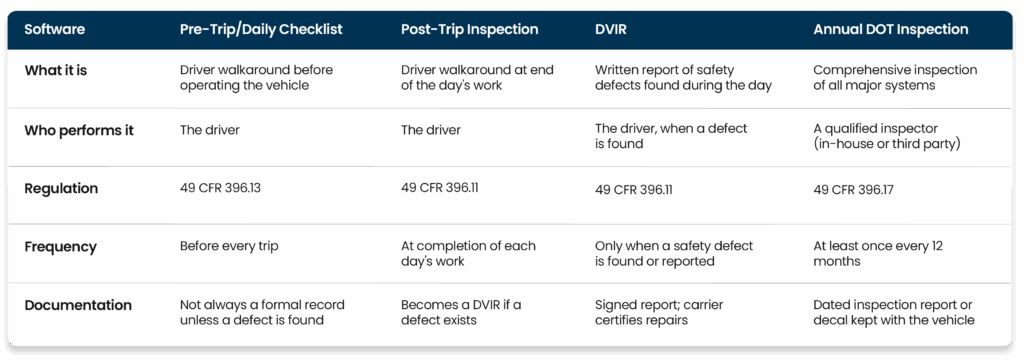
The daily checklist and the post-trip inspection are the same activity performed at opposite ends of the day. The DVIR is the paperwork that gets triggered when either one turns up a defect. The annual inspection, required under FMCSA’s vehicle inspection requirements, is a far more thorough, periodic check that exists independently of daily driver checks — a truck can pass its annual inspection in January and still develop a brake defect in March that a driver catches on a Tuesday morning walkaround. A truck DOT inspection checklist for the annual visit and a driver’s daily walkaround are both necessary, and neither one substitutes for the other.
Build a Consistent Daily Inspection Process Across the Fleet
A checklist only works if every driver runs it the same way, every day, regardless of who’s behind the wheel or which yard the truck is parked in. That consistency is harder to maintain than it sounds: paper forms go missing, handwriting is illegible, and a defect written down at 6 a.m. might not reach a shop foreman until the truck is already back on the road for its next run.
Moving the daily truck inspection checklist into a mobile app closes that gap. Whip Around’s inspection forms let drivers work through the same checklist on a phone, attach a photo to anything questionable, and submit the report before they ever put the truck in gear. A failed item doesn’t just sit in a file, it can automatically generate a work order, so the shop knows about a bad brake light before the driver has finished the rest of the walkaround. For fleets running the same checklist across multiple yards or terminals, that also makes it possible to standardize truck inspections across locations instead of every location running its own version of the form.
The documentation side matters just as much as the checklist itself. When an auditor asks for three months of DVIRs, or a roadside inspector wants to see the last inspection report, a fleet manager should be able to pull that record in seconds rather than digging through a filing cabinet. Fleets that want to automate DOT inspection reporting generally start here, not by replacing the checklist, but by making sure every completed inspection produces a searchable, audit-ready record automatically. If your fleet is still deciding how to structure that process, booking a demo is a reasonable next step to see how the checklist, the DVIR, and the work order connect in practice.
Daily Truck Inspection Checklist FAQs
Can the same checklist be used for semi-trucks and box trucks? The core systems — brakes, tires, lights, steering, fluids, safety equipment, apply to both. The main difference is coupling devices: a semi-truck’s checklist needs a fifth-wheel and kingpin check that a box truck’s doesn’t. Most fleets run one base daily truck inspection checklist and add a coupling section for combination vehicles.
How long should a daily truck inspection take? A thorough walkaround typically takes 10 to 15 minutes for a single unit, longer for a tractor-trailer combination. Rushing this check defeats its purpose — most defects that get missed are missed because a driver skipped a section, not because the section wasn’t on the form.
Can a fleet require drivers to submit no-defect inspection reports? FMCSA rules don’t require a written DVIR when no defect is found, but nothing stops a carrier from requiring drivers to submit a completed checklist either way. Many fleets do this specifically to create a record that the inspection actually happened, not just that a defect was found.
Who should review completed truck inspection checklists? A fleet manager, safety manager, or shop foreman should review reports daily, not just when a defect appears. Regular review catches drivers who are rushing through the checklist and surfaces recurring issues on a specific truck before they become a bigger repair.
Are electronic truck inspection checklists accepted during DOT audits? Yes. Electronic inspection reports are permitted under FMCSA rules as long as they capture the same information a paper DVIR would: driver, vehicle, date, defects found, and repair certification. Most auditors prefer electronic records because they’re faster to search and harder to lose than paper.
Ready to move your fleet’s daily inspections off paper? See Whip Around in action or start a free trial to try digital inspection forms with your own trucks.