TL;DR: To reduce fleet management costs, start by measuring cost per mile or engine hour for every asset. Then go after the biggest leaks:
- Prevent breakdowns with on-time PMs.
- Catch problems early with consistent inspections.
- Shorten the time from defect to repair.
- Control parts and repair spending.
- Cut fuel waste.
- Right-size the fleet.
- Base repair-or-replace decisions on lifecycle data.
- Automate the manual work that eats up your team’s time.
Track the results so you know what’s actually working.
Most fleets don’t overspend in one big place. They leak money in dozens of small ones:
- a PM that slips and turns into a roadside breakdown
- a defect that sits for a week and gets worse
- a rush-ordered part
- a truck that idles through lunch
- a pickup nobody has driven in a month
Each one looks minor. Together, they add up fast.
That pressure isn’t easing. The American Transportation Research Institute reported that the average cost to operate a truck reached a record $2.336 per mile in 2025. This guide covers the biggest fleet costs and nine practical ways to reduce them without hurting vehicle availability. It also shows how to measure whether your fleet cost reduction strategy is working.
What are the biggest fleet management costs?
Fleet management costs are all the expenses of owning and operating vehicles and equipment, including acquisition or lease payments, fuel, maintenance and repairs, parts, technician labor, insurance, registration, depreciation, and the lost productivity caused by downtime. They fall into two groups. Fixed costs, like payments, insurance and registration, stay roughly the same whether an asset works or sits. Variable costs, like fuel, maintenance, parts, labor and tires, rise and fall with how much and how hard each asset is used.
For most fleets, fuel and maintenance are the largest variable costs and the ones you can influence most. But the most expensive cost often doesn’t appear on any invoice: downtime. When a truck or machine breaks down unexpectedly, you pay for the tow, the emergency repair and the overtime. You also pay for the delayed job, the rental you had to bring in, and the crew that stood around waiting. A strong fleet maintenance program is where most of those hidden costs get controlled.
9 ways to reduce fleet management costs
The strategies below start with understanding where your money goes, then move through maintenance, repairs, fuel, utilization and lifecycle decisions. You don’t have to tackle them all at once. Your baseline numbers from the first step will show you which ones will save the most.
1. Calculate your current fleet costs and set a baseline
You can’t cut costs you can’t see. Start by calculating total cost of ownership and cost per mile or per engine hour for each asset, including fuel, maintenance, parts, labor and fixed costs. Break the numbers down by asset type, location and age so you can compare like with like. Pull at least 12 months of data if you have it, since seasonal work can make a single month look better or worse than it really is.
The baseline usually turns up surprises. A handful of older assets may account for a big share of repair spend. One location may burn far more fuel per mile than another, or labor hours may be much higher than anyone thought. Tracking the right fleet management KPIs from the start gives you a clear before-and-after picture, which also makes it much easier to report savings to leadership.
2. Prevent costly breakdowns with preventive maintenance
Unplanned repairs cost far more than planned service. A breakdown adds towing, overtime, rush parts and missed work on top of the repair itself. The failure can also damage nearby components that would have been fine if the problem had been caught earlier. Preventive maintenance moves that work onto your schedule, at a lower cost.
Build a fleet preventative maintenance plan with service intervals based on mileage, engine hours or calendar dates, and track PM compliance every week. Usage-based intervals tend to save more than calendar-only schedules: hard-working assets get serviced more often, and assets that mostly sit don’t get over-serviced. Fleet maintenance software can automate reminders so nothing slips through. Review your intervals once a year against actual repair history. If an asset type keeps failing between services, shorten the interval. If it never shows wear at service time, you may be able to extend it.
3. Catch vehicle problems early through regular inspections
Inspections are the cheapest maintenance tool you have, and they’re often the first place to look when you’re working out how to reduce fleet costs. A driver who spots a slow leak, a worn tire or a cracked hose during a pre-trip inspection turns a potential major repair into a minor one. The key is consistency: inspections need to happen every day, on every asset, with the same checklist.
Digital fleet inspection software makes that consistency easier to enforce. Drivers complete inspections on their phones and attach photos of defects, and managers can see who inspected and who skipped. That visibility matters for cost as much as for safety, because a skipped inspection is how a $50 fix becomes a $5,000 repair.
4. Speed up the defect-to-repair process
Every day a reported defect waits for repair, it can get worse and more expensive to fix, and the vehicle may be out of service in the meantime. The gap between “driver reported it” and “technician fixed it” is one of the most overlooked sources of fleet cost. It often comes from manual handoffs: a paper form that never reaches the shop, an email that gets buried, or a work order that sits unassigned.
Automating that handoff closes the gap. When a failed inspection item automatically creates a work order with photos and notes attached, the shop can act right away. A clear defect resolution process and strong fleet work order management make sure every defect ends one of three ways: repaired, deferred with a reason, or confirmed as not needing repair. That keeps small problems from quietly growing into big ones. Track average defect-to-repair time by location. If one shop consistently takes days longer than another, that’s a cost problem worth solving.
5. Control parts inventory and repair spending
Parts and labor are where maintenance budgets often slip without anyone noticing. With rising fleet parts costs and longer lead times on some components, emergency purchases and stockouts cost more than ever. Overstocking has its own cost, tying up cash in parts that may sit on a shelf for years. Track parts usage by asset type and season, set reorder points for high-use items, and stage parts ahead of scheduled PMs.
Labor deserves the same attention. Untracked technician labor costs make repairs look cheaper than they really are and hide which jobs and shops are inefficient. Tie labor hours and parts to each work order so you get a true cost per repair. Set up a repair approval workflow so high-cost repairs get reviewed before work starts.
6. Reduce fuel waste and unnecessary mileage
Fuel is usually a fleet’s largest variable cost, and idling is one of the easiest places to cut it. According to the U.S. Department of Energy’s Alternative Fuels Data Center, more than 6 billion gallons of gasoline and diesel are lost to idling every year across U.S. road vehicles. Use telematics data to find the vehicles and drivers with the most idle time, set a clear idling policy, and follow up.
Unnecessary mileage is the other half of fuel waste. Group jobs by location, plan routes to avoid backtracking, and review route data for patterns. Keep vehicles maintained, too, since underinflated tires, dirty filters and overdue services all hurt fuel economy. Fuel management software tracks fill-ups and cost per asset so outliers stand out. Looking at connected fuel, driver, and maintenance data together helps you find the real cause.
7. Improve vehicle utilization and right-size the fleet
Every vehicle costs money whether it’s working or not. Insurance, registration, depreciation and baseline maintenance keep adding up even when an asset sits in the yard. Review utilization by asset at least quarterly to find vehicles and equipment that rarely get used. Then decide whether to sell them, consolidate, share them across locations, or rent instead of owning.
Right-sizing isn’t only about cutting. Utilization data may show that some assets are overworked while others sit idle, which drives up wear and repair costs on the busy ones. Rotating assets spreads that wear more evenly and can delay replacing your most heavily used vehicles. For construction and field service fleets, tracking equipment utilization across jobsites also helps you avoid unnecessary rentals. Strong fleet asset management keeps every vehicle, trailer and machine visible in one place.
8. Use lifecycle costs to decide when to repair or replace vehicles
Keeping an aging vehicle can feel like saving money, until repair costs, downtime and falling fuel economy outweigh the cost of a replacement. On the other hand, replacing vehicles too early wastes the value left in them. The right answer depends on each asset’s actual lifecycle cost, not its age or mileage alone.
Track total maintenance and repair spend, downtime and fuel efficiency for every asset over time. It’s time to consider replacement when an asset’s annual operating cost starts climbing sharply, or when a major repair would eat up a large share of its remaining value. Accurate service history, including true labor and parts costs, makes these decisions objective instead of a guess. Build a simple replacement policy with clear triggers for each asset type, such as a maximum annual repair cost or downtime limit. That way replacements are planned and budgeted instead of forced by a sudden failure.
9. Automate manual fleet management tasks
Manual work is a hidden cost of its own. Every hour spent chasing paper inspection forms, re-entering defects into work orders, updating PM spreadsheets or building reports by hand is an hour your team isn’t spending on work that saves money. Manual processes also lead to errors, missed PMs and lost defects, which create more costs later.
Look for the repetitive tasks that take the most time and automate them first. Common wins include automatic work orders from failed inspections and scheduled reports delivered by email. Another is PM reminders based on real mileage and engine hours pulled from telematics integrations. AI workflow automation for maintenance defects goes a step further by helping sort reported issues so the most urgent repairs happen first. The goal isn’t to replace your team. It’s to give managers and technicians back the hours they now spend on data entry and follow-up.
How to measure whether your fleet cost reduction strategy is working
Cost reduction only counts if you can prove it. Track a small set of metrics monthly, compare them to your baseline, and break them down by asset type and location. The table below shows the metrics that matter most and what improvement looks like.
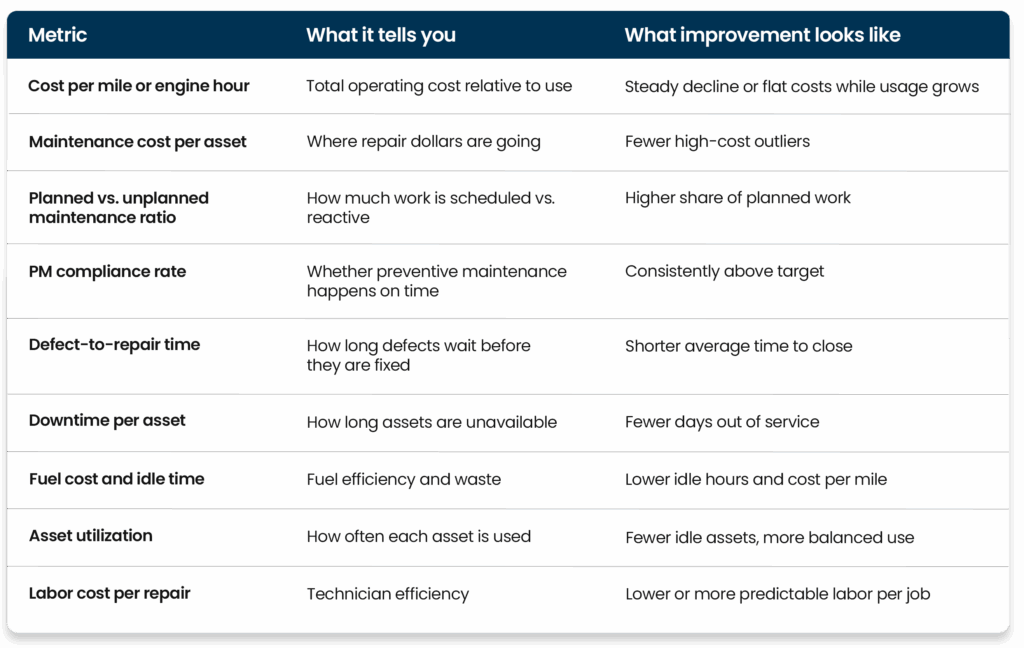
Review these numbers with your shop and operations leaders every month. If one metric stalls, look closely at the strategy behind it. Fleet reporting software that pulls inspection, maintenance, parts, labor and fuel data into one dashboard makes this review fast enough to actually happen. Our guide to fleet labor reporting metrics covers the labor side in more detail. Share wins with drivers and technicians, too. When they see that faster defect reporting cut downtime, or that better idling habits lowered fuel spend, they’re far more likely to keep it up.
Reduce fleet costs with better maintenance visibility
Learning how to reduce fleet management costs comes down to visibility. When you can see what every asset costs, which defects are open, which PMs are due, and where fuel and labor are going, the ways to save become obvious. When that information is scattered across paper forms, spreadsheets and separate systems, money leaks out unnoticed.
Whip Around connects inspections, work orders, preventive maintenance, parts, labor, fuel and reporting in one maintenance workflow. Failed inspection items become work orders automatically, PMs run on real mileage and engine hours, and every repair is tracked back to the asset with its true cost. With fixed, unlimited-user pricing, every driver, technician and manager can use the system without per-seat costs adding up. To see how much your fleet could save, try the Whip Around ROI calculator, book a demo, or start a free trial.