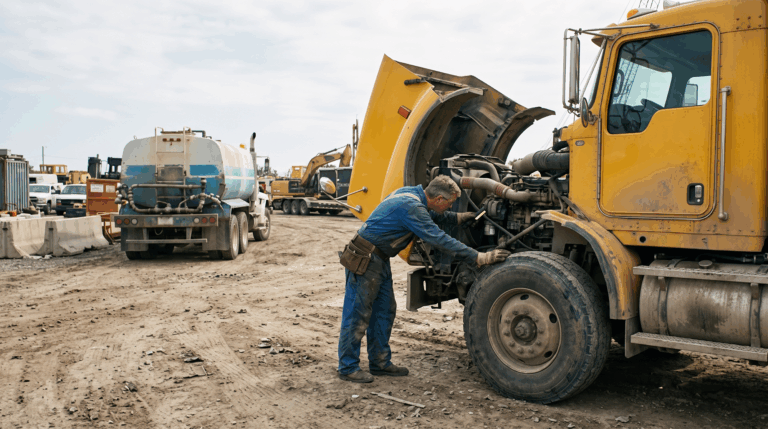
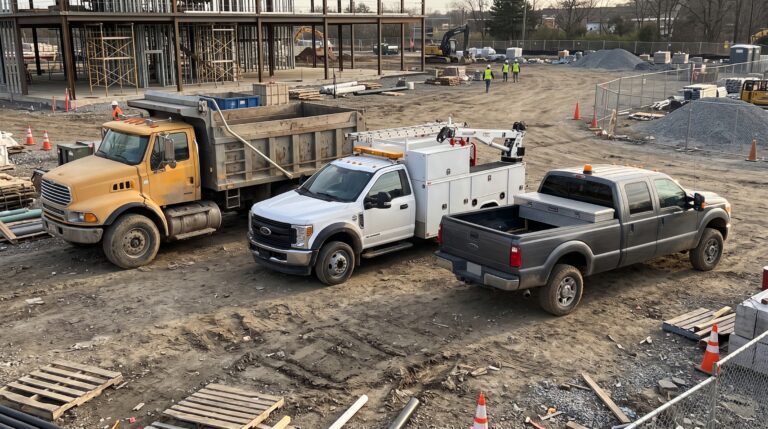
A dump truck hauls aggregate to the site each morning. A water truck moves between projects. A service truck tows a trailer carrying a skid steer. They do different work, but each road-going vehicle may need its own DOT annual inspection. The trailer can need one too.
Quick answer: Under 49 CFR § 396.17, a covered commercial motor vehicle must pass a periodic inspection at least once during the preceding 12 months. The inspection must cover the applicable items in Appendix A to Part 396, be performed by a qualified inspector, and be documented. A report or qualifying sticker or decal must be on the vehicle; the inspection report must also be retained as the rule requires. The truck’s job—hauling dirt, carrying water, or servicing equipment—does not by itself create an exception.
Here is how to apply the rule across a construction fleet without confusing the annual vehicle inspection with daily checks or cargo securement.
Which construction vehicles need a DOT annual inspection?
Start with whether the unit is a commercial motor vehicle (CMV) under the applicable federal rules. For property transportation in interstate commerce, the CMV definition in 49 CFR § 390.5 generally includes a vehicle or combination with a gross weight rating or actual gross weight of 10,001 pounds or more, whichever is greater. Other passenger and placarded hazardous-material criteria also exist. State rules may apply to intrastate fleets as well.
For DOT annual inspection requirements, construction vehicles should be assessed one unit at a time:
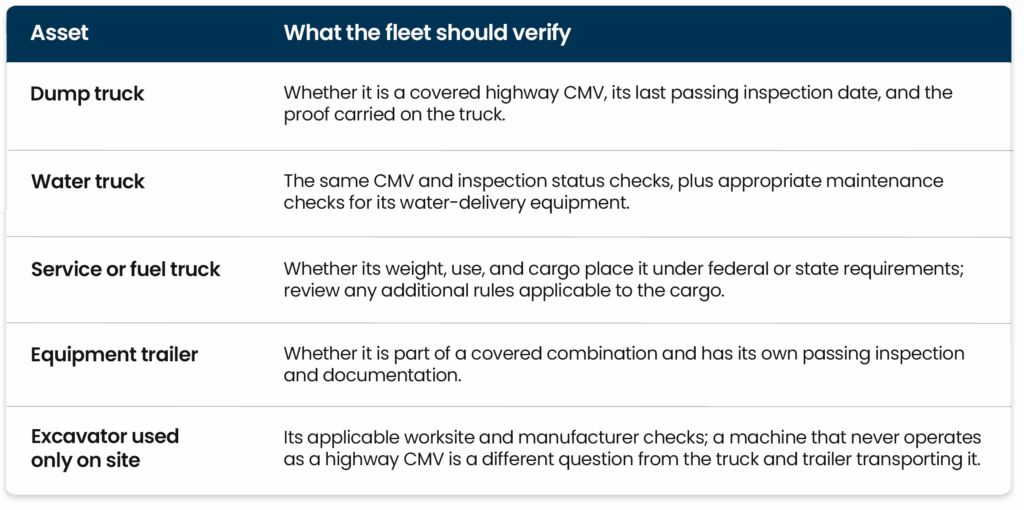
Section 396.17 expressly treats each vehicle in a combination as a separate vehicle for periodic inspection. A passing inspection for the power unit does not cover the trailer behind it. In a mixed fleet, keeping the truck’s and trailer’s inspection dates on separate asset records helps prevent an expired trailer from being assigned to an otherwise current truck.
What does a 49 CFR 396.17 construction fleet inspection cover?
The federal annual inspection must include, at a minimum, the parts and accessories listed in Appendix A to Part 396. These include safety-related systems such as brakes, steering, tires, wheels, lighting, suspension, and coupling components where applicable. The inspector records what was examined and whether it met the minimum standards.
An annual inspection for dump trucks therefore evaluates the road vehicle against the applicable criteria; it is not simply a check that the dump body works. Likewise, a water truck DOT inspection addresses the covered highway vehicle’s required systems. A fleet should also maintain equipment-specific checks for items such as dump-body controls or a water truck’s tank, pump, valves, and spray equipment as appropriate to the unit. Ask the inspector and maintenance team which components fall under the federal inspection criteria and which are covered by a separate operational checklist.
If you need a broader explanation of the federal inspection and whether your own shop may perform it, see Whip Around’s general DOT annual inspection guide. This article focuses on applying that rule to the different trucks and trailers in a construction fleet.
Who can perform the inspection, and what proof is required?
The annual inspection can be performed in-house or by an outside shop, provided the person meets the inspector qualifications in § 396.19. The rule addresses knowledge of the inspection criteria, ability to identify defects, and appropriate training or experience. The carrier must retain evidence of the inspector’s qualifications for the required period.
The inspector’s report must identify the inspector, carrier, date, vehicle, components checked, and results, and certify the report’s accuracy and completeness. Under § 396.21, the responsible entity retains the original or a copy of the report for 14 months at the location where the vehicle is housed or maintained and makes it available on demand. If another entity performed the last inspection, the carrier remains responsible for obtaining the report when requested.
Section 396.17 also requires documentation on the vehicle showing it passed an inspection within the preceding 12 months. That may be the report or a qualifying sticker or decal containing the specified information. Keep the vehicle identifier and inspection date easy to match to your fleet records, especially when similar-looking dump trucks and trailers rotate between jobsites.
Does the annual inspection replace daily construction vehicle checks?
No. The annual inspection is a periodic assessment. § 396.13 requires drivers to be satisfied that the vehicle is in safe operating condition before driving and to review relevant previous defect reports. § 396.11 governs driver vehicle inspection reports and follow-up on safety-related defects, including the rule’s no-defect-report exception for property-carrying operations.
A dump truck can pass its annual inspection and develop a tire or brake problem the following week. A water truck can have an up-to-date sticker and still need a repair identified during a daily check. Make it easy for drivers to report those issues and for maintenance to document the response. Whip Around’s digital fleet inspections support vehicle-specific forms, while its fleet maintenance software connects defects to work orders and service history.
Annual truck inspection vs. heavy equipment tie-down rules
These are separate requirements at different points in the job. This article addresses the condition and inspection record of the road-going truck or trailer. If that trailer carries a skid steer, excavator, or other machine, the load also needs to be secured under the applicable cargo rules. For tiedown counts, working load limits, and attachment points, use our separate guide to DOT heavy equipment tie-down requirements.
A current trailer inspection does not show that today’s machine was secured correctly. A correctly secured machine does not establish that the trailer passed its annual inspection. Keep both checks in your dispatch and pre-trip process.
A practical annual inspection process for construction fleets
List every road-going truck, trailer, and other potentially covered unit as its own asset. Record the inspection date, inspection report, proof carried on the vehicle, and the next date the unit must be inspected. Build enough lead time to schedule a qualified inspector before a project move or peak season.
Use separate daily checklists for the way each unit is operated: a dump truck, a water truck, and a service truck do not have identical jobsite equipment. Keep the federal periodic inspection record distinct from those daily forms. When a defect is found, assign and document the repair, then confirm the vehicle is ready before it returns to service.
Whip Around’s construction fleet solution helps teams manage inspections and maintenance across vehicles and equipment. The aim is straightforward: know which unit is due, where its proof is, and what happened to any defects found between annual inspections.
Frequently asked questions
Do dump trucks need an annual DOT inspection?
A dump truck that is a covered CMV must meet § 396.17’s periodic inspection requirement. Its dump-truck label does not determine coverage; check the vehicle, weight, highway use, and applicable federal and state rules.
Does a water truck need a DOT annual inspection?
If the water truck is a covered CMV, yes. Its vehicle safety systems must meet the applicable annual inspection criteria. Tank, pump, and spray-system operational checks should also be addressed through the fleet’s maintenance program as appropriate.
Does an equipment trailer need its own annual inspection?
Yes, when it is a vehicle in a covered combination. Section 396.17 requires each vehicle in the combination to pass an inspection and have its own documentation.
How long is a DOT annual inspection valid?
The vehicle must have passed an applicable periodic inspection at least once during the preceding 12 months. The inspection report generally must be retained for 14 months under § 396.21. Track the date and documentation for each unit.
Is a DOT annual inspection the same as a daily DVIR or a cargo tie-down check?
No. The annual inspection checks the covered vehicle against periodic inspection criteria. Daily driver checks and defect reports address its condition during use. Cargo securement addresses how equipment or materials are restrained for a particular trip.
Featured image idea: A dump truck and water truck parked side by side at a construction yard, with a mechanic inspecting one truck’s tires.
Suggested image alt text: Mechanic checking a construction truck during a fleet vehicle inspection.