Construction fleet management has always been complex with balancing equipment availability, maintenance, safety and cost control across multiple jobsites. But as fleets grow larger and projects become more demanding, traditional approaches are starting to fall short.
That’s where artificial intelligence (AI) is making a measurable difference.
AI for construction fleet management is not about replacing human expertise, it’s about enhancing it. By turning large volumes of fleet data into actionable insights, AI helps teams prevent downtime, improve safety and make smarter operational decisions.
In this guide, we’ll break down how AI is being used in construction fleets today, the real-world problems it solves and what to look for when evaluating AI-powered solutions.
Why AI Matters More for Construction Fleets Than Ever
Construction fleets operate in highly variable environments. Equipment moves between jobsites, usage patterns fluctuate and maintenance needs are rarely predictable.
Historically, fleet managers have relied on:
- Manual inspections
- Reactive maintenance
- Spreadsheet-based tracking
- Experience-based decision-making
While these methods still play a role, they often lead to:
- Unexpected breakdowns
- Inefficient equipment utilization
- Safety risks
- Rising operating costs
AI changes the equation by introducing:
- Predictive analytics
- Real-time monitoring
- Automated insights
- Pattern recognition across large datasets
Instead of reacting to problems, fleets can now anticipate them and act earlier.
If you’re already exploring broader applications of AI in operations, this shift aligns closely with trends discussed in AI in fleet management, where data-driven decision-making is becoming the new standard.
How AI Improves Construction Fleet Management in Practice
AI’s value becomes clear when you look at how it applies to everyday fleet challenges. Below are the most impactful use cases.
Predictive Maintenance That Flags Problems Before They Turn Into Breakdowns
One of the most powerful applications of AI is predictive maintenance.
AI systems analyze:
- Engine diagnostics
- Sensor data
- Historical maintenance records
- Usage patterns
From this, they can detect early warning signs of failure often before a human would notice.
Instead of waiting for a breakdown, teams can:
- Schedule repairs proactively
- Reduce emergency downtime
- Extend equipment lifespan
This represents a major shift from reactive maintenance to a preventative, data-driven approach.
Smarter Preventive Maintenance Scheduling Based on Usage
Traditional preventive maintenance follows fixed schedules: every 250 hours, every 3 months, etc.
But construction equipment doesn’t operate under uniform conditions.
AI enables dynamic scheduling based on:
- Actual usage
- Load intensity
- Environmental conditions
- Operator behavior
This means:
- Over-maintenance is reduced
- Under-maintenance is avoided
- Resources are allocated more efficiently
The result is a maintenance program that adapts to reality not assumptions.
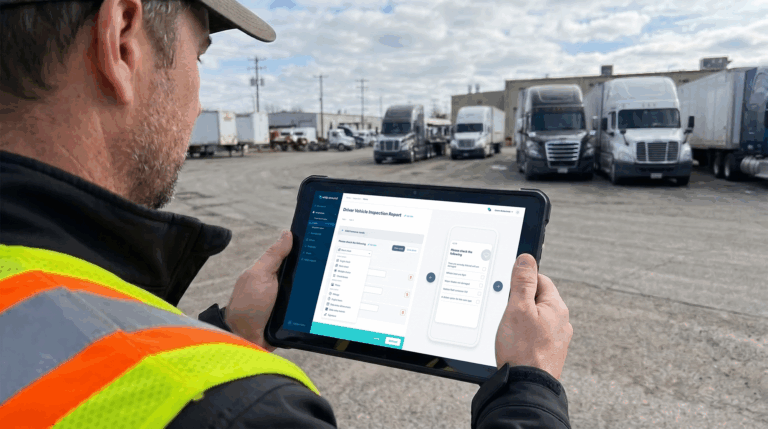
Better Inspection Data Through Faster, More Consistent Issue Detection
Inspections are critical, but they’re also prone to inconsistency.
AI improves inspection processes by:
- Standardizing data capture
- Flagging anomalies automatically
- Identifying patterns across inspections
With AI-enhanced inspections, teams can:
- Catch issues earlier
- Reduce human error
- Ensure compliance across all sites
Solutions like AI-powered inspections help streamline this process, turning inspections into a more reliable source of operational insight.
Reduced Idle Time, Fuel Waste and Unproductive Equipment Use
Idle equipment is one of the biggest hidden costs in construction fleets.
AI can analyze:
- Engine idle time
- Fuel consumption patterns
- Equipment movement
From there, it identifies inefficiencies such as:
- Excessive idling
- Poor routing
- Underutilized assets
Fleet managers can then:
- Adjust workflows
- Improve operator behavior
- Reduce fuel costs
Over time, even small improvements in efficiency can lead to significant savings.
Improved Equipment Utilization Across Jobsites and Crews
Many fleets struggle with uneven utilization, some equipment is overused while others sit idle.
AI provides visibility into:
- Equipment availability
- Usage trends
- Jobsite demand
This allows teams to:
- Reallocate assets more effectively
- Avoid unnecessary rentals or purchases
- Maximize ROI on existing equipment
Better utilization also reduces wear and tear imbalances across the fleet.
Faster Response to Faults, Defects, and Maintenance Issues
When issues arise, speed matters.
AI systems can trigger real-time alerts when:
- Fault codes appear
- Inspection issues are logged
- Performance metrics deviate from normal
This enables:
- Immediate action
- Faster repair cycles
- Reduced downtime
Instead of waiting for reports to surface problems, teams can respond instantly.
Better Safety Monitoring for Vehicles, Drivers and Heavy Equipment Operators
Safety is a top priority in construction and AI plays a growing role in improving it.
AI-powered systems can monitor:
- Operator behavior
- Equipment usage patterns
- Environmental risks
They can detect:
- Harsh braking or acceleration
- Unsafe operation
- Potential hazards
This allows for:
- Targeted safety training
- Real-time alerts
- Proactive risk mitigation
These capabilities align closely with the broader goals outlined in AI fleet maintenance, where safety and compliance are tightly connected to operational performance.
Stronger Control Over Unauthorized Use, Theft Risk and Asset Movement
Construction equipment is valuable and often vulnerable to theft or unauthorized use.
AI enhances security by:
- Monitoring equipment location in real time
- Detecting unusual usage patterns
- Triggering alerts for unauthorized movement
This improves:
- Asset tracking
- Theft prevention
- Accountability across teams
Geofencing and anomaly detection make it much harder for misuse to go unnoticed.
Easier Reporting Through AI-Generated Insights and Natural Language Queries
Reporting is often time-consuming and manual.
AI simplifies this by:
- Automating report generation
- Allowing natural language queries
- Summarizing key insights
Instead of digging through spreadsheets, fleet managers can ask:
- “Which assets had the most downtime last month?”
- “What’s our average fuel usage by jobsite?”
Fleet managers get instant answers. This dramatically reduces administrative workload while improving decision-making speed.
More Accurate Decisions on Fleet Sizing, Replacement and Asset Planning
Fleet planning decisions–when to replace equipment, how large the fleet should be—are traditionally based on experience and limited data.
AI improves these decisions by analyzing:
- Total cost of ownership
- Utilization rates
- Maintenance history
- Performance trends
This leads to:
- Smarter replacement timing
- Optimized fleet size
- Better capital allocation
Over time, these improvements have a major impact on profitability.

Benefits of AI for Construction Fleet Management
When implemented effectively, AI delivers measurable benefits across multiple areas.
Reduced Downtime
Predictive maintenance and faster issue detection keep equipment operational and minimize disruptions.
Improved Safety
AI helps identify risky behavior and unsafe conditions before incidents occur.
Lower Operating Costs
Fuel savings, optimized maintenance, and better utilization all contribute to cost reduction.
Increased Productivity
With fewer breakdowns and better asset allocation, crews can work more efficiently.
Better Decision-Making
AI provides data-driven insights that replace guesswork with clarity.
Enhanced Compliance
Automated tracking and reporting make it easier to meet regulatory requirements.
These benefits collectively help fleets shift from reactive operations to proactive, optimized performance.
What to Look for in AI Construction Fleet Management Software
Not all AI solutions are created equal. When evaluating options, it’s important to focus on capabilities that deliver real operational value.
1. Strong Data Foundation
AI is only as good as the data it uses.
Look for systems that:
- Capture high-quality inspection and maintenance data
- Integrate with telematics and existing tools
- Provide real-time visibility
2. Practical, Actionable Insights
Avoid tools that overwhelm users with data but offer little direction.
The best solutions:
- Highlight what matters most
- Provide clear recommendations
- Enable quick decision-making
3. Seamless Integration Into Daily Workflows
AI should enhance—not disrupt—your team’s workflow.
Look for:
- Mobile-friendly interfaces
- Easy inspection processes
- Minimal training requirements
4. Predictive and Preventive Capabilities
Core AI value comes from anticipating issues.
Prioritize tools that offer:
- Predictive maintenance alerts
- Usage-based scheduling
- Automated anomaly detection
5. Safety and Compliance Features
Safety and compliance should be built into the system, not added later.
Key features include:
- Real-time alerts
- Inspection tracking
- Compliance reporting
6. Scalability for Growing Fleets
Your needs will evolve.
Choose a solution that:
- Scales with your fleet size
- Supports multiple jobsites
- Adapts to changing operations
7. Proven Industry Fit
Construction has unique challenges compared to other industries.
Look for platforms designed specifically for:
- Heavy equipment
- Field operations
- Multi-site environments
For a deeper look at how AI is transforming construction operations, see how construction businesses are evolving with Whip Around.
Turning AI Into Better Construction Fleet Performance
AI is not a silver bullet but it is a powerful tool when applied correctly.
The most successful fleets don’t try to overhaul everything at once. Instead, they:
- Start with high-impact areas (like maintenance or inspections)
- Implement AI tools that integrate with existing workflows
- Use early wins to drive broader adoption
Over time, these incremental improvements add up to:
- More reliable equipment
- Safer operations
- Lower costs
- Better overall performance
As the construction industry continues to evolve, AI will play an increasingly central role in how fleets operate.
The question isn’t whether to adopt AI, it’s how soon you can start using it effectively.
If you’re exploring ways to modernize your fleet operations, understanding how AI fits into your workflows is the first step. From predictive maintenance to smarter inspections, the opportunities are already here and growing fast. Book a demo to learn more.