A burned-out turn signal looks minor. A tire with an audible air leak looks like a quick fix. But at a roadside inspection, both can end up on your carrier’s record for the next two years, and some violations count far more against you than others.
The Vehicle Maintenance BASIC is often the hardest CSA category to keep under control because every truck, every trailer, and every inspection adds to it. This guide covers how the Vehicle Maintenance BASIC is scored, which CSA vehicle maintenance violations carry the most weight, the most common vehicle maintenance violations inspectors find, what FMCSA’s proposed changes mean for your fleet, and how to bring your CSA maintenance score down.
What Is the Vehicle Maintenance BASIC?
The Vehicle Maintenance BASIC is one of the seven categories in FMCSA’s Safety Measurement System (SMS) that measures how well a motor carrier maintains its commercial motor vehicles. According to FMCSA’s SMS methodology, it tracks failure to properly maintain a CMV and to prevent shifting loads, spilled or dropped cargo, and overloading. Examples include inoperative brakes or lights, other mechanical defects, improper load securement, and failure to make required repairs.
The data comes from roadside vehicle inspections (Levels 1, 2, 5, and 6) over the past 24 months. Every violation an inspector writes up feeds your CSA maintenance score, which FMCSA uses alongside the other BASICs to decide which carriers to prioritize for warning letters, investigations, and audits. If you’re new to the system, start with our quick guide to the Safety Measurement System.
How Your CSA Maintenance Score Is Calculated
Your Vehicle Maintenance BASIC measure is the sum of your time-weighted and severity-weighted violations, divided by the total time weight of all your relevant vehicle inspections. Clean inspections count too. They increase the denominator, which pulls your measure down. FMCSA then converts that measure into a percentile ranking against carriers with a similar number of inspections.
Two weights decide how much each violation hurts you: how serious it is and how recent it is.
Severity Weights
Each violation has a severity weight from 1 (least severe) to 10 (most severe), based on its link to crash risk. If the violation results in an out-of-service (OOS) order, FMCSA adds 2 more points. The total severity for any single inspection is capped at 30 before time weighting.
Time Weights
Recent violations count more than older ones. FMCSA applies a time weight of 3 to violations from the past six months, 2 to violations from six to 12 months ago, and 1 to violations from 12 to 24 months ago. After 24 months, a violation drops out of the BASIC.
Intervention Thresholds
FMCSA prioritizes a carrier for intervention when its Vehicle Maintenance BASIC percentile reaches the threshold for its carrier type:
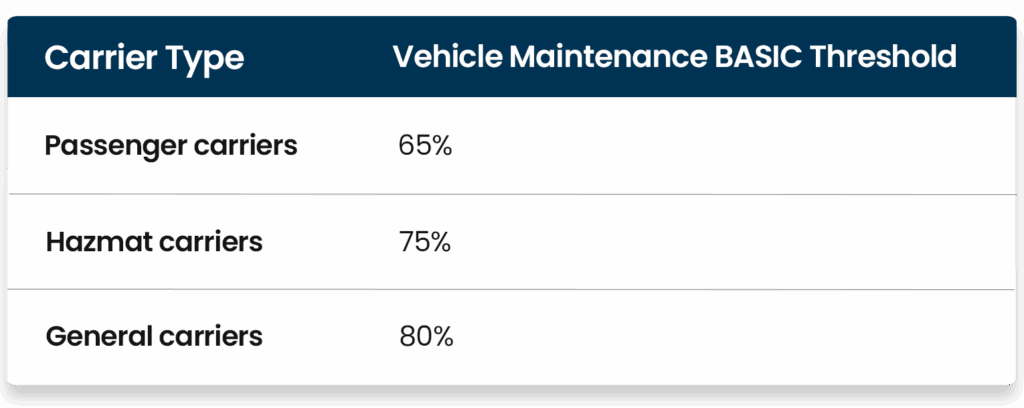
To receive a percentile at all, a carrier needs at least five relevant inspections with at least one Vehicle Maintenance violation, along with other data sufficiency requirements.
The Most Common Vehicle Maintenance Violations
Brakes, tires, and lights consistently top roadside inspection results. During CVSA’s 2026 International Roadcheck, held May 12 to 14, inspectors conducted 54,575 inspections across North America and placed 10,350 commercial motor vehicles (19%) out of service. The top five vehicle OOS violations were:
- Brake systems: 3,379 violations (24.3%)
- Tires: 2,914 violations (20.9%)
- Defective brakes (20% or more): 2,072 violations (14.9%)
- Cargo securement: 1,724 violations (12.4%)
- Lights: 1,659 violations (11.9%)
FMCSA’s own list of common violations follows the same pattern. It includes parts and accessories in disrepair, oil and grease leaks, hub and wheel seal leaks, operating a CMV without a periodic inspection, and failure to correct defects noted on an inspection report.
The CSA Vehicle Maintenance Violations That Hurt Your Score Most
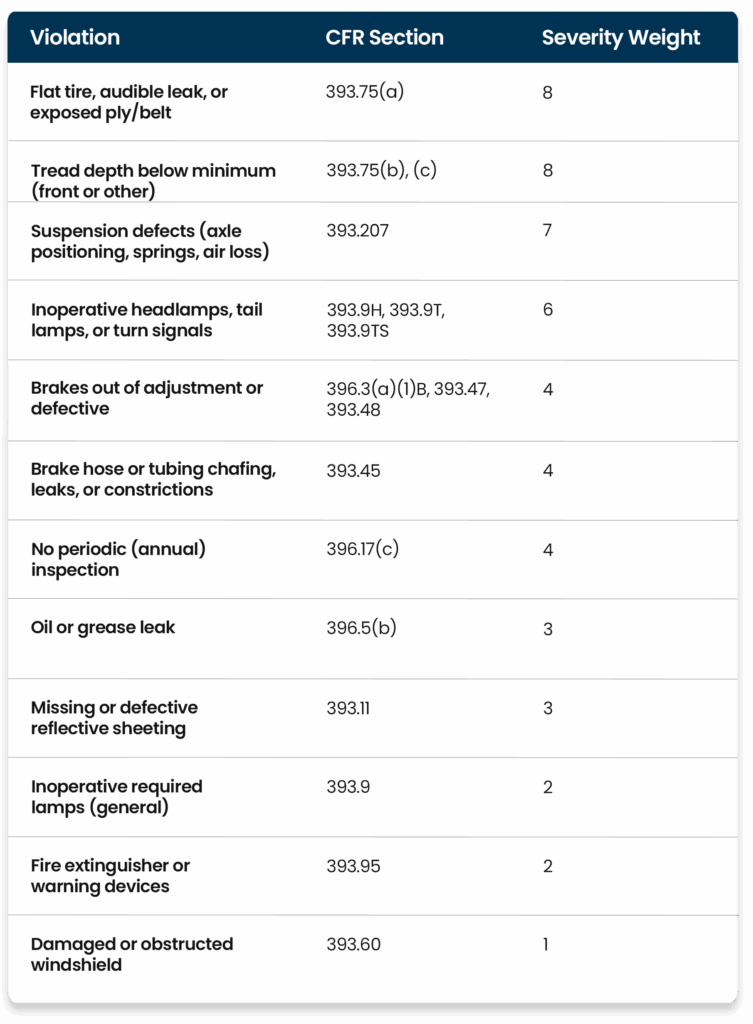
How much a violation hurts depends on its severity weight multiplied by how often it shows up. The table below shows severity weights for common CSA vehicle maintenance violations, as listed in the SMS methodology’s Appendix A. Add 2 points to any violation that results in an OOS order.
Tire Violations: The Highest Weight in the BASIC
Tire violations carry a severity weight of 8, and a flat tire or audible air leak usually brings an OOS order, adding 2 more points. One OOS tire violation found in the past six months can produce 30 weighted points from a single inspection: (8 + 2) × 3. Tires were also the second most common OOS violation in Roadcheck 2026.
Most tire violations are visible during a walk-around. Low tread, sidewall cuts, and underinflation are exactly what a thorough pre-trip inspection should catch before the truck leaves the yard.
Suspension Defects
Suspension violations under 393.207 carry a weight of 7. They show up less often than tires or lights, but a missing axle positioning part, a cracked leaf spring, or an air suspension pressure loss can hit your score almost as hard as a tire violation. These issues are easier to find during scheduled PM work than during a quick walk-around, so make sure your maintenance intervals include suspension checks.
Lighting Violations
Inoperative headlamps, tail lamps, and turn signals each carry a weight of 6. Lighting is one of the most frequent violations on roadside inspections, and it’s also one of the most avoidable. Lights are easy to check, and they’re often the first thing an inspector notices when deciding whether to pull a truck in.
A frequent, moderate-weight violation can add up faster than a rare high-weight one. Ten lighting violations over a year will damage your CSA maintenance score more than a single suspension defect.
Brake Violations
Individual brake violations carry a weight of 4, lower than tires or lights. But brakes are the most common category of OOS violations by a wide margin. When more than 20% of a vehicle’s service brakes are defective, the truck goes out of service, which adds 2 points to the violation.
Volume is why brakes matter so much. Brake adjustment, linings, hoses, and air system leaks can all generate separate violations on the same inspection. Regular brake inspections during PMs, plus driver checks for air leaks and hose damage, are the most effective way to keep them off your record.
Missing Periodic Inspections
Operating a CMV without a current annual inspection carries a weight of 4 and is entirely a recordkeeping problem. The truck may be in perfect condition, but if the periodic inspection is overdue or the proof isn’t on board, it counts against you. Tracking inspection due dates by asset is a simple fix with a direct payoff.
What’s Changing: FMCSA’s Proposed SMS Updates
FMCSA has proposed a major overhaul of the SMS. According to FMCSA’s CSA Prioritization Preview, the Vehicle Maintenance BASIC would be split into two Compliance Categories:
- Vehicle Maintenance: Driver Observed: violations that “could reasonably be observed by a driver” or that show up in a walk-around (Level 2) inspection
- Vehicle Maintenance: all other maintenance violations, typically found by a mechanic or in a full (Level 1) inspection
The proposal also replaces the 1 to 10 severity scale with a weight of 1 or 2, with OOS violations receiving a 2. Operating an OOS vehicle (396.9(c)(2)) would move to Unsafe Driving. FMCSA says both new maintenance categories would keep the same thresholds as the current Vehicle Maintenance BASIC. As of this writing, FMCSA has not set an implementation date and says carriers should keep using the current SMS. For background, see our post on FMCSA’s new prioritization system.
How to Lower Your CSA Maintenance Score
Lowering your Vehicle Maintenance BASIC score comes down to catching defects before inspectors do, fixing them fast, and documenting everything.
Make Pre-Trip Inspections Count
Tires, lights, brake hoses, air leaks, and reflective sheeting can all be caught on a walk-around. If FMCSA’s proposed Driver Observed category goes into effect, driver inspections will matter even more, because they’ll be measured directly. Use our DOT pre-trip inspection checklist as a baseline and require photos for high-risk items.
Whip Around’s mobile DVIR app guides drivers through asset-specific inspection forms and requires photos on the items you choose, so checks can’t be skipped. Mark Smith, Construction Operations Manager at Belknap Landscape, said drivers “can’t cheat the system and in some cases even have to take photographs assuring certain items were checked.” Belknap has caught 10,826 defects before they became breakdowns.
Close the Loop on Every Defect
Under 49 CFR 396.11, carriers must repair any reported defect likely to affect safety before the vehicle is operated again. Failure to correct defects noted on an inspection report is itself a violation. The faster a defect moves from the driver’s report to a completed repair, the less likely it is to show up on a roadside inspection.
With Whip Around, failed inspection items automatically create work orders in your fleet maintenance software, so the shop sees the issue right away and you can track it through to repair. Belknap Landscape resolves work orders in a median of 1.2 days.
Stay Ahead With Preventive Maintenance
Suspension defects, brake wear, worn linings, and hub leaks are best caught during scheduled PMs. Set PM intervals by mileage, engine hours, or calendar date, and track each asset’s annual inspection due date so 396.17(c) violations never happen. Our truck maintenance checklist covers the items that matter most.
Monitor Your SMS Data and Challenge Errors
Check your SMS profile at least monthly to see which violations are driving your score. If a violation was recorded incorrectly, you can request a review through FMCSA’s DataQs system. Clean inspections also help, since every inspection without a violation lowers your measure. For tips on passing roadside checks, see our guide to avoiding a failed DOT vehicle inspection.
The results can be significant. After rolling out digital inspections, Ryan Miller, General Manager at Northwest Repossession, said: “We’re getting pulled over less. The few times that they have pulled us over, we’re always passing with flying colors.”
Frequently Asked Questions About the Vehicle Maintenance BASIC
What is a good Vehicle Maintenance BASIC score?
Lower is better. FMCSA’s intervention thresholds are 80% for general carriers, 75% for hazmat carriers, and 65% for passenger carriers. Staying well below your threshold reduces the chance of warning letters, investigations, and extra roadside inspections.
Which vehicle maintenance violations carry the most CSA points?
Tire violations carry a severity weight of 8, followed by suspension defects at 7 and inoperative headlamps, tail lamps, and turn signals at 6. Any violation that results in an out-of-service order adds 2 points, and recent violations are multiplied by up to 3.
What are the most common vehicle maintenance violations?
Brakes, tires, and lights. In CVSA’s 2026 International Roadcheck, brake systems, tires, defective brakes, cargo securement, and lights were the top five vehicle out-of-service violations.
How long do vehicle maintenance violations stay on your CSA score?
Violations stay in the Vehicle Maintenance BASIC for 24 months. They count three times as much in the first six months, twice as much from six to 12 months, and at full value from 12 to 24 months.
How can I lower my CSA maintenance score quickly?
Focus on high-frequency, high-weight violations first: tires, lights, and brakes. Strengthen pre-trip inspections, repair reported defects before dispatch, keep annual inspections current, and challenge any incorrect violations through DataQs.
Catch Violations Before Inspectors Do
Your CSA maintenance score reflects what happens at your yard every day. When drivers find defects early and repairs happen before the next dispatch, fewer violations make it to a roadside inspection.
See how Whip Around connects driver inspections to maintenance so defects get fixed and documented faster. Book a demo or start a free trial today.