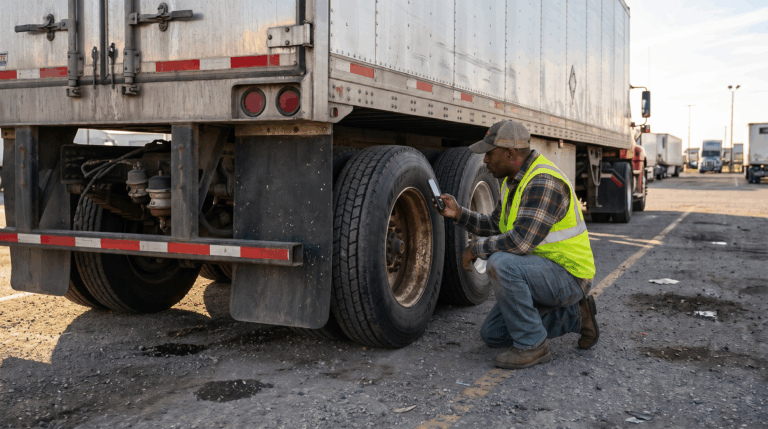
A driver pulls a loaded tractor-trailer off the interstate, backs into a warehouse dock, and waits while a forklift operator unloads the trailer. Then the truck heads to your shop for a brake job. In those few hours, the same truck and driver have moved between two federal safety agencies more than once.
For fleet managers, the OSHA vs. DOT question isn’t academic. Get it wrong and you could be training to the wrong standard, keeping the wrong records, or missing a hazard neither agency’s rules seem to cover. This guide explains how OSHA vs. DOT jurisdiction works, when OSHA rules apply to truck drivers, how OSHA handles motor vehicle safety, and how to build one compliance program that covers both.
OSHA vs. DOT: The Short Answer
OSHA regulates workplace safety and health, while the DOT, mainly through the Federal Motor Carrier Safety Administration (FMCSA), regulates commercial motor vehicles and drivers operating in interstate commerce. When an FMCSA regulation directly addresses a hazard, the DOT has authority. When it doesn’t, OSHA generally does.
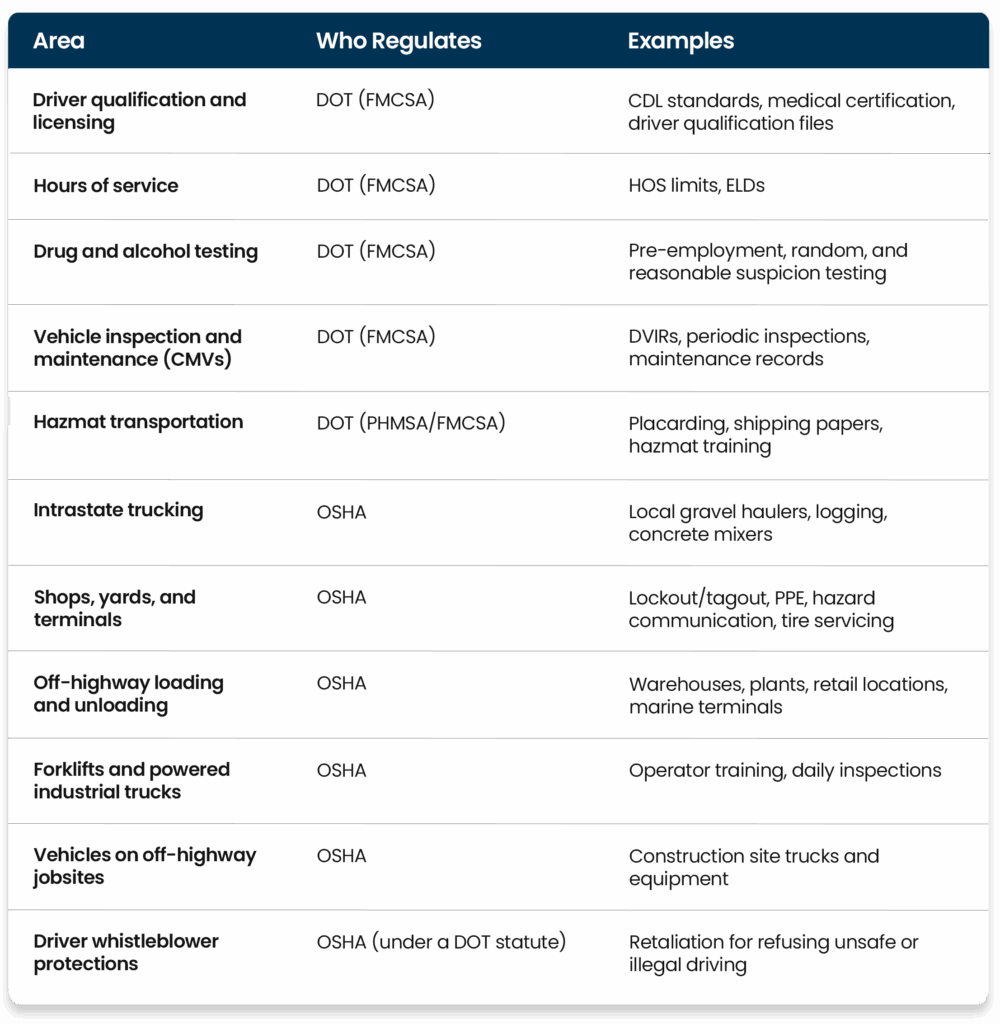
In practice, most fleets answer to both. The DOT governs driver qualifications, hours of service, drug and alcohol testing, and vehicle roadworthiness. OSHA governs your yards, shops, terminals, warehouses, and most off-highway work. The deciding factor isn’t your industry. It’s the specific working condition and whether another federal agency already regulates it.
How OSHA vs. DOT Jurisdiction Works
The dividing line comes from Section 4(b)(1) of the Occupational Safety and Health Act. According to OSHA, the agency is preempted from enforcing its regulations when “a working condition is regulated by another Federal agency.” OSHA also notes that “only another Federal agency may preempt OSHA’s authority,” which means a state or industry rule can’t take OSHA out of the picture.
On public highways, OSHA says the DOT “only preempts OSHA” with respect to hazards addressed by FMCSA regulations. That’s a narrower carve-out than many fleet managers assume. The DOT doesn’t take over everything a driver does. It takes over the specific conditions its rules cover, such as hours of service, CDL standards, and vehicle equipment requirements like brakes.
Interstate vs. Intrastate Operations
OSHA states plainly that “DOT has authority over interstate commerce while OSHA has authority over intrastate commerce.” Per OSHA’s highway driving guidance, the agency has authority over all intrastate trucking, including gravel and sand haulers, logging, agriculture, and cement and concrete mixers.
There’s one major exception: hazardous materials. The DOT regulates hazmat transportation whether the load crosses state lines or not. If your fleet runs both interstate and local routes, expect different rules to apply to different trucks, and sometimes to the same truck on different days.
What Counts as a Commercial Motor Vehicle?
FMCSA rules apply to commercial motor vehicles (CMVs). Under FMCSA’s definition, a CMV is a vehicle used on highways in interstate commerce that has a gross vehicle weight rating of 10,001 pounds or more, or that transports placarded quantities of hazardous materials. Vehicles designed to carry passengers above certain thresholds also qualify.
This definition matters because it determines which agency enforces certain rules at your facility. If the trailer at your dock isn’t a CMV, or your company doesn’t own, operate, or lease CMVs, OSHA’s rules typically apply instead of FMCSA’s.
Who Regulates What: OSHA vs. DOT at a Glance
Do OSHA Rules Apply to Truck Drivers?
Yes, in many situations. FMCSA preempts OSHA only for the hazards its regulations address while drivers operate CMVs in interstate commerce. Once a driver steps out of the cab, OSHA rules often apply. According to OSHA, the agency has authority over “off-highway loading and unloading, such as warehouses, plants, grain handling facilities,” along with retail locations, marine terminals, wharves, piers, and shipyards.
That means a driver strapping loads at a customer’s warehouse, climbing onto a trailer, handling chemicals, or working in your shop is likely covered by OSHA standards for fall protection, PPE, hazard communication, and material handling. Drivers running intrastate routes are covered by OSHA on the road as well.
The Loading Dock Gray Area
Wheel chocking is the classic example of how OSHA vs. DOT jurisdiction gets complicated. In a 2011 letter of interpretation, OSHA confirmed that FMCSA’s parking brake regulations preempt OSHA’s chocking requirements for CMVs. OSHA states it “does not cite for failure to chock trailer wheels if the vehicle is otherwise adequately secured.”
But OSHA can still enforce chocking for vehicles that aren’t CMVs, for intrastate trucks, and for companies that don’t own, operate, or lease CMVs. So the forklift operator unloading a trailer may be protected by different rules depending on whose truck is at the dock. The safest practice is to secure every trailer, every time, with chocks or a dock lock, regardless of which agency would enforce it.
Driver Whistleblower Protections
OSHA also enforces a DOT law that every fleet manager should know: the Surface Transportation Assistance Act (STAA). According to OSHA’s STAA guidance, drivers are protected from retaliation when they refuse to operate a vehicle in a way that would actually violate a DOT safety regulation, such as exceeding hours-of-service limits or driving while impaired by fatigue or illness.
Drivers have 180 days to file a retaliation complaint with OSHA. This is one more reason to make it easy for drivers to report unsafe conditions and to respond to every report quickly.
How OSHA Handles Motor Vehicle Safety
OSHA doesn’t have a general industry standard for driving on public roads. Instead, OSHA motor vehicle safety requirements appear in industry-specific standards. OSHA’s motor vehicle safety page points to rules for construction (29 CFR 1926 Subpart O), agriculture (including rollover protection for tractors), and maritime operations.
For construction fleets, 29 CFR 1926.601 is the key standard. It covers vehicles operating on an “off-highway jobsite, not open to public traffic.” It requires vehicles to be checked at the beginning of each shift, including service brakes, parking brakes, tires, horn, steering, and lights, and it states that “all defects shall be corrected before the vehicle is placed in service.” It also requires reverse signal alarms or a spotter for vehicles with an obstructed rear view, plus seat belts.
OSHA Standards That Apply to Fleet Operations
OSHA’s trucking industry page lists the general industry standards most relevant to fleets. Several apply directly to shops and yards:
- 1910.147: Lockout/tagout for servicing equipment
- 1910.177: Servicing multi-piece and single-piece rim wheels
- 1910.178: Powered industrial trucks (forklifts)
- 1910.132: Personal protective equipment
- 1910.1200: Hazard communication
- 1910.23: Ladders
- 1910.157: Portable fire extinguishers
If your team runs forklifts, start with a forklift safety inspection checklist. For waste and recycling fleets, our guide to OSHA guidelines for waste collection workers covers PPE, lifting, and vehicle hazards on the route.
Recordkeeping: Don’t Assume DOT Records Are Enough
Most employers must also keep OSHA injury and illness records under 29 CFR Part 1904, including the OSHA 300 log. A crash recorded for DOT purposes isn’t automatically exempt from OSHA recordkeeping. Each work-related injury should be evaluated against OSHA’s recording criteria separately.
Why Getting OSHA vs. DOT Right Matters
The stakes go beyond citations. Transportation incidents were the most frequent type of fatal workplace event in 2024, making up 38.2% of all occupational fatalities, according to the U.S. Bureau of Labor Statistics. The Network of Employers for Traffic Safety puts the average cost of an on-the-job crash to employers at $55,772.
Jurisdiction confusion creates blind spots. A fleet focused only on DOT compliance may run flawless DVIRs while missing lockout/tagout training in the shop. A fleet focused only on OSHA may overlook HOS or driver qualification files. Treating the two as one safety program closes those gaps.
How to Build a Fleet Safety Program That Covers Both
You don’t need two separate programs. You need one system that captures the right information for each regulator:
- Map your operations. List every location and activity (highway driving, intrastate routes, docks, shops, jobsites) and note which agency governs each.
- Inspect every asset, not just CMVs. DOT requires DVIRs for CMVs, and OSHA requires inspections for forklifts and construction jobsite vehicles. Use one equipment inspection checklist process across all of them.
- Fix defects before use. Both FMCSA and OSHA’s construction standard require defects to be corrected before a vehicle goes back into service.
- Keep records audit-ready. Store inspections, repairs, training, and incident records where you can pull them for a DOT audit or an OSHA inspection.
Whip Around’s fleet compliance software puts both sides in one platform. Drivers complete DOT-compliant digital inspections on their phones, and you can build custom forms for forklifts, jobsite equipment, and shop tools with Whip Around Beyond Vehicles. Failed items automatically generate work orders, so defects are fixed and documented before the asset goes back into service.
Inspection quality matters as much as completion. At General Insulation, better visibility into inspection data reduced pencil-whipped inspections from 35% to just 1.5%. For more on the DOT side, see our guide to the Federal Motor Carrier Safety Regulations and our DOT audit compliance checklist.
Frequently Asked Questions: OSHA vs. DOT
What is the difference between OSHA and DOT?
OSHA regulates workplace safety and health across nearly all industries. The DOT, through FMCSA, regulates commercial motor vehicles and drivers in interstate commerce, including licensing, hours of service, drug and alcohol testing, and vehicle maintenance.
Does OSHA have jurisdiction over truck drivers?
OSHA has jurisdiction over truck drivers for hazards that FMCSA regulations don’t address. That includes off-highway loading and unloading, work in shops and yards, and all intrastate trucking. On public highways, FMCSA rules take over only for the specific hazards they cover.
Can OSHA and DOT both apply to the same fleet?
Yes. Most fleets are subject to both agencies. The DOT covers drivers and vehicles on the road, while OSHA covers the facilities and most off-highway tasks.
Does OSHA regulate motor vehicle safety?
OSHA addresses motor vehicle safety through industry-specific standards, including construction (29 CFR 1926.601 for off-highway jobsites), agriculture, and maritime. It also enforces driver whistleblower protections under the Surface Transportation Assistance Act.
One Platform for DOT and OSHA Compliance
The OSHA vs. DOT line can shift depending on where a truck is and what the driver is doing. Your inspection and recordkeeping process shouldn’t change with it. With one system for every vehicle, piece of equipment, and work order, you’re ready for either agency’s audit.
See how Whip Around helps fleets stay compliant across every asset and location. Book a demo or start a free trial today.