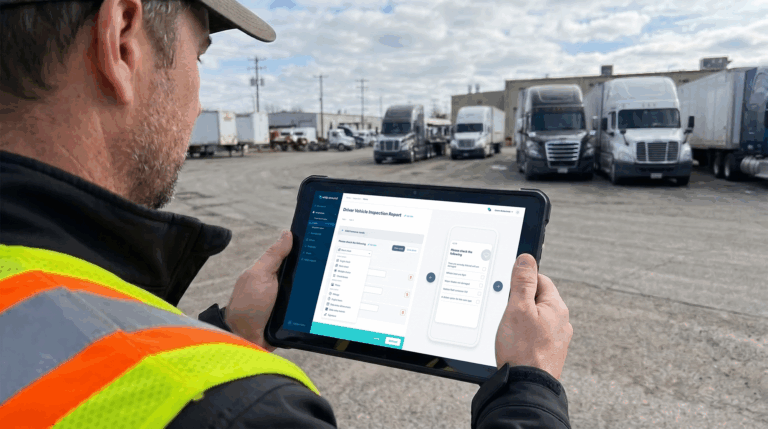
A refuse truck that fails to start on collection day doesn’t just sit in the yard. It stalls an entire route, backs up a schedule that’s already tight, and puts a supervisor on the phone explaining missed pickups to a municipality or commercial customer. Waste and recycling fleets run on some of the hardest-working vehicles on the road: packer bodies cycling all day, hydraulic lifts under constant load, and routes full of stop-start driving that wears brakes and suspension faster than long-haul trucking ever would. Waste and recycling fleet management is the set of practices and tools fleets use to keep these vehicles inspected, maintained, and compliant so breakdowns don’t dictate the schedule. At the center of that is waste and recycling vehicle maintenance, the day-to-day inspection, repair, and scheduling work that determines whether a truck shows up ready for its route or ends up on a hook.
Most of the fleets still fighting downtime aren’t short on mechanics or good intentions. They’re running the process on paper, radio calls, and institutional memory, which breaks down the moment a driver forgets to mention a leak or a mechanic loses track of which truck is due for service. This guide covers the maintenance workflows worth digitizing, what to look for in fleet software, a practical PM cadence, and how to build a system that catches problems before they hit the route.
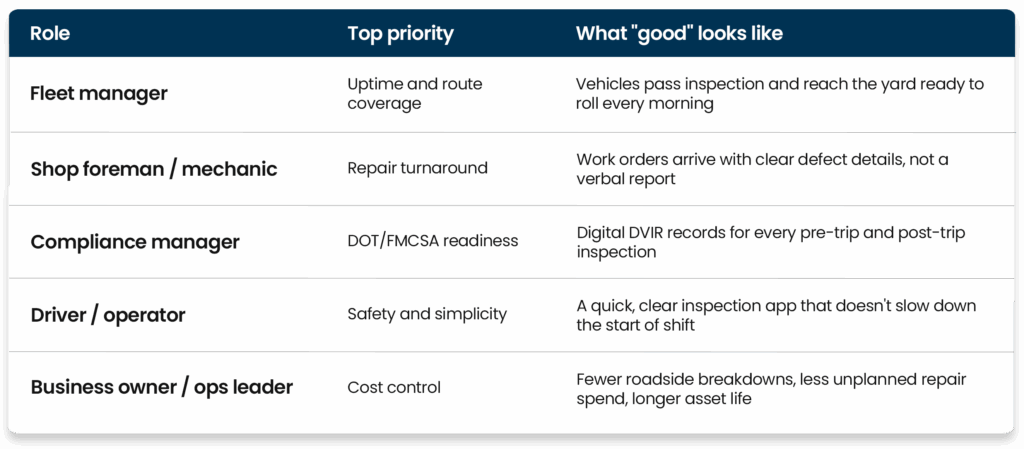
At a glance: Waste fleet management priorities by role
9 maintenance workflows every waste and recycling fleet should digitize
Paper checklists and verbal handoffs between drivers and mechanics create gaps. A defect gets mentioned in passing, a work order gets written on a sticky note, and three weeks later the same hydraulic leak takes a truck out of service on a Monday morning. Digitizing these nine workflows closes those gaps and gives fleet managers a real-time view of vehicle health across refuse trucks, recycling vehicles, and roll-offs. None of these require a full software overhaul on day one. Most fleets get the biggest return by starting with inspections and work orders, then layering in preventive maintenance scheduling and reporting once the basics are consistent.
1. Pre-trip inspections built for refuse and recycling vehicles
A generic truck inspection form misses the components that fail most often on collection vehicles: packer blades, hopper seals, tailgate locks, and hydraulic hose routing. Digital pre-trip inspections let fleets build custom checklists for refuse and recycling bodies specifically, so drivers are checking the parts that actually break instead of a one-size-fits-all form built for a dry van.
2. Post-trip inspections that capture route damage
Curbside routes are rough on equipment. Curb strikes, container impacts, and debris damage happen constantly and often go unreported until the vehicle is already scheduled for its next run. A post-trip inspection, completed before the driver clocks out, captures that day’s damage with photos and notes while it’s still fresh, instead of surfacing three days later as a mystery leak.
3. Defect reporting before trucks leave the yard
The goal of any inspection program is to catch a defect before the vehicle leaves the yard, not after it’s blocking a residential street. Digital defect reporting flags failed items immediately and routes them to the shop, rather than relying on a driver to remember to mention it during a shift change.
4. Preventive maintenance scheduling by mileage, engine hours, and service cycles
Refuse trucks accumulate engine hours and hydraulic cycles differently than mileage alone would suggest. A truck running a short, dense residential route can rack up as many PTO cycles as one running double the miles on a rural route. Scheduling PMs by mileage, engine hours, and defined service intervals, rather than mileage alone, keeps maintenance timed to actual wear instead of an approximation. Automated reminders based on these triggers also take the guesswork off the fleet manager’s plate, so a service date doesn’t get missed because a spreadsheet wasn’t updated that week.
5. Hydraulic, PTO, and compactor maintenance tracking
The power take-off (PTO) system, hydraulic lift, and compactor mechanism are subjected to constant mechanical stress and are also the components most likely to cause a roadside breakdown when neglected. Tracking hydraulic fluid changes, hose inspections, and compactor cycle counts as their own maintenance category, separate from general engine service, makes it easier to catch wear before a hydraulic failure strands a truck mid-route. A slow hydraulic leak that gets logged and monitored over a few weeks is a scheduled repair. The same leak ignored is a truck stuck at the curb with a full hopper.
6. Tire, brake, and suspension checks for stop-start routes
Collection routes involve near-constant stopping and starting, which accelerates brake wear and puts more stress on tires and suspension components than steady highway driving. Building tire tread depth, brake wear, and suspension checks into every scheduled inspection, not just an annual DOT inspection, helps catch wear patterns before they become safety issues.
7. Work orders connected to inspection failures
When a failed inspection item doesn’t automatically generate a work order, it depends on someone remembering to follow up. Connecting inspection failures directly to work order creation means a defect flagged during a pre-trip inspection turns into an assigned, trackable repair job without a manual handoff step in between.
8. Parts and inventory tracking for high-wear components
Waste and recycling vehicles go through filters, hydraulic fluid, brake components, and seals faster than most fleet segments because of the corrosive environment and constant mechanical cycling. Tracking parts inventory and setting reorder thresholds for these high-wear components keeps a common repair from turning into an extended vehicle-down situation because a part wasn’t on the shelf.
9. Maintenance reporting that spots repeat defects and risky assets
A single failed brake inspection is a repair. Three failed brake inspections on the same vehicle in two months is a pattern that deserves a closer look, whether from a driver behavior issue, a parts quality problem, or an asset nearing the end of its useful life. Maintenance reporting that surfaces defect trends by vehicle, not just by individual work order, helps fleet managers make replace-or-repair decisions with data instead of guesswork.
What to look for in waste and recycling fleet management software
Not every fleet software platform is built with refuse and recycling operations in mind. Many general-purpose fleet tools are designed around over-the-road trucking and treat inspections as a compliance checkbox rather than a maintenance signal. For waste and recycling fleets, the software needs to reflect how these vehicles actually break down, through hydraulic wear, hopper and blade damage, and heavy-cycle usage, not just mileage and fuel. When evaluating options, look for:
- Customizable inspection forms that account for packer bodies, compactors, hydraulic lifts, and roll-off mechanisms, not just standard tractor-trailer checklists.
- DOT-compliant DVIR recordkeeping with audit-ready digital records for every pre-trip and post-trip inspection.
- Automatic work order generation from failed inspection items, so defects don’t sit in a notebook waiting for someone to act on them.
- Preventive maintenance scheduling that supports mileage, engine hours, and calendar-based triggers together, since heavy-cycle waste vehicles don’t wear evenly by mileage alone.
- Telematics integration with providers like Geotab, Samsara, or Motive, so fault codes and engine data can feed directly into maintenance workflows instead of living in a separate system.
- Mobile accessibility for drivers and mechanics working across yards, routes, and shop floors, without requiring a desk or a paper clipboard.
- Reporting that flags repeat defects and downtime trends, not just a log of completed inspections.
- Support for non-truck assets like roll-off containers, compactors, and trailers, since waste fleets often manage more than just the powered vehicle.
Weigh these against how the software fits your current process, too. A platform with every feature on this list still needs driver and mechanic buy-in to work. If the inspection app is slower than the paper form it’s replacing, adoption will stall no matter how strong the reporting is on the back end.
A simple preventive maintenance cadence for waste collection vehicles
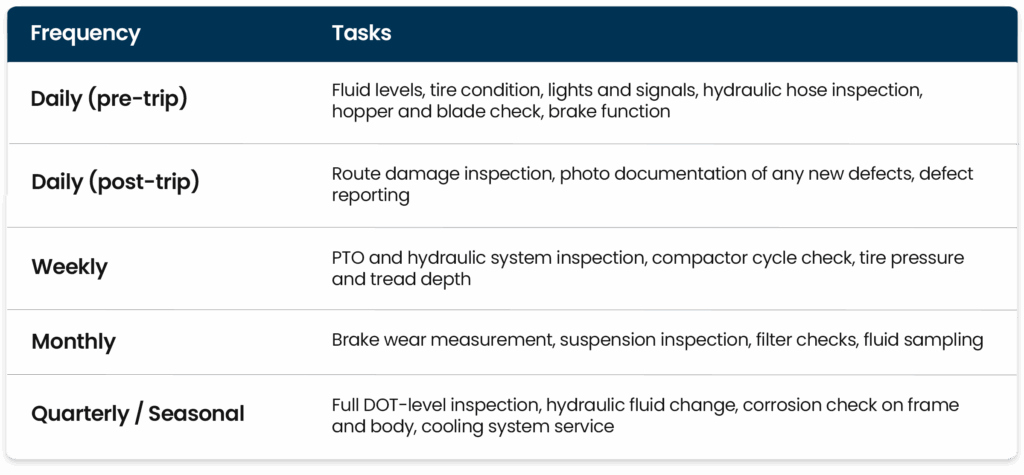
This cadence is a starting point. Actual intervals should reflect manufacturer recommendations, route intensity, and vehicle age. The goal is a documented, repeatable schedule instead of maintenance that happens reactively after something breaks.
How Whip Around helps waste and recycling fleets stay route-ready
Whip Around gives waste and recycling fleets a mobile-first way to run the workflows above without relying on paper checklists or side conversations between drivers and the shop. Drivers complete customizable pre-trip and post-trip inspections built for refuse and recycling vehicles, with photo capture for route damage and defect documentation built in. When an inspection item fails, it can automatically generate a work order, so the shop knows about a hydraulic leak or a failed compactor sensor as soon as the driver does, not at the next shift change.
On the maintenance side, preventive maintenance scheduling supports mileage, engine hours, and calendar triggers, which matters for vehicles that accumulate hydraulic cycles and engine hours differently than their odometer suggests. Fleet managers get maintenance reporting that surfaces repeat defects and downtime trends across the fleet, making it easier to spot a truck that needs closer attention before it fails on a route. For fleets already running telematics, Whip Around integrates with providers like Geotab, Samsara, and Motive, so fault codes and engine data can trigger inspection and maintenance workflows directly, rather than sitting in a separate dashboard nobody checks daily. Because the platform works across asset types, it also covers roll-off containers, compactors, and trailers alongside the powered vehicles in a fleet. See how it applies specifically to waste recycling fleet software.
Fleets looking for more detail on the cost side of this can review these automated waste fleet management strategies, and larger operations managing multiple facilities or municipalities can see how the same workflows scale in this look at enterprise waste fleet management.
None of this requires ripping out an existing process overnight. Most fleets move drivers onto digital pre-trip and post-trip inspections first, since that’s where the biggest visibility gap usually sits, then bring the shop onto automated work orders once inspection data is flowing consistently. Preventive maintenance scheduling and fleet-wide reporting tend to follow naturally once those two pieces are in place, because the data needed to schedule PMs accurately and spot repeat defects is already being captured at the inspection level.
Keep collection vehicles ready before the route starts
Waste and recycling fleets don’t have the luxury of a flexible schedule. Routes run on fixed days, customers expect consistent service, and a truck down for an avoidable repair creates a problem that ripples through the rest of the fleet. Digitizing inspections, connecting defects to work orders, and scheduling preventive maintenance around actual usage, not just mileage, turns maintenance from a reactive scramble into a predictable process. Fleets running telematics alongside their maintenance program can get even more out of both systems, as covered in this breakdown of fleet maintenance with Whip Around and telematics data, and fleets exploring where automation fits into inspections and safety can see more in this piece on AI in fleet maintenance.
If your fleet is still tracking inspections on paper or chasing down verbal defect reports, it’s worth seeing what a digital workflow looks like in practice. Book a demo or start a free trial to see how it fits your routes.
FAQs about waste and recycling fleet management
How often should refuse trucks be inspected?
Refuse trucks should undergo a pre-trip inspection before every shift and a post-trip inspection at the end of every route, in addition to standard periodic DOT inspections. Because of the mechanical stress on hydraulic and PTO systems, many fleets also add weekly checks specifically for compactor and hydraulic components, beyond what a standard daily inspection covers.
What software features are most useful for waste fleet maintenance?
The most useful features are customizable inspection forms built for refuse and recycling bodies, automatic work order generation from failed inspections, preventive maintenance scheduling based on mileage and engine hours together, and reporting that flags repeat defects by vehicle. Telematics integration is valuable for fleets that want fault code data feeding directly into maintenance workflows.
How can waste fleets reduce vehicle downtime?
Reducing downtime starts with catching defects before a vehicle leaves the yard rather than after it’s on a route, which requires consistent pre-trip inspections and a fast path from failed inspection to work order. Preventive maintenance scheduled around actual usage, including hydraulic and PTO cycles, not just mileage, also catches wear before it causes a breakdown, and maintenance reporting that flags repeat issues helps fleets address problem vehicles before they fail in the field. Fleets that combine these workflows with telematics data get an added layer of visibility, since fault codes and engine data can trigger a maintenance check before a driver even notices a symptom.