A residential collection route is twenty stops behind schedule because a packer truck threw a fault code on its second pickup and the driver didn’t know. The shop didn’t see the fault code either, so it sat in the telematics dashboard while dispatch kept rerouting the next truck. By the time anyone connected the dots, the morning was lost and customer service was answering complaints about missed bins.
This is what enterprise waste fleet management looks like when three critical systems run in isolation. Routing software knows where the trucks are supposed to be. Telematics knows what the engines are doing. Driver inspection apps know what’s wrong with the equipment. None of them talk to each other.
The article below covers what integrated waste fleet operations actually look like at scale, why the silos quietly bleed money, and how enterprise haulers stitch route, maintenance, and driver reporting data into one operational picture.
What Integrated Waste Fleet Management Means at Enterprise Scale
Enterprise waste fleet management is the practice of unifying route data, vehicle maintenance records, and driver inspection reporting into a single operational view across every yard, region, and fleet a hauler operates. Instead of running routing, telematics, and maintenance as standalone tools, integrated fleets connect them so that what one system sees, every system can act on.
At the scale most large haulers operate — hundreds of packer trucks, roll-offs, recycling units, and roll-back tractors spread across multiple yards — that integration is the difference between an operation that runs on data and one that runs on phone calls and clipboards. Purpose-built waste fleet management software makes that integration tractable.
A genuinely integrated waste fleet has three things working in the same direction. Route adherence data flows in real time from the routing platform. Engine health data flows from telematics. Driver-reported defects flow from electronic DVIRs on a mobile app. All three feed a maintenance workflow that schedules PMs, opens work orders, closes them, and reports on them, and a reporting layer that lets a VP of operations see route adherence, MTTR, and inspection completion across every yard in one dashboard.
The point isn’t to replace systems you already use. It’s to make them stop working in isolation.
The Three Data Streams Driving Modern Waste Operations
Every enterprise hauler runs on three data streams. Understanding what each captures — and what decisions it should drive — is the foundation of any integration strategy.
Route Data — Where Trucks Go and How Efficiently
Route data comes from routing and dispatch software (Routeware, AMCS, Soft-Pak, FleetMind, RouteSmart) and tells you where every truck should be, where it actually is, what got serviced, and what got missed. It captures stop times, route adherence percentages, exception flags from drivers at the curb, and service confirmation through cab tablets or driver apps.
Industry research suggests AI-driven route optimization can improve route efficiency by 20–30%, but only when the underlying route data is accurate enough to trust. For enterprise haulers, the operational value of route data isn’t the maps. It’s the exception data: contamination flags, blocked containers, overweight pickups, customer disputes. Each one is a decision the rest of the organization needs to see in time to act on.
Maintenance Data — What Keeps Each Truck on the Road
Maintenance data lives in your CMMS or fleet maintenance software and covers everything an asset needs to stay on the road: preventive maintenance schedules, work orders, parts inventory, service history, mean time to repair, and cost per repair.
For waste fleets specifically, maintenance pressure is unusually high. Packer cycles, roll-off lifts, hydraulic systems, and stop-and-go duty all wear components fast in corrosive environments. Strong maintenance data tells you which trucks are due, which are overdue, what failed last month, what’s costing you, and which assets are approaching end of service life. Industry benchmarks suggest unplanned maintenance costs 3–9× more than planned work — which is why a missed PM on a packer is rarely a small problem.
Driver Reporting Data — What’s Actually Happening in the Cab and at the Curb
Driver reporting is the data only the person behind the wheel can give you. Pre-trip and post-trip eDVIRs, defect reports, photos of broken hopper cylinders, notes about brake feel, and curbside exception flags all live in this stream. The driver is the only sensor on the truck that can tell you something doesn’t sound right.
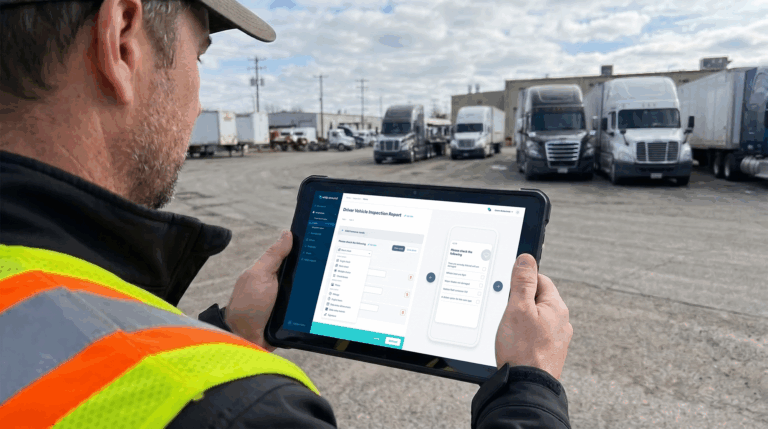
In a paper-based shop, that information dies on a clipboard. In an integrated operation, an eDVIR submission flows directly into the maintenance system, the shop sees the defect within seconds, and a work order opens automatically — no retyping, no lost forms, no end-of-shift triage pile.
Why Siloed Systems Cost Enterprise Waste Fleets Time and Money
When the three streams run in isolation, the cost shows up everywhere.
Duplicate data entry burns shop and admin time. VINs get typed into routing, retyped into telematics, retyped again into the maintenance system. Telematics fault codes from packer trucks fire in a dashboard nobody is watching, then turn into roadside breakdowns three weeks later. PMs come due based on a calendar in one system while the mileage in another system says the truck is 40,000 miles past its service interval.
Operationally, the most expensive failure mode is the one that hits the customer. A truck breaks down mid-route. Dispatch has to find a sub. Customers get missed pickups. CSRs field complaints for two days. The all-in cost of that breakdown — towing, overtime, rental, customer credits, regulatory exposure if the load was hazardous — easily runs into five figures.
Audit risk is the other quiet cost. When DVIRs live in one system, work orders in another, and roadside inspection records in a third, proving you closed out a defect on time becomes a paper chase. FMCSA and DOT auditors don’t wait for you to assemble PDFs from three databases.
Enterprise teams still running waste operations on siloed systems aren’t paying for software anymore. They’re paying for the gap between the systems — and the case for data-driven fleet management is exactly that gap.
How Enterprise Waste Teams Connect Route, Maintenance, and Driver Reporting
There’s no single product that does all of this. Enterprise integration is an architecture, not a SKU. The teams that get it right tend to follow the same five-step pattern.
1. Pull Route and Telematics Data into a Central Operational Picture
The first move is making sure routing and telematics aren’t living in separate browser tabs. Most enterprise haulers already run a routing platform and a telematics provider — typically Samsara, Geotab, or Motive. The integration job is making those two systems publish to a single operational layer where dispatch, ops, and the shop can all see the same trucks at the same time.
That usually means an API or middleware layer pulling location and route adherence data into the same view as engine status, fault codes, idle time, and fuel use. GPS fleet tracking on its own reduces idle time by an estimated 10–20%, but the bigger win at enterprise scale is decision speed: when a truck goes down, dispatch can see the fault on the same screen they use to reroute. Whip Around supports this through deep telematics integrations with the major providers.
2. Tie Driver Inspections Directly to Work Orders
The second step is where most fleets discover how much money paper DVIRs are quietly costing them. In an integrated operation, a driver’s eDVIR isn’t a form — it’s a trigger. When a driver flags a hydraulic leak or a fault light on a roll-off truck, the inspection record syncs to the maintenance platform, opens a work order automatically, assigns it to the right shop, and stays in the audit trail forever.
With Whip Around’s fleet inspection software, defect items captured during a DVIR generate work orders without anyone retyping anything. AI Inspections Pro adds another layer: the system reviews inspection photos automatically and flags defects a tired driver or a busy reviewer might miss. The shop sees real defects faster, and the audit file builds itself.
3. Use Engine Fault Codes to Trigger Predictive Maintenance
Telematics generates fault codes constantly, but only a fraction of them require shop attention immediately. The third step is filtering those codes through a maintenance system that knows which DTCs matter for which asset class, what the threshold is for action, and which PM should trigger.
Industry research suggests IoT-driven predictive maintenance can reduce unplanned downtime by up to 40% — but only when fault codes actually reach the shop. In an integrated architecture, a fault code from a Samsara or Geotab unit flows into the maintenance platform, gets evaluated against asset-specific rules, and either opens a work order or schedules a follow-up PM. The same engine hours and mileage data that drives fault analysis also drives PM scheduling, so the work the truck actually needs gets done — not the work the calendar thinks it needs.
4. Standardize Reporting Across Yards, Regions, and Fleets
Enterprise haulers running 10 yards in 4 states have a problem a 50-truck operation doesn’t: every yard ends up developing its own way of doing things. The fourth step is standardizing reporting so that “PM compliance rate” or “inspection completion rate” means the same thing in Phoenix as it does in Pittsburgh.
That requires shared definitions, shared inspection forms, and a reporting layer that can roll regional data up to a corporate view. Strong fleet reporting software gives operations and finance leaders a single view of route adherence, maintenance cost per mile, work order cycle time, and inspection compliance across every yard. Without standardization, you can’t benchmark, you can’t identify outliers, and you can’t tell the difference between a yard with a real problem and a yard with messy data.
5. Build Dashboards That Operations, Maintenance, and Safety All Trust
The final step is the one most often skipped: shared dashboards. Operations cares about route adherence and missed pickups. Maintenance cares about MTTR and PM compliance. Safety cares about inspection completion, defects per truck, and audit defensibility. Finance cares about cost per truck per month.
Each of those groups has historically pulled its own reports from its own system. Integrated waste fleet management means everyone is looking at the same numbers from the same source of truth, with the ability to drill down to a single truck on a single shift. When operations, maintenance, and safety all trust the same data, decisions stop being political. The conversation moves from “your numbers don’t match mine” to “what are we going to do about Yard 7?”
Choosing a Fleet Platform That Connects the Pieces
Most enterprise haulers already own a routing platform and a telematics provider. What’s usually missing is the layer that turns route and telematics data into actual maintenance and inspection workflows, and gives ops, maintenance, and safety a single record of every truck’s life.
Whip Around fits in that role. It’s not a routing system and it’s not a telematics platform. It’s the inspections, maintenance, compliance, and reporting layer that complements both. Drivers run eDVIRs from a mobile app on every pre-trip and post-trip. Failed inspection items open work orders automatically. Fault codes from Samsara, Geotab, or Motive flow in through native integrations and trigger maintenance workflows on the asset side. The argument for this stack is laid out in detail in our piece on how Whip Around integrates telematics rather than replacing it.
PMs can be scheduled by mileage, engine hours, or calendar date — which matters for a waste fleet running heavy-cycle, stop-and-go duty where the calendar is often the worst proxy for actual wear. The platform also covers non-vehicle assets — containers, balers, compactors, generators, yard equipment — so the same inspection and PM workflows extend across everything in the yard, not just the trucks.
If you’re piecing your fleet stack together, the question isn’t which tool to replace. It’s which tool ties the rest of them together.
Metrics Enterprise Waste Teams Should Track Across Integrated Systems
Once route, maintenance, and driver data are talking to each other, the metrics that matter for enterprise waste operations sharpen up. The list below is what most operations directors and VP-level fleet leaders should be tracking weekly:
- Route adherence percentage — how often trucks complete their planned route within service windows
- On-time service rate — percentage of stops completed within commitment windows
- Inspection completion rate — percentage of trucks with a completed pre-trip eDVIR daily
- Defect-to-work-order time — time between a driver flagging a defect and a work order opening
- Mean time to repair (MTTR) — average duration of work orders from open to close
- Preventive-to-reactive maintenance ratio — share of work that’s planned vs. unplanned
- Work order cycle time — average days from work order creation to closure
- Fault-code-to-repair time — how long telematics-flagged DTCs sit before shop action
- Missed pickup rate — pickups missed per 1,000 stops, by cause
- Cost per truck per month — total cost of operation per vehicle, all-in
The right benchmark depends on the operation, but the principle holds: if you can’t measure these across every yard, you can’t manage at enterprise scale.
Building a Smarter, Safer Waste Operation
The waste haulers that operate well at enterprise scale aren’t doing anything magical. They’ve connected the systems most of their peers still run in isolation. Route data, maintenance records, and driver reporting move between platforms without anyone retyping anything. Fault codes turn into work orders. eDVIRs build the audit trail automatically. Every yard reports on the same metrics, and the leadership team sees the same numbers regardless of who they ask.
That’s what integrated enterprise waste fleet management actually looks like. It isn’t a product — it’s an operating discipline supported by the right tools.
If you’re trying to tie your existing routing, telematics, and maintenance systems together, book a demo or start a free trial to see how Whip Around fits the gap.