A pump truck on a remote pad sits idle for the third morning in a row. A fault code fired on Sunday night that nobody acted on. The engine-hours log shows the truck was 80 hours past a recommended service interval. Geofence records show it left the site at 02:47 on Tuesday, came back at dawn, and no dispatch ticket explains the trip. By the time anyone connects the dots, the completion crew is sitting on its hands waiting for water, and the operator is writing a six-figure check for the delay.
Every piece of data needed to prevent that morning was already being captured. None of it was being used to stop a breakdown before it happened. That gap between the telematics data oilfield fleets already collect and the maintenance actions they actually take is where most oil and gas fleet downtime lives.
This article walks through how enterprise oil and gas operators use three telematics inputs — geofencing, engine hours, and fault codes — together to keep assets in service. The pattern is the same across upstream operators, midstream haulers, and oilfield service companies: the fleets that minimize downtime aren’t the ones with the most sensors. They’re the ones with the tightest loop between sensor and shop.
What “Fleet Downtime” Actually Costs in Oil & Gas Operations
Oil and gas fleet downtime is any time an asset (a tanker, pump truck, frac unit, water truck, or field service vehicle) is unavailable for work because of mechanical failure, unscheduled repair, missed inspection, or operational restriction. Unlike most trucking or delivery fleets, oilfield downtime rarely stops at the cost of the repair itself.
A water truck that breaks down on a fracking pad can stall a completion crew at thousands of dollars per hour. A tanker out of service mid-haul triggers rerouting, overtime, and customer credits. A pump truck with an undetected DEF or aftertreatment fault can sideline a wellsite for days. Add hazmat exposure, lone-worker risk, and HSE recordkeeping pressure, and the all-in cost of one breakdown often runs into six figures.
Industry research suggests unplanned maintenance costs three to nine times more than planned work, and preventive maintenance programs can reduce equipment downtime by up to 45%. For enterprise fleet management software for oil and gas buyers, that’s the prize: shifting maintenance from reactive to proactive using data the fleet is already generating.
Reducing oil and gas fleet downtime is also a compliance story. FMCSA out-of-service rates, DOT inspection results, and internal HSE audits all benefit from the same telemetry that prevents breakdowns in the first place. A tanker that fails a roadside because of an unaddressed brake fault is the same tanker that should have been pulled into the shop the day the DTC fired. Fleets that connect their telematics signals to a shop workflow rarely fail a roadside the second time.
The Three Telematics Inputs That Drive Oilfield Uptime
Every modern oil and gas fleet sits on top of three telematics inputs that, when used together, predict and prevent most downtime. The full breakdown is covered in our piece on oil and gas fleet telematics data, but the short version is this: location, wear, and engine health. Each signal answers a different question, and each one is wasted if it’s not feeding a maintenance or operations workflow.
1. Geofencing — Knowing Where Assets Are and When They Move
Geofencing draws virtual boundaries around physical locations — wellsites, yards, refineries, customer pads — and logs every time an asset enters, exits, or moves inside them. For an enterprise oilfield fleet, geofencing is less about mapping and more about exception detection: did this water truck leave the pad after hours, did this frac unit arrive on time, did this service vehicle stop somewhere it wasn’t supposed to. Each event is a potential operational decision — a service call, a dispatch confirmation, a theft investigation, a lone-worker check-in.
2. Engine Hours — The Real Wear Clock for Oilfield Equipment
For trucks that mostly drive highway miles, mileage works fine as a wear proxy. For an oilfield fleet running pump trucks, frac equipment, gensets, and water trucks that idle at wellsites for hours, mileage understates the actual wear. Engine hours capture how much an engine has actually run, regardless of how far it moved. They are the right metric for preventative maintenance scheduling on any asset that earns its keep sitting still as much as it does rolling.
3. Fault Codes (DTCs) — Early Warning From the Engine Itself
Fault codes — formally diagnostic trouble codes, or DTCs — are the engine’s way of telling you something is wrong before the driver notices. Severity tiers range from informational to cautionary to critical, and a single critical DTC on a tanker can mean the difference between an in-shop repair and a roadside breakdown carrying hazardous material. Most fleets capture fault codes. Far fewer turn them into shop action within hours.
How Geofencing Reduces Downtime in Oil & Gas Operations
Geofencing reduces downtime in two distinct ways: by preventing the events that cause unscheduled service, and by surfacing the operational signals that drive scheduled service before failures happen.
On the prevention side, wellsite geofences detect after-hours movement, unauthorized use, and theft attempts on high-value assets like fuel tankers and frac equipment. An alert fires the moment a truck leaves its assigned zone outside of a scheduled window. Combined with driver authentication, that single control reduces the number of off-the-books trips that quietly add engine hours, accelerate wear, and create HSE exposure no one logged.
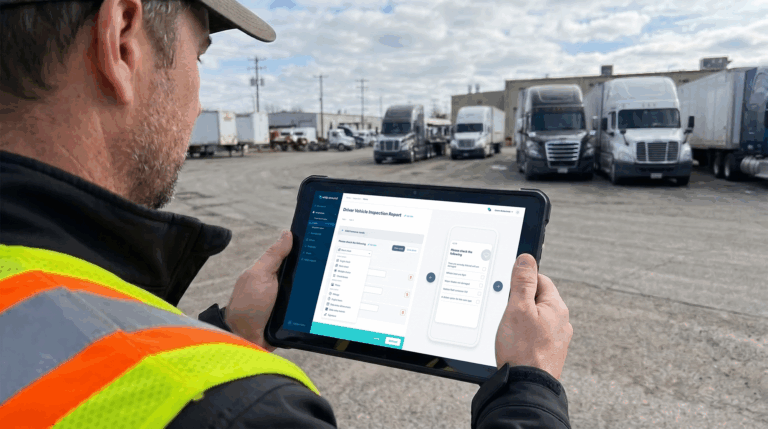
On the operational side, geofence events feed dispatch and maintenance workflows. An entry into a yard geofence prompts a post-trip eDVIR. Arrival at a wellsite stamps the dispatch ticket automatically. Departure from a service zone logs the lone-worker check-out for HSE recordkeeping — the kind of recordkeeping a strong fleet safety in oil and gas program is built on. Each of those events removes a manual step that, in the field, gets skipped under pressure.
The most underused geofencing application in enterprise oilfield operations is service-zone PM triggers. A water truck that enters a high-duty completion pad geofence is, statistically, about to accumulate engine hours faster than it does on standby. Fleets that tie geofence arrival to a scheduling rule — flag for a 250-hour PM if the asset enters this zone — catch wear they would otherwise miss.
Geofencing on its own won’t eliminate oil and gas fleet downtime, but it shrinks the surface area of avoidable incidents. Theft losses drop. Unauthorized use stops adding silent engine hours. HSE recordkeeping holds up at audit because the zone arrival and departure logs are timestamped and tamper-resistant. And the dispatch team stops chasing trucks that already showed up.
How Engine-Hours Tracking Drives Smarter Preventive Maintenance
Calendar-based PM scheduling assumes assets wear at a constant rate over time. Mileage-based PM scheduling assumes wear correlates with distance. Neither holds up for the half of an enterprise oilfield fleet that’s measured in idle hours and PTO cycles instead of road miles.
A pressure pumper running 14 hours of high-RPM work on a frac pad accumulates more wear than a service truck driving 600 highway miles. A genset that powers a remote camp for a month never moves and never logs odometer miles — but it logs 720 engine hours of continuous service, every one of them counting against the next oil change and the next fuel-filter replacement.
Engine-hours-based PM scheduling fixes the mismatch. Tied to a fleet maintenance software platform, engine-hours triggers schedule PMs by actual usage. The 250-hour oil change happens at 250 hours, not whenever the calendar says or whenever a tech notices. Aftertreatment regen cycles, hydraulic fluid changes, DEF system service, and air filter replacements all align with how the asset is actually being used.
The benefits compound at enterprise scale. Industry estimates suggest IoT-driven predictive maintenance can reduce unplanned downtime by up to 40%. A fleet running engine-hours-based PMs across 200+ heavy assets eliminates the two failure modes that calendar scheduling can’t: the asset that gets a PM it didn’t need, and the asset that didn’t get one it did.
How Fault Codes Catch Failures Before They Become Breakdowns
A modern diesel engine throws fault codes constantly. Most are informational. Some are cautionary. A few are critical — the kind of DTC that, left unaddressed for 48 hours, becomes a roadside breakdown on a backhaul through nowhere.
The challenge for enterprise oil and gas fleets isn’t capturing fault codes — telematics providers like Samsara, Geotab, and Motive all do that. The challenge is routing the right codes to the shop fast enough to act. A critical DPF or SCR fault on a Class 8 tanker carrying hazardous material is an operational emergency. A minor sensor fault on a light-duty pickup is not. Most fleets treat both the same way: they sit in a dashboard until someone reviews them.
Predictive maintenance starts when fault codes flow directly into the maintenance system, get evaluated against asset-specific rules, and either open a work order or schedule a follow-up inspection. A failed fault item captured on an eDVIR at pre-trip should generate the same work order whether the trigger was the driver or the engine. With Whip Around’s telematics integrations, DTCs from a connected telematics platform flow into the maintenance workflow automatically — the shop sees the fault, opens the work order, and the audit trail builds itself.
The cost of getting this wrong is concrete. A water truck breakdown 60 miles off-pavement during completion isn’t a tow bill — it’s a stalled crew, a delayed frac stage, and a logged incident on the HSE board. For enterprise fleets where a single avoidable failure can cost more than a year of telematics subscriptions, the math for routing fault codes into a real workflow is straightforward.
Tying Geofencing, Engine Hours, and Fault Codes into One Uptime Workflow
The individual signals matter. What separates enterprise fleets from everyone else is whether the three signals feed one workflow or three disconnected dashboards.
In an integrated stack, geofence arrival prompts a driver to complete a pre-trip eDVIR. Engine-hours thresholds open scheduled PMs without anyone running a query. Fault codes flow into the maintenance system, get triaged by severity, and open work orders the shop sees in real time. All three feed the same record of asset health, the same reporting layer, and the same compliance audit trail.
Whip Around sits in that integration layer for many enterprise oil and gas fleets. It’s not a telematics platform — it’s the inspection, maintenance, compliance, and reporting layer that turns telematics signals into shop action. Geotab, Samsara, and Motive data flows in. Engine hours drive PM scheduling. Fault codes trigger work orders. eDVIRs generate defect items. Compliance records build automatically for FMCSA, DOT, and internal HSE audits. The Whip Around platform also handles non-vehicle assets — gensets, pumps, trailers, yard equipment — which matters when a third of an enterprise oilfield fleet doesn’t have a VIN.
A practical example of how this plays out in the field is documented in the Lone Star Corporation case study, where an enterprise oil and gas operator used Whip Around to bring inspection, maintenance, and compliance workflows onto a single platform.
Metrics Enterprise Oil & Gas Fleets Should Track for Uptime
Once geofencing, engine hours, and fault codes are feeding the same maintenance workflow, the metrics that actually predict uptime sharpen up. The list below is what most VPs of operations and fleet directors at oil and gas companies should be tracking weekly:
- Fleet uptime percentage — share of assets available for service, by class and yard
- Unplanned downtime hours per asset per month — the lagging indicator that exposes everything else
- Mean time to repair (MTTR) — average duration of a work order from open to close
- Mean time between failures (MTBF) — running average by asset class
- PM compliance rate — share of PMs completed within the engine-hours or mileage window
- Fault-code-to-repair time — hours between a DTC firing and the work order opening
- Geofence violation count — after-hours movement, unauthorized exits, off-route events
- Inspection completion rate — share of pre-trip and post-trip eDVIRs completed daily
- Cost per operating hour — total cost of operation per engine-hour, by asset class
- HSE-related downtime events — incidents tied to inspection failures, lone-worker exposure, or hazmat issues
The right benchmark depends on the operation, but the principle holds: if you can’t measure these across every yard and every asset class, you can’t manage uptime at enterprise scale.
Building an Uptime-First Oil and Gas Fleet
The enterprise oil and gas operators that run with the lowest downtime aren’t capturing more data than their competitors. They’re acting on the data they already have. Geofence events trigger inspections. Engine hours drive PM scheduling. Fault codes open work orders. Every signal flows into the same record of asset health, and the same audit trail covers FMCSA, DOT, and internal HSE requirements without anyone scrambling at quarter-end.
That’s what an uptime-first oil and gas fleet actually looks like. It’s less about new technology and more about connecting the technology already in service. The reduction in oil and gas fleet downtime that comes from that connection is rarely a single dramatic improvement — it’s the steady disappearance of breakdowns that used to feel unavoidable, the audit trail that builds itself, and the maintenance budget that finally tracks against engine hours instead of guesswork.
If you want to see how Whip Around ties geofencing, engine hours, and fault codes into a single inspection and maintenance workflow, book a demo or start a free trial.