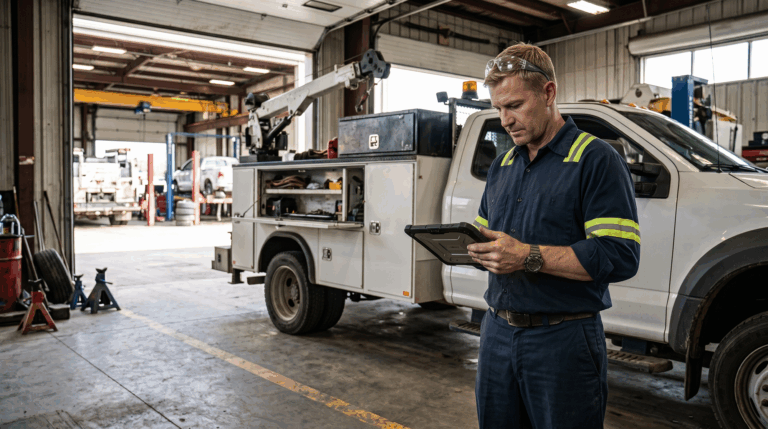
A construction equipment inspection is the cheapest insurance policy a fleet operator owns, and the most commonly half-completed task on any jobsite. Operators rush pre-shift checks to get billable hours started. Defects get noted on torn-off sheets that never make it to the shop. A hydraulic seep on Tuesday becomes a stalled excavator on Friday, and the day’s productivity disappears with it. The misconception that derails most inspection programs isn’t that they’re unimportant, it’s that they’re just paperwork. They aren’t. They’re the operational signal that tells a fleet what’s about to break, what’s about to fail an OSHA spot check, and where downtime is hiding.
This guide covers what high-quality construction equipment inspections actually look like in practice: the habits, documentation standards, and tools that separate fleets running tight from fleets reacting to the next breakdown.
Best Practices for Successful Equipment Inspections in Construction
A construction equipment inspection is a visual and functional check of a machine’s exterior, systems, and safety features to confirm it’s in safe working order before and during use. The areas that matter most across heavy equipment like engine, hydraulics, electrical, undercarriage, attachments, and operator-presence systems like seat belts, alarms, and ROPS — don’t change much from machine to machine. What changes is whether the crew treats the inspection as a habit or a hurdle.
Prioritize preventive over reactive maintenance
The fleets that run the highest equipment utilization aren’t the ones with the fastest repair shops. They’re the ones that catch defects before they become breakdowns. Inspections are the front line of that work. A loose hydraulic fitting found during a pre-shift walkaround is a five-minute fix. The same fitting found at 2 p.m. on a Tuesday is an oil-soaked jobsite, a stalled excavator, and a half-day of lost production.
Industry research consistently shows planned maintenance costs three to nine times less than unplanned repair, and a defect caught in inspection is the cheapest version of that work. The mental shift for crews is treating the inspection as a maintenance tool, not a compliance form — what the operator sees in 10 minutes saves the shop two hours later.
The other half of the equation is what happens with the report. A defect logged in a system the shop already uses gets fixed on a schedule. A defect noted on a clipboard left in the cab gets fixed when the machine stops moving. The fleets that pull ahead are the ones where inspections feed straight into the maintenance backlog, with no human relay step in between.
Build a safety culture through training and reporting
Equipment-related incidents on construction sites are rarely random. They follow patterns: missed pre-shift checks, operators running unfamiliar attachments, defects reported verbally but never written down. A real safety culture is built when every operator knows that a defect they report will be acted on, and that an inspection they skip will be visible.
That visibility starts with training. Every operator should know what to inspect on the specific machine they’re running, how to identify a fail condition, and where to send the report. People Also Ask searches on construction equipment inspection frequency consistently surface the same answer: daily pre-shift walkarounds are the baseline, with deeper monthly and annual checks layered on top. OSHA requires inspections for several equipment types (cranes, aerial lifts, forklifts, scaffolding) and treats undocumented inspections as effectively no inspection at all under the General Duty Clause.
Document inspections with the detail an auditor would expect
The difference between a construction equipment inspection report that holds up under audit and one that doesn’t is specificity. “Checked hydraulics — OK” is not a record. A useful record names the machine by unit number, identifies the operator, timestamps the inspection, lists the items checked, calls out any defects with photos, and documents what was done about them. General Insulation, a Whip Around customer, rebuilt their inspection program around this kind of specificity and saw measurable gains in compliance and shop responsiveness — their full story is in the improved inspections with Whip Around case study.
Documentation also matters for warranty claims and resale value. A machine with a complete, time-stamped inspection and service history sells for more, and a manufacturer is more likely to honor a warranty claim when there’s evidence the operator followed the inspection cycle. For teams building out their daily routine, our checklist for daily inspection reference is a useful starting point for what specifically to capture.
Match inspection frequency to the equipment and the work
Inspection cadence isn’t one-size-fits-all. A skid steer running 10 hours a day on a high-cycle demolition site needs more attention than the same machine on a low-utilization landscaping crew. The right cadence usually layers four intervals: a daily pre-shift walkaround, a weekly deeper check (fluid levels, filters, undercarriage wear), a monthly mechanical inspection by a qualified technician, and an annual or periodic inspection that meets the regulatory requirement for that asset class. The cadence should be set per machine, not per fleet and adjusted when a machine moves into harder duty.
Engine hours and cycle counts matter more than calendar dates for high-utilization equipment. A loader hitting 200 hours a month wears differently than one hitting 60, and a calendar-only schedule will either over-service the second or under-service the first. The right inspection software lets the cadence trigger on engine hours, mileage, or calendar — whichever hits first — so the inspection happens when the machine actually needs it.
Simplify Construction Inspections With Automated Tools
Paper inspection forms create three predictable problems: they’re incomplete, they’re late, and they’re invisible until something breaks. A jobsite with five machines and four operators produces a stack of paper every week that no one has time to read. The defect that mattered is buried two pages into a report that sat on a clipboard for three days.
Construction equipment inspection software solves the visibility problem by moving the inspection onto the device the operator is already carrying. With Whip Around’s fleet inspection platform, operators run digital inspections from the mobile app, capture photos directly inside defect items, and submit the report from the cab. The report is time-stamped, GPS-located, and tied to the asset’s unit number, there’s no scenario where a paper form ends up in the wrong folder or never makes it to the shop.
The capabilities that move the needle for construction fleets:
- Custom inspection forms by asset type. A form for an excavator looks different than a form for a haul truck — the platform supports per-asset forms so operators check what’s actually on the machine.
- Photo capture inside defect items. A picture of a cracked hose attached to the report eliminates the back-and-forth between operator and mechanic.
- Defect-to-work-order automation. Failed inspection items generate a work order in the shop system automatically, so nothing falls through the gap between operator and technician.
- Cloud storage and reporting. Every inspection lives in a searchable database — when an auditor or insurer asks for the inspection history on a specific machine, the answer is a five-minute export, not a week of binder searches.
- Fleet-wide visibility. A manager sees, at a glance, how many inspections were completed today, which machines are out of service, and which defects are still open.
For broader maintenance workflows, fleet maintenance software handles the work-order side once a defect is captured, scheduling repairs, tracking parts, and feeding PM intervals back into the inspection cycle. And for construction operations evaluating a platform, our construction fleet management software overview walks through how the pieces connect across mixed fleets of trucks, trailers, and heavy equipment.
The takeaway: inspections are operational signal, not paperwork
High-quality construction equipment inspections aren’t about filling out a form. They’re about catching the small things that become the big things — a hairline crack in a bucket, a slow leak in a hydraulic line, a worn track pad — before they take a machine out of service in the middle of a billable shift. The fleets that get this right run inspections as a habit, document with specificity, and use digital tools to make sure nothing reported gets lost between the cab and the shop.
If you want to see how Whip Around brings construction equipment inspections, maintenance, and reporting into a single workflow your crews can actually use, book a demo or start a free trial. The result is fewer breakdowns, cleaner audits, and a fleet that runs on signal instead of guesswork.