A DOT safety rating may just seem like one word on your SAFER profile, but it can actually decide whether you win a contract, what you pay for insurance and, in the worst case, whether your trucks can legally run at all. Most carriers don’t think about it until an investigator shows up for a compliance review. By then, the records that decide the rating already exist.
That’s why we put together this guide on what a DOT safety rating is, how FMCSA makes a safety fitness determination, what Satisfactory, Conditional and Unsatisfactory actually mean, and how to upgrade a DOT safety rating once you’ve fixed the problems behind it.
What Is a DOT Safety Rating?
A DOT safety rating is FMCSA’s official finding on whether a motor carrier has adequate safety management controls to operate commercial motor vehicles safely. FMCSA issues it after an on-site or offsite compliance review, and it appears on the carrier’s public record in the SAFER Company Snapshot. The process behind the rating is called a safety fitness determination, and its rules are in 49 CFR Part 385.
A safety rating is not the same as a CSA score. CSA scores are percentile rankings that update every month from roadside inspection and crash data. A safety rating is a formal determination, and it changes only after a compliance review or an approved upgrade request. High CSA scores are, however, one of the main reasons FMCSA schedules a compliance review in the first place.
The Three DOT Safety Ratings (Plus Unrated)
There are three possible ratings, plus a fourth status for carriers FMCSA hasn’t reviewed yet.
Satisfactory
A Satisfactory rating means the carrier “has in place and functioning adequate safety management controls” to meet the federal safety fitness standard. It’s the rating you want, and it’s final as soon as FMCSA issues the notice.
Conditional Safety Rating
A conditional safety rating means the carrier “does not have adequate safety management controls in place,” and that gap could lead to the safety problems listed in 49 CFR 385.5. A Conditional carrier can keep operating. However, the rating stays on its public record until a new review or an approved upgrade replaces it, and many shippers, brokers and insurers check that record before doing business.
Unsatisfactory Safety Rating
An unsatisfactory safety rating means the carrier lacks adequate safety management controls and that gap has already led to the problems listed in 385.5. A final Unsatisfactory rating makes the carrier unfit, and FMCSA issues an order placing its operations out of service. Federal agencies also can’t hire an Unsatisfactory carrier for transportation.
Unrated
An Unrated carrier simply hasn’t been assigned a rating. Most active carriers fall into this group, because compliance reviews reach only a small share of the industry. Unrated is not a negative finding, but it isn’t proof of compliance either.
How FMCSA Makes a Safety Fitness Determination
During a compliance review, an investigator checks your records against six rating factors, as laid out in Appendix B to Part 385:
- General: insurance and general requirements (Parts 387 and 390)
- Driver: drug and alcohol testing, CDLs and driver qualification (Parts 382, 383 and 391)
- Operational: driving rules and hours of service (Parts 392 and 395)
- Vehicle: parts, accessories, inspection, repair and maintenance (Parts 393 and 396)
- Hazardous materials: hazmat requirements (Parts 171, 177, 180 and 397)
- Accident: your recordable accident rate
Each “acute” violation scores 1 point. A pattern of “critical” violations also scores 1 point; a pattern means more than one violation and at least 10% of the records checked. Hours-of-service patterns score 2 points. A factor with 0 points is rated Satisfactory, 1 point is Conditional and 2 or more points is Unsatisfactory. The accident factor applies to carriers with two or more recordable accidents in 12 months, and it’s rated Unsatisfactory above 1.5 accidents per million miles (1.7 for urban carriers).
How Factor Ratings Become Your Overall Rating
FMCSA then combines the six factor ratings into one overall DOT safety rating:
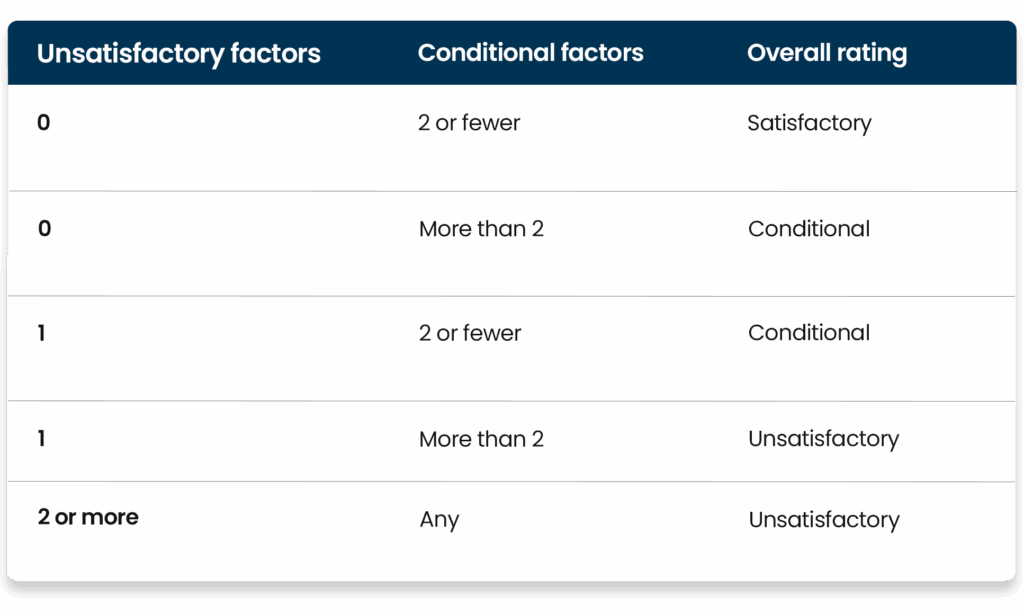
The math leaves little room for error. Two weak areas, such as a pattern of missing DVIRs and a few HOS problems, can be enough to drop a carrier to Unsatisfactory.
What Happens After a Conditional or Unsatisfactory Rating
Satisfactory ratings are final right away. Conditional and Unsatisfactory ratings are issued as proposed ratings. They become final after 45 days for passenger carriers and placarded hazmat carriers, or after 60 days for everyone else. The notice lists the violations you need to fix.
For a proposed Unsatisfactory rating, that window is your deadline. If the rating becomes final, the carrier can’t operate CMVs starting on day 46 or day 61. FMCSA can give property carriers up to 60 more days if they’re making a good-faith effort to improve. Carriers that keep running under an out-of-service order face civil penalties and can lose their operating authority.
How to Upgrade a DOT Safety Rating
Under 49 CFR 385.17, a carrier with a proposed or final Conditional or Unsatisfactory rating can request a change at any time once it has corrected the problems. Here’s how the process works:
- Read the notice line by line. Every violation listed is something you’ll need evidence for.
- Fix the root cause, not just the paperwork. If DVIRs were missing, show the new process that makes sure they get done, not a stack of backfilled forms.
- Document every corrective action. Gather policies, training records, inspection reports, maintenance records and audit results that show you’re compliant now.
- Submit a written request to your FMCSA Service Center. Send it to the Service Center for the region where your principal place of business is located. Include a written description of each corrective action and the supporting documents.
- Track the review timeline. For Unsatisfactory ratings, FMCSA must decide within 30 days for passenger and placarded hazmat carriers and within 45 days for all other carriers.
If you believe FMCSA made an error, you can also request an administrative review under 49 CFR 385.15 within 90 days. For a proposed Unsatisfactory rating, file within 15 days so FMCSA can decide before the operating ban starts. An upgrade request doesn’t pause the 45-day clock for passenger and hazmat carriers, so start early.
Where Vehicle Maintenance Fits In
Factor 4, the vehicle factor, is where your inspection and maintenance records count. Missing inspection and maintenance records (396.3), skipped DVIRs (396.11) and missed annual inspections (396.17) are all on FMCSA’s list of critical violations. A vehicle out-of-service rate of 34% or more, across three or more roadside inspections in the past year, also starts the vehicle factor at Conditional.
These records are also the hardest to keep complete on paper. Whip Around’s fleet compliance software captures timestamped, photo-backed digital inspections and routes defects to work orders. Its maintenance software schedules PMs and DOT annual inspections by due date. Together, they document the corrective actions an upgrade request needs and leave an audit trail that holds up in the next compliance review. Northwest Repossession, for example, faced a possible DOT shutdown after a mock audit and a poor SAFER snapshot showed gaps in its paper records. Since moving to digital inspections, the team reports fewer roadside stops and lower insurance rates.
Is the DOT Safety Rating System Changing?
Possibly, but not yet. In 2023, FMCSA published an advance notice of proposed rulemaking asking whether to change how it makes safety fitness determinations. One option is to use roadside and crash data, not only compliance reviews, so more carriers could get a rating. According to FMCSA, that notice made no specific proposals, and the three-tier system described here still applies.
Either way, the practical takeaway for carriers is the same. Your inspection, maintenance and roadside records are likely to matter more in future safety fitness determinations, not less. Our DOT audit checklist is a good place to start tightening them up.
Frequently Asked Questions
How do I check my DOT safety rating?
Search your USDOT number in FMCSA’s SAFER Company Snapshot. The carrier safety rating section lists your rating, the date it was issued and the type of review.
Can I operate with a conditional safety rating?
Yes. A Conditional rating doesn’t stop you from operating, but it stays on your public record until you’re re-reviewed or approved for an upgrade. Some shippers, brokers and insurers may limit work with Conditional carriers.
How long does a DOT safety rating last?
A rating stays in effect until FMCSA issues a new one after another compliance review or an approved upgrade request. It doesn’t expire on its own.
How long does it take to upgrade a DOT safety rating?
For Unsatisfactory ratings, FMCSA must decide within 30 days for passenger and placarded hazmat carriers and within 45 days for others. The regulations set no deadline for Conditional upgrade requests, so send a complete, well-documented package to avoid delays.
Is an Unrated carrier worse than a Satisfactory one?
No. Unrated only means FMCSA hasn’t reviewed the carrier, so it isn’t a negative finding. Some shippers do prefer carriers with a Satisfactory rating on record.
Protect Your DOT Safety Rating Before the Review
A DOT safety rating reflects the records you already have when the investigator arrives. Carriers that document inspections, defect repairs and maintenance every day are the ones that earn Satisfactory ratings, and the ones that recover fastest when they don’t.
If your inspection and maintenance records still live on paper, book a demo to see how Whip Around builds an audit-ready record for every asset. You can also start a free trial and have your drivers completing digital DVIRs this week.