A heavy equipment maintenance checklist is a list of inspections and service tasks that repeats on daily, weekly, monthly and annual intervals. It keeps machines like excavators, loaders and dozers safe, compliant and running. Most versions online stop at a parts list. The ones that actually prevent downtime are tied to engine hours, completed in the field and connected to the shop.
This guide gives construction fleet managers, shop leads and operators a tiered checklist they can run from a phone. It also covers a practical way to schedule service by hours instead of guesswork. You’ll also see how to make sure inspections really happen and how to turn every failed item into a work order before it turns into a breakdown.
Why skipped maintenance costs construction fleets more than it saves
Nobody decides to skip maintenance. It usually starts with a missed interval, because nobody tracked hours on a machine that moved between three jobsites last month. It continues with paper checklists that sit in a cab, get filled out at the end of the week, or never make it back to the office. Then operators start skipping the walkaround because the crew is already behind, and the habit sets in.
The real cost is not the repair bill. It’s the excavator that goes down mid-pour and idles the crew around it. It’s the rework when a job slips, the rental you scramble to bring in, and the safety exposure of running a machine with a hydraulic leak or a dead backup alarm. Consistent preventive maintenance for construction equipment is cheaper than any of those outcomes, but only when the checklist behind it gets completed every time.
What belongs on a heavy equipment maintenance checklist
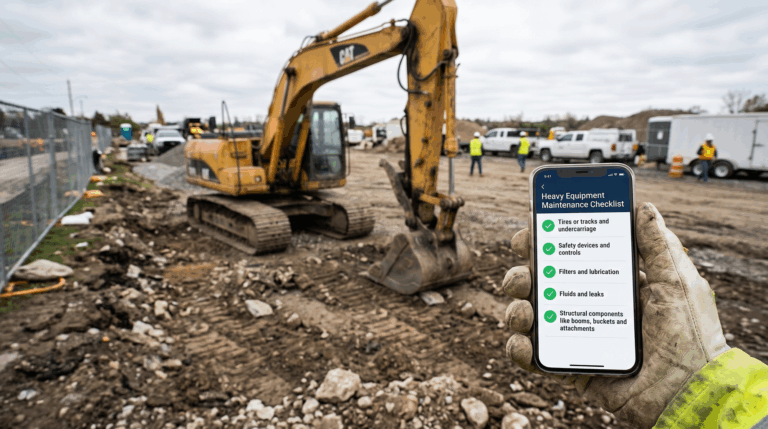
A heavy equipment maintenance checklist should cover five core categories:
- Fluids and leaks
- Tires or tracks and undercarriage
- Safety devices and controls
- Filters and lubrication
- Structural components like booms, buckets and attachments
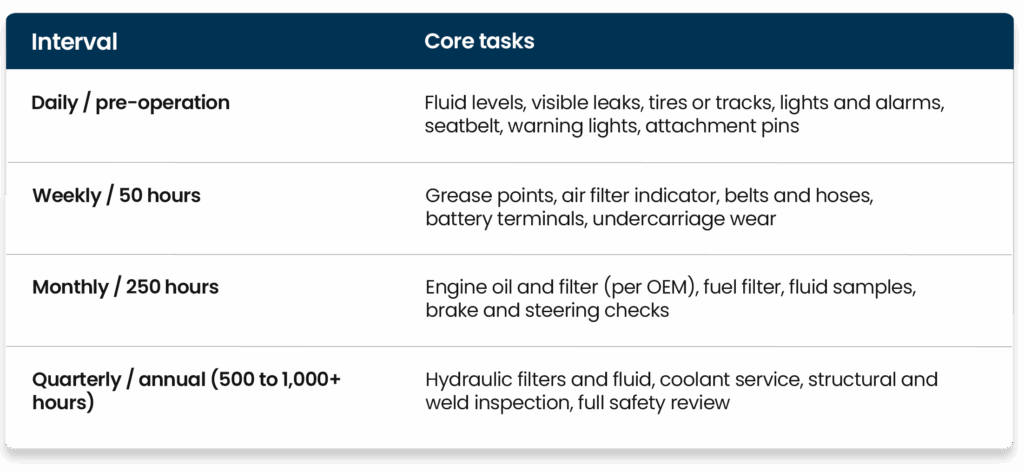
Tasks are grouped by daily, weekly (50-hour), monthly (250-hour) and quarterly or annual intervals, set by engine hours and the OEM manual.
Daily and pre-operation checks
The daily walkaround is the foundation of the whole schedule. Before startup, operators should check engine oil, hydraulic fluid, coolant and fuel levels, and look under and around the machine for leaks. They should also check tires for cuts and pressure, or tracks for tension, damaged pads and debris packed into the undercarriage.
Next, operators confirm the safety systems work: horn, lights, backup alarm, seatbelt, mirrors, fire extinguisher and ROPS. Then they start the machine and watch for warning lights or fault codes. On the jobsite, OSHA construction equipment requirements call for vehicles in use to be checked at the beginning of each shift, so this step matters for compliance as much as uptime. Our construction equipment inspection checklist breaks the walkaround down further by machine type.
Weekly and 50-hour checks
Weekly checks catch the wear a quick walkaround misses. Grease every lube point on pins, bushings and pivots, especially on high-cycle attachments. Check the air filter restriction indicator, inspect belts and hoses for cracking, and clean and tighten battery terminals.
This is also the right time to look closely at the undercarriage. On tracked machines, that means rollers, idlers, sprockets and track shoes. On rubber-tired machines, check wheel lugs and tire wear. On dusty sites, clean out radiators and coolers, because packed debris can cause overheating fast.
Monthly and 250-hour service
Many machines are due for an engine oil and filter change around 250 hours. Some OEMs now set a longer interval, so check the manual. Replace or inspect fuel filters and drain water separators. If you run an oil analysis program, pull engine, hydraulic and transmission fluid samples, since analysis is one of the cheapest ways to catch internal wear early.
Test brakes, steering and swing functions under load, and inspect hydraulic cylinders for scoring or seal leaks.
Quarterly and annual service
Quarterly and annual service covers the bigger jobs and usually falls somewhere between 500 and 2,000 hours, depending on the component. That includes hydraulic filter and fluid changes, coolant service, final drive and differential oil, and a full structural inspection of booms, frames and welds for cracks.
Base every one of these intervals on engine hours and the OEM manual, not the calendar alone. A machine that ran double shifts all quarter needs service well before one that sat parked. The intervals above are general starting points. Your machines’ manuals set the final schedule.
Want this checklist ready to use? Whip Around offers customizable digital inspection app templates you can set up for each asset type and run from any phone.
How to build a maintenance schedule by hours, not guesswork
A heavy equipment maintenance schedule built only on calendar reminders will always drift. Two identical loaders can log 200 hours and 900 hours in the same quarter, but a monthly reminder treats them the same. Engine-hour triggers fix that by scheduling service based on how hard each machine actually works.
A common hours-based structure looks like this:
- 10 hours (daily): Walkaround, fluid checks, safety devices
- 50 hours: Greasing, filter indicators, belts, hoses, undercarriage
- 250 hours: Engine oil and filter, fuel filters, fluid sampling
- 500 hours: Hydraulic and transmission filters, deeper component checks
- 1,000 to 2,000 hours: Hydraulic fluid, coolant, drivetrain oils, structural inspection
Hours-based scheduling only works if your hour readings are accurate. Have operators log hour meter readings with each inspection, or pull them automatically from telematics. Then set PM triggers on each asset so the shop knows what’s due before it’s overdue. For a step-by-step approach, see how to build a fleet maintenance schedule.
Make the checklist stick: digital inspections vs paper
The weakest point in any construction equipment maintenance checklist is the gap between assigning a task and getting it done. Paper forms hide that gap. A checked box doesn’t prove anyone walked around the machine, and pencil-whipped inspections are a known problem on every jobsite that still runs on clipboards.
Digital inspections close the gap. With Whip Around, operators complete inspections on their phones with required photos, timestamps and location data, so managers can see who inspected what, when and where. General Insulation saw this across 46 locations: only 1.5% of its inspections were pencil-whipped, down from 35% at the start. “We can get granular with the driver data to make sure that when they are getting in the cab of the truck, they’re performing that inspection and they’re doing it correctly,” said Ian Allison, Transportation and Supply Chain Manager. Read how General Insulation made inspections stick, and pair it with these heavy equipment inspection best practices.
Turn checklist findings into work orders and uptime
An inspection that finds a problem is only useful if someone fixes it. On paper, a flagged hydraulic leak can sit in a binder for days while the machine keeps working. The goal is a closed loop: a failed checklist item becomes a work order, the shop orders parts, and the fix happens before the breakdown.
Whip Around fleet maintenance automates that loop. Failed inspection items create work orders automatically, PMs trigger by engine hours or calendar date, and every repair goes into the asset’s service history. That record also matters for compliance. For vehicles under DOT jurisdiction, the FMCSA inspection, repair and maintenance records rules require systematic maintenance and documented records. A digital history keeps you audit-ready without digging through filing cabinets.
Ready to keep every machine inspection-ready? Whip Around Fleet Maintenance turns your heavy equipment maintenance checklist into scheduled service and work orders, so construction equipment stays compliant and running. Book a demo or start a free trial.
Frequently asked questions
What should be on a heavy equipment maintenance checklist?
A heavy equipment maintenance checklist should include daily pre-operation checks for fluids, leaks, tires or tracks and safety devices. It should also include scheduled weekly, monthly and annual service tied to engine hours and the manufacturer’s recommended intervals.
How often should heavy equipment be serviced?
Service heavy equipment by engine hours rather than by calendar alone. That means daily walkarounds, minor service around every 50 hours, fuller service near 250 hours, and major service between 500 and 2,000 hours, adjusted to each machine’s OEM manual.
What is the difference between a maintenance checklist and an inspection?
An inspection records a machine’s condition at a point in time. A maintenance checklist drives the recurring service tasks that keep it running. Digital tools link the two, so a failed inspection item automatically becomes a work order.
Is there a free heavy equipment maintenance checklist template?
Yes. Whip Around provides digital inspection and maintenance templates you can customize for each asset type. Unlike a static PDF, they stay current, capture photos and timestamps, and keep records audit-ready.