Predictive maintenance for heavy equipment means servicing machines based on data that signals a likely failure, instead of waiting for a breakdown or following a fixed calendar. It gets pitched as a sensor-and-AI project that only the largest contractors can afford. The reality is more practical. A predictive program is only as good as the data feeding it, and most construction fleets already collect much of that data.
This guide explains what predictive maintenance actually is and how it differs from preventive maintenance. It also covers the data it depends on, a realistic way to start without replacing the telematics you already run, and where it falls short.
What predictive maintenance for heavy equipment actually means
Predictive maintenance for heavy equipment uses condition data, such as telematics signals, fault codes, usage hours and inspection history, to spot a component heading toward failure and fix it before it breaks. Preventive maintenance services machines on a set schedule. Predictive maintenance acts when the data says a specific part needs attention.
Picture an excavator throwing a recurring hydraulic temperature code, while operators keep noting a slow leak at the same fitting on their walkarounds. Neither signal means much alone. Together, they point to a pump or hose that’s likely to fail soon, which gives the shop time to order parts and schedule the repair between jobs.
Predictive vs preventive vs reactive maintenance
The three approaches differ in what triggers the work:
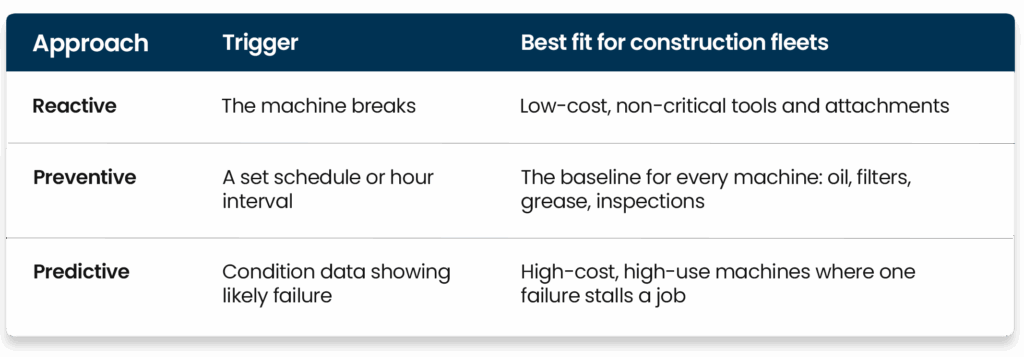
Predictive maintenance doesn’t replace preventive maintenance. It sits on top of it. A solid program of preventive maintenance for construction equipment keeps the basics of heavy equipment maintenance on track, while predictive maintenance helps you catch the failures a fixed schedule misses. For a look at fleet predictive maintenance beyond heavy equipment, see our guide to predictive fleet maintenance.
What predictive maintenance needs to work
Every predictive program runs on the same chain: data comes in, a pattern or threshold triggers an alert, and the alert becomes a work order. Weak data at the start means weak predictions at the end.
Machine data and telematics signals
Telematics units and onboard controllers report engine temperature, oil pressure, fuel use, idle time, location and more. On heavy equipment, these signals can show early warning signs like rising coolant temperatures or abnormal hydraulic pressure.
You don’t need a new system to get this data. If your machines already report to Geotab, Samsara, Motive or an OEM platform, that data can feed maintenance workflows through telematics integrations.
Inspection and defect history
This is where most fleets already have the data but don’t capture it consistently. Every daily walkaround is a condition report: a leak noted on Monday, a worn track pad on Wednesday, a cracked hose by Friday. Tracked over time, those notes show which machines and components keep failing.
The catch is consistency. Paper inspections that get skipped, rushed or lost leave gaps that no algorithm can fill. Digital inspections with photos and timestamps create a reliable record, and these heavy equipment inspection best practices help make them a habit.
Fault codes and usage hours
Fault codes, or DTCs, are the machine telling you something is wrong. One code may be noise. The same code repeating across several shifts is a pattern worth acting on.
Usage hours add context. A fault on a machine running double shifts carries different weight than the same fault on one that barely moves. Combining hours, fault history and inspection notes gives you a much clearer picture of which machines are truly at risk.
How to start predictive maintenance without ripping out your stack
You don’t need to put sensors on your whole fleet to get started. Most fleets begin with a few practical steps:
- Pick your critical assets. Start with the machines where one failure costs the most, like a primary excavator, a crane or a paver.
- Lock in your preventive baseline. Hours-based PMs and daily inspections need to be consistent before predictions can mean anything.
- Connect the data you already have. Bring telematics fault codes and engine hours into the same place as your inspection and service records.
- Set simple thresholds first. Repeat fault codes, defects flagged on multiple inspections, or components near the end of their typical service life.
- Review and adjust monthly. Track which alerts led to real problems and tune from there.
The right equipment maintenance software should work alongside the telematics you already run, not force you to switch. For more on condition-based approaches, the US DOE on predictive and condition-based maintenance is a useful vendor-neutral resource.
Where it breaks down: limits, false alerts and safety
Predictive maintenance isn’t a crystal ball. False alerts are common early on, especially when thresholds are set too tight, and crews quickly learn to ignore a system that cries wolf. Data gaps cause the opposite problem: if a machine skips inspections or its telematics unit drops offline, real warning signs can slip by.
That’s why a human stays in the loop. Mechanics and operators know what a machine sounds and feels like in ways data can’t fully capture. A prediction should prompt a closer look, not replace one. And predictive alerts never replace required safety checks: the daily walkaround still happens, no matter what the data says.
Turn predictions into fixes your crew actually makes
A prediction only saves money when it turns into a repair. The goal is a closed loop: an alert or failed inspection item becomes a work order, the shop orders parts, and the fix is scheduled before the machine fails on the job. Keeping that history documented also supports FMCSA maintenance recordkeeping for any vehicles under DOT rules.
Whip Around fleet maintenance gives you the record a predictive program runs on. It brings inspections, defects, telematics fault codes and service history together, and turns failed items into work orders automatically. Delsco Northwest, an oil field service company that inspects workover rigs, telehandlers and lifting equipment across 22 lines of business, used that visibility to cut its average time to correct defects by 74%, from 114.25 days to 29.26. Within three months, the team had set up weekly maintenance review meetings built on Whip Around data. See how Delsco sped up defect resolution.
Ready to build your predictive program on data you can trust? Whip Around Fleet Maintenance captures the inspection, fault and service history that predictive maintenance depends on, and turns every alert into a work order your crew can act on. Book a demo or start a free trial.
Frequently asked questions
What is predictive maintenance for heavy equipment?
It’s maintenance triggered by a machine’s actual condition. It uses telematics signals, fault codes, usage hours and inspection history to predict a likely failure and fix it before it happens, rather than following a fixed schedule.
What is the difference between predictive and preventive maintenance?
Preventive maintenance runs on a set schedule or hour interval. Predictive maintenance uses condition data to act when the data shows a specific part is heading toward failure.
Do you need special sensors for predictive maintenance?
Telematics and onboard sensors help, but the first step is consistent inspection, fault code and maintenance data. Many fleets start predictive programs using data they already collect.
Is predictive maintenance worth it for a small construction fleet?
Often, yes, for high-cost or high-use machines, where one avoided failure pays for the effort. Start with your most critical assets rather than the whole fleet.