Every fleet manager has had the same Friday afternoon: a driver gets pulled into a roadside inspection, a missing form turns up in the cab, and a clean CSA score takes a hit nobody saw coming. DOT fleet compliance lives or dies in the small stuff like a skipped DVIR, an expired medical card, a maintenance record that exists on someone’s whiteboard instead of in a file. The fleets that stay clean aren’t the ones with the most rules. They’re the ones with systems that don’t rely on memory.
This guide covers what DOT fleet compliance actually requires, the recordkeeping that holds up under an audit, and how automated reporting closes the gaps that paper-based processes can’t. The goal isn’t more paperwork. It’s fewer violations, faster audits, and a fleet that knows where it stands every morning.
What Is DOT Fleet Compliance and Why It Matters
DOT fleet compliance is the set of federal and state regulations a commercial motor carrier must follow to operate legally on U.S. roads. It’s governed primarily by the Federal Motor Carrier Safety Administration (FMCSA), which enforces the Federal Motor Carrier Safety Regulations (FMCSRs) found in 49 CFR Parts 350–399. For most fleets, the requirements cover driver qualification, hours of service, vehicle inspection, maintenance, drug and alcohol testing, hazardous materials handling, and recordkeeping.
The reason compliance matters goes beyond the citation. The FMCSA’s Compliance, Safety, Accountability (CSA) program scores carriers on seven BASICs (Behavior Analysis and Safety Improvement Categories). High scores trigger interventions, raise insurance premiums, and can pull a carrier into a full DOT audit. A single out-of-service order can shut a truck down for days. A pattern of violations can pull an operating authority.
There’s also a direct financial line. Maintenance violations average several hundred dollars each, HOS violations can reach $16,000 per infraction, and falsification of records can run into the six figures. Beyond fines, non-compliant fleets pay more for insurance, lose contracts with safety-sensitive shippers, and absorb the downstream cost of preventable crashes. Compliance is cheaper than non-compliance, but only if the system makes it easy to do the right thing every day.
Worth remembering: DOT compliance scales with fleet size only on paper. A 10-truck operation and a 200-truck operation face the same rules. The difference is that the smaller operation can’t absorb a single bad audit the same way. That’s why the operational habits matter more than the headcount, a 10-truck fleet running tight inspections and digital records will pass an audit faster than a 200-truck fleet running on paper.
Key DOT Compliance Requirements Every Fleet Must Meet
The FMCSA’s regulations are dense, but most commercial fleets are responsible for a recurring set of obligations:
- Driver Qualification Files (DQFs): A complete file for every driver, including application, motor vehicle record (MVR), medical examiner’s certificate, road test results, and annual review (49 CFR 391).
- Driver Vehicle Inspection Reports (DVIRs): Pre-trip and post-trip inspections of any commercial motor vehicle (CMV) over 10,000 lbs GVWR, with documented defects and repairs (49 CFR 396.11).
- Hours of Service (HOS): Logs of driving and on-duty time, recorded by an Electronic Logging Device (ELD) for most interstate CMV drivers (49 CFR 395).
- Vehicle Maintenance Records: Documentation of systematic inspection, repair, and maintenance for every CMV, retained for at least 12 months while in service and 6 months after disposal (49 CFR 396.3).
- Drug and Alcohol Testing: Pre-employment, random, post-accident, and reasonable suspicion testing under the Clearinghouse rule (49 CFR 382).
- Hazardous Materials Compliance: Placarding, shipping papers, training, and security plans for any fleet hauling hazmat (49 CFR 171–180).
- Annual and Roadside Inspections: Annual periodic inspection for every CMV, plus compliance with random roadside inspections under the MCSAP program.
Every one of these creates a record. Every record has a retention period. Every retention period has an auditor who can ask to see it. The fleets that struggle aren’t usually missing the rules, they’re missing the paperwork that proves they followed them.
How to Improve Fleet Compliance in Practice
Knowing the requirements is one thing. Running a process that catches every DVIR, every PM interval, and every expiring medical card across a fleet of 50 trucks is another. These are the practical moves that move the needle.
Standardize Driver Vehicle Inspection Reports (DVIRs)
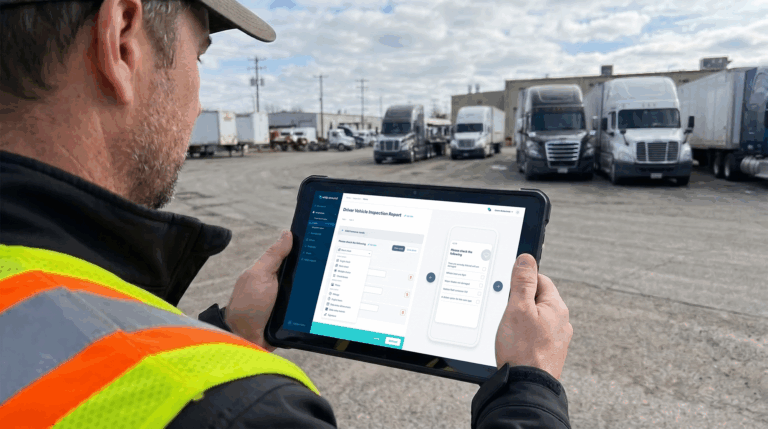
DVIRs are the most-cited compliance area in DOT audits because they’re the easiest to skip and the easiest to falsify on paper. A compliant DVIR program needs four things: a pre-trip inspection covering the items in 49 CFR 396.11 (brakes, steering, lights, tires, horn, mirrors, coupling devices, wheels, emergency equipment), a post-trip inspection where the driver documents any defects, a repair record showing the defect was addressed before the next dispatch, and a “no defect” log retained even when nothing was wrong.
The no-defect rule trips up new fleets. Even when a driver finds nothing wrong, the report still has to be submitted and retained — though under current FMCSA guidance, motor carriers only need to retain post-trip DVIRs that contain defects for 90 days. Pre-trip inspections still have to happen, and drivers are still required to review the previous post-trip DVIR before operating the vehicle.
Electronic DVIRs (eDVIRs) solve the legibility, completeness, and retention problems in one move. They timestamp every inspection, attach photos to defects, and make every record searchable on demand.
Keep Maintenance Records Complete and Up to Date
49 CFR 396.3 requires every motor carrier to keep maintenance records for each CMV: identification of the vehicle, a schedule of inspection and maintenance, the nature and date of inspections and repairs, and tests on emergency equipment for buses. These records must be kept for the life of the vehicle plus six months after disposal.
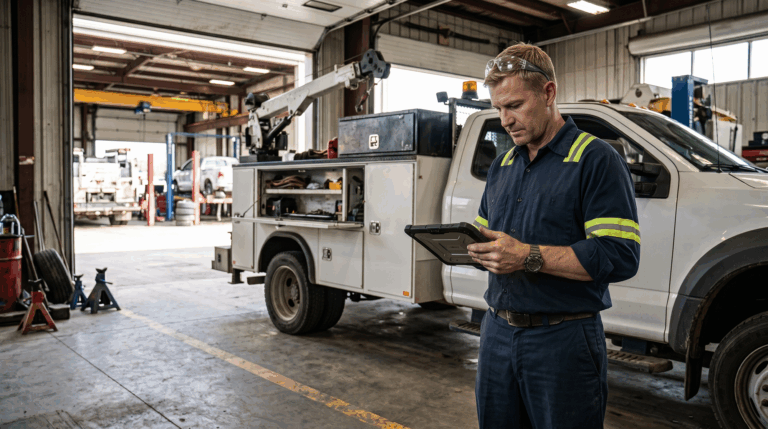
The gap that creates audit risk isn’t the existence of records, it’s the gap between what was done and what was documented. A mechanic who repairs a brake actuator on the side of a yard and writes it on a sticky note hasn’t created a record that survives an auditor’s request. Every repair needs a work order, a parts list, and a sign-off tied to the vehicle’s unit number.
Defect-to-work-order automation is the cleanest way to close the gap. When a failed DVIR item generates a work order automatically, and that work order can’t be closed without parts and labor entries, the paperwork follows the wrench.
Track Hours of Service (HOS) Accurately
HOS violations remain one of the top drivers of CSA scores in the Unsafe Driving BASIC. The ELD mandate, fully effective since December 2019, requires most interstate CMV drivers to use a registered ELD that records driving time automatically. Paper logs are only permitted in narrow exceptions (8-day rule, drive-away/tow-away, vehicles older than model year 2000).
Compliance isn’t just about having an ELD, it’s about how the data is reviewed. Supplemental documents (toll receipts, fuel receipts, dispatch records) need to align with the ELD record. Edits to driver logs must be annotated and approved. The carrier has to retain logs for six months and produce them on request.
The fastest path to clean HOS records is a system that pulls ELD data into the same dashboard as inspections and maintenance, so a supervisor can see HOS exceptions, missing certifications, and unsigned logs without logging into a separate tool. Drivers also need to keep eight days of supporting documents on file, and the carrier has to retain those for the same six-month window. Mismatches between an ELD log and a fuel receipt timestamp are a common audit finding, usually preventable with a system that captures both in the same record.
Maintain Driver Qualification Files (DQFs)
49 CFR 391 requires a DQF for every driver: employment application, MVR within 30 days of hire and annually thereafter, road test certificate, medical examiner’s certificate, employer notification of CDL and medical certification status, and an annual review of driving record. Some items have to be in the file before the driver operates a CMV; others have to be added within 30 days.
The expiring-document problem dominates DQF compliance. Medical certificates expire on rolling dates, CDLs renew on different schedules, and MVRs need annual refreshes. Manual tracking on a spreadsheet always lags reality. Automated compliance platforms tie every driver record to expiration dates and push alerts to fleet managers 30, 60, and 90 days out — so a medical card never expires while the driver is on the road.
DQFs also have to survive driver turnover. When a driver leaves, the carrier still has to retain the qualification file for three years after the driver’s separation. A digital DQF system that keeps separated-driver records archived and searchable is a meaningful audit advantage, especially for fleets with high churn.
Set Up Preventive Maintenance Schedules
Preventive maintenance (PM) isn’t itself a DOT regulation, but a missed PM is what creates the maintenance violation that becomes the DOT problem. PM schedules should run on a combination of triggers: mileage, engine hours, calendar time, and DOT inspection cycles. A truck that runs hard might hit a 15,000-mile PM in two months; a low-utilization unit might hit it in eight. Calendar-only PM schedules over-service some assets and under-service others.
The PM cadence should also align with annual DOT inspections under 49 CFR 396.17 so the inspection isn’t a surprise. Fleets running fleet compliance software can set PM triggers per asset and route work orders to the shop automatically as intervals approach.
Use Real-Time Alerts for Compliance Deadlines
Most compliance failures are deadline failures. A medical card expires, a registration lapses, a permit isn’t renewed, and the violation happens at the next roadside stop, not when the document expired. Real-time alerting closes that window. The right system pushes notifications to fleet managers (and the affected driver) on a tiered schedule, escalates if no action is taken, and removes the asset or driver from dispatch if the deadline passes without resolution.
Alert categories that matter most: medical certificate expiration, CDL renewal, IFTA filings, registration, IRP, periodic inspection due, PM interval breach, and drug/alcohol testing schedule. Alerts shouldn’t live in email alone, they should generate a task that lives in the workflow until it’s resolved.
Digitize Documentation and Centralize Records
The single highest-leverage compliance move a paper-based fleet can make is digitizing every record into one searchable system. An auditor’s request for “all DVIRs for unit 142 between January and June” should be a five-minute pull, not a five-day search through binders and email threads.
Digital recordkeeping doesn’t just speed up audits, it makes ongoing compliance visible. A fleet manager can see at a glance how many DVIRs were completed yesterday, how many defects are open, how many PMs are overdue, and which drivers have documents expiring this month. That visibility is what turns compliance from reactive into predictive.
How Automated Reporting Improves Fleet Compliance
Automated reporting is the operational layer that converts compliance data into action. Instead of fleet managers building spreadsheets to track what was done, the system surfaces what wasn’t.
So how can automated reporting improve fleet compliance? In practice, it does five things:
- Generates audit-ready reports on demand. DVIR logs, maintenance histories, HOS records, and DQF status — all exportable in the format a DOT auditor expects, without manual assembly.
- Pushes proactive alerts for expiring documents and overdue tasks. Medical certificates, CDLs, registrations, PM intervals, and inspection due dates trigger notifications before they become violations.
- Routes failed inspections into work orders automatically. A defect captured in a DVIR creates a work order in the same system, assigns it to the shop, and holds the vehicle out of service until the repair is documented.
- Surfaces fleet-wide compliance trends. Repeated defects on the same axle, drivers with chronic missed pre-trips, units with elevated PM overruns — patterns that paper systems hide.
- Eliminates the data-entry gap. When inspections, work orders, and driver records all live in one platform, the manager isn’t reconciling three systems before producing a report.
Whip Around’s fleet management reporting brings these into a single dashboard, so the answer to “are we audit-ready right now?” doesn’t take a week to produce. For teams evaluating software, our list of compliance safety questions to ask vendors is worth running through before signing anything. And for fleets exploring how machine learning is reshaping inspection review and predictive maintenance, our overview of AI in fleet maintenance, safety and compliance covers what’s working and what’s marketing.
Build a Compliance-First Fleet Operation
Improving DOT fleet compliance isn’t a quarterly initiative, it’s a daily operating discipline. The fleets that stay clean treat compliance the way safe shops treat housekeeping: as a constant, low-effort routine that makes the bigger problems visible early. Every shift starts with a DVIR. Every defect generates a work order. Every PM hits on time. Every document is current. None of those individually take much effort. Together, they’re what separate the fleets that pass an audit cold from the fleets that scramble for two weeks beforehand.
The accelerant is automation. Replacing paper with a digital workflow eliminates the legibility and retention issues that cause most audit findings. Adding real-time alerts catches expiring documents before they expire. Tying inspections to work orders closes the loop between problem identified and problem fixed. And automated reporting turns a year of operational data into a five-minute compliance review.
The compounding benefit is cultural. When drivers see that defects get fixed instead of buried, inspections stop being a formality. When mechanics see that work orders close cleanly with parts and labor tied to the asset, recordkeeping stops being an afterthought. Compliance becomes the byproduct of a well-run operation, not a separate workstream that competes with everything else for attention.
If you want to see how Whip Around brings DVIRs, maintenance, driver records, and audit-ready reporting into one workflow, book a demo or start a free trial. It’s the difference between hoping your fleet is compliant and knowing it is.