When you’re managing equipment across five jobsites, the problem usually isn’t that you don’t have enough assets — it’s that you don’t know where they are, what they’re doing, or whether they’re working at all. An excavator sitting idle on a commercial build while a crew across town is waiting on one costs you twice: once in idle time, and again in rental spend to fill the gap.
For enterprise construction fleets, construction equipment utilization is the metric that ties fleet performance directly to project profitability. Get it right, and your assets are working when and where they’re needed. Get it wrong, and you’re carrying hundreds of thousands of dollars in equipment that isn’t earning its keep.
This guide covers how to measure equipment utilization, what’s driving it down in multi-site operations, and the specific strategies fleet and operations managers use to improve it.
Why Equipment Utilization Is the Hidden Cost Driver in Construction Fleets
Most fleet conversations in construction focus on acquisition costs — what a new excavator or lift runs, how long to finance it, whether to rent versus buy. Utilization rarely gets the same attention, and that’s where the money quietly disappears.
Industry estimates suggest that up to 30% of equipment time on construction jobsites is idle. When heavy machinery downtime runs $450 to $760 per hour depending on the asset, that idle time compounds fast. A piece of equipment sitting unused for even two hours a day across a 250-day operating year adds up to a significant drag on margins.
The challenge is visibility. In a single-site operation, a superintendent can walk the yard and see what’s running. In an enterprise fleet spread across multiple active projects, that visibility breaks down. Equipment gets assigned to sites and stays there — whether it’s needed or not. Without a clear picture of utilization across the full fleet, managers are making allocation decisions blind.
Improving construction equipment utilization isn’t about squeezing more hours out of every machine. It’s about matching the right assets to the right jobs, catching problems before they cause unplanned downtime, and making allocation decisions based on data instead of instinct.
What Is Equipment Utilization Rate and What’s a Good Target?
Equipment utilization rate measures how effectively a fleet asset is being used relative to its available operating time. The formula is straightforward:
Utilization Rate = (Actual Hours Used ÷ Available Hours) × 100
“Actual hours used” refers to productive operating time — engine hours logged while the equipment is actively performing work. “Available hours” is the total time the asset could theoretically be deployed, minus scheduled maintenance windows and planned downtime.
A utilization rate between 70% and 85% is generally considered optimal for most construction equipment. Rates consistently below 60% are a signal that something is off — either the asset is assigned to a low-demand project, it’s spending too much time in maintenance, or it simply isn’t being tracked and scheduled effectively.
The right target varies by asset type. A haul truck on an active earthmoving project will have different utilization expectations than a specialty lift used intermittently across several sites. The goal isn’t a uniform number across every asset — it’s having the visibility to know which assets are underperforming and why.
The Biggest Barriers to High Utilization on Multi-Jobsite Operations
Enterprise construction fleets face utilization challenges that small contractors rarely deal with. When you’re managing assets across multiple active projects, the coordination complexity multiplies.
Poor asset visibility is usually the root cause. Without a single source of truth for where equipment is located and what it’s doing at any given time, fleet managers are dependent on phone calls, spreadsheets, or intuition. By the time you discover that three units on one site are idle while another site is requesting a rental, the cost has already hit.
Siloed scheduling compounds the problem. When each project manager requests and holds equipment independently — treating it as their asset for the duration of a project — you end up with equipment locked to sites that no longer need it. Enterprise fleets need centralized scheduling, not per-site hoarding.
Unplanned downtime is the third major driver. Equipment that breaks down unexpectedly doesn’t just lose its own operating hours — it can stall an entire crew. Reactive maintenance costs 3 to 9 times more than planned maintenance, according to industry benchmarks, and the knock-on effects to project timelines are often worse than the repair bill itself.
Data lag ties it all together. If fleet reports are generated weekly or monthly, by the time a manager sees that a unit has been sitting idle for two weeks, the opportunity to redeploy it is gone. Real-time or near-real-time data is what separates fleets that can act on utilization problems from those that only discover them in hindsight.
How Enterprise Construction Fleets Improve Equipment Utilization
The fleets that consistently hit strong utilization numbers aren’t relying on a single tactic — they’re operating a system. Here are the core strategies that make a measurable difference.
1. Centralize Equipment Visibility Across All Jobsites
The first step is establishing a single view of every asset in the fleet — where it is, whether it’s in use, idle, or in maintenance, and which project it’s assigned to. Without this, every other utilization strategy is harder to execute.
Telematics integrations make this possible for GPS-tracked vehicles and heavy equipment. For assets that aren’t telematics-enabled, digital check-in and inspection workflows can provide a comparable level of status visibility. The point is that someone in a central operations role should be able to answer “where is unit 47 right now, and is it running?” without making a phone call. Fleet management software for construction that consolidates asset status across sites is where this visibility starts.
2. Track Utilization by Asset, Project, and Time Period
Visibility is the foundation; measurement is what drives improvement. Fleets that improve construction equipment utilization track it consistently — by individual asset, by project, and over time — so they can identify patterns and act on them.
The core metrics to track are utilization rate (actual hours used vs. available hours), idle time percentage, cost per hour of operation (maintenance and fuel divided by hours used), and downtime frequency. Tracking these at the asset level reveals which machines are chronic underperformers. Tracking them at the project level shows which sites are hoarding equipment or driving excessive idle time.
Without this data, fleet composition decisions — whether to buy, rent, or dispose of assets — are guesswork.
3. Implement Cross-Jobsite Scheduling and Redeployment
The biggest utilization win available to enterprise fleets is also one of the least used: systematically redeploying underutilized assets from low-demand sites to high-demand ones before a rental request gets approved.
This requires two things. First, real-time visibility into which assets are idle and where they’re located. Second, a centralized scheduling process that gives someone the authority and the information to move assets across projects proactively, rather than waiting for site-level requests.
Fleets that build this redeployment workflow reduce unnecessary rental spend significantly. An asset sitting at 40% utilization on one site can often cover the need that would otherwise trigger a rental at another. The math is straightforward — the challenge is organizational, not technical.
4. Right-Size the Fleet Using Utilization Data
Utilization data is the most honest input into fleet composition decisions. If an asset consistently runs below 50% utilization across multiple projects over multiple months, that’s a signal worth acting on — whether that means redeploying it to higher-demand applications, scheduling it for disposal, or reconsidering ownership versus rental for that asset category.
Conversely, assets that regularly run above 85% utilization may be candidates for additional capacity, either through acquisition or a planned rental strategy for peak demand periods. Right-sizing based on actual data — rather than gut feel or historical procurement patterns — reduces both idle cost and equipment shortages.
5. Shift to Preventive Maintenance Scheduling
Unplanned downtime is one of the fastest ways to destroy utilization rates. When a piece of equipment fails mid-project, you lose not just its operating hours but often the productivity of the crew that depends on it. Industry benchmarks consistently show that preventive maintenance programs reduce equipment downtime by up to 45% compared to reactive approaches.
The shift from reactive to preventive maintenance starts with scheduling service based on actual usage — engine hours are more reliable triggers than calendar intervals for most construction equipment. Tie maintenance windows to natural project lulls where possible: between project phases, during weather delays, or during crew downtime.
Equipment maintenance software that tracks service history per asset and sends automated reminders when PM thresholds are approaching takes the manual tracking burden off the shop team. Understanding vehicle maintenance basics — from service intervals to parts inventory — is the operational foundation this scheduling sits on.
6. Enforce Pre- and Post-Use Equipment Inspections
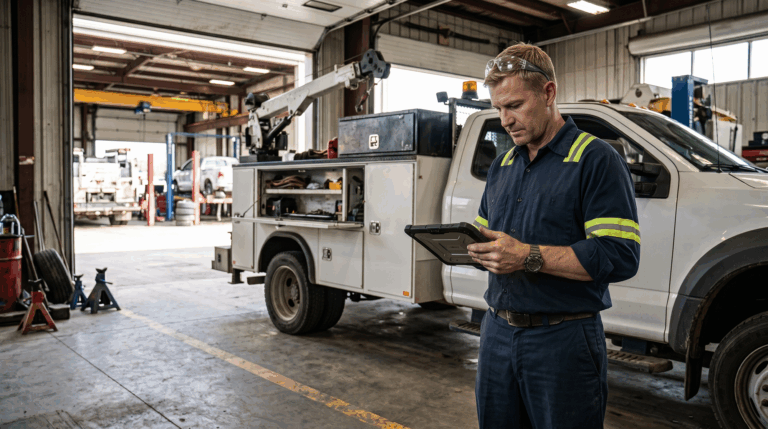
Daily inspections do two things that directly affect utilization. First, they catch developing issues before they become failures — a driver who flags a hydraulic fluid leak on a pre-use check prevents the mid-shift breakdown that takes the machine offline for two days. Second, they create an accountability record for equipment condition that supports both maintenance planning and asset lifecycle decisions.
For commercial vehicles operating on public roads, pre- and post-trip DVIRs are a federal requirement. The FMCSA no-defect DVIR rule outlines exactly what’s required for motor carriers. For off-road construction equipment that doesn’t trigger FMCSA rules, digital inspection forms provide the same paper trail — equipment condition records that support maintenance decisions and protect the fleet from liability.
Fleets with consistent inspection workflows catch more defects earlier, schedule more maintenance proactively, and spend less time reacting to unexpected failures. The connection between daily inspections and utilization is direct, even if it doesn’t feel like it.
7. Train Operators on Efficient Equipment Use
Operator behavior has a measurable effect on utilization. Excessive idling is the most common issue — engines running during crew breaks, between tasks, or while operators wait for instructions are burning fuel and adding wear hours without contributing productive output.
GPS fleet tracking reduces idle time by 10 to 20% on average in fleets that monitor it actively. But the data alone isn’t enough. Operators need feedback: showing crews their own idle time data and explaining what it costs per hour makes the behavior visible and creates accountability. Combine data feedback with clear site policies on idle time limits and you get lasting behavior change.
Training should also cover proper startup and shutdown procedures, load capacity limits, and basic condition reporting — all of which affect both uptime and equipment longevity.
8. Use Alerts and Thresholds to Flag Underperformance
Waiting for a monthly utilization report to discover that a $300,000 excavator has been sitting idle for three weeks is too slow. Proactive alerting — where the fleet management system flags assets that fall below a defined utilization threshold within a set time window — allows managers to intervene while there’s still time to redeploy.
Set thresholds by asset category, not uniformly across the fleet. A compactor and a crane have very different expected utilization profiles. Alerts should also account for assets in maintenance windows, so planned downtime doesn’t trigger false positives. When an underperforming asset is flagged in real time, the redeployment conversation can happen in days, not weeks.
Key Metrics Every Construction Fleet Should Track
Tracking construction equipment utilization effectively means monitoring a short list of metrics consistently. Here’s what matters most:
Utilization Rate — Actual hours used ÷ available hours. Target: 70–85% for most asset categories. Flag anything consistently below 60%.
Idle Time % — Percentage of available hours where the engine was running but the equipment wasn’t performing productive work. Industry estimates suggest up to 30% of equipment time on construction sites is idle; a realistic goal is getting that below 20%.
Cost Per Hour of Operation — Total maintenance and fuel costs divided by productive hours used. Tracks the true cost of each asset and surfaces inefficiencies in maintenance spend.
Downtime Frequency — Number of unplanned downtime events per asset per month. Rising frequency is an early warning sign that a PM program isn’t catching failures early enough.
Asset Availability — Percentage of time an asset is ready to deploy (not in maintenance, not awaiting repair). High availability is the prerequisite for high utilization.
Mean Time Between Failures (MTBF) — Average time between unplanned failures for a given asset. Declining MTBF over time is a signal that an asset is approaching end of useful life.
These six metrics, tracked consistently at the asset level, give a fleet manager a complete picture of where utilization is strong and where intervention is needed.
How Whip Around Helps Construction Fleets Maximize Equipment Utilization
Construction fleets that struggle with utilization usually have the same underlying problem: their maintenance, inspection, and compliance workflows are disconnected. Equipment condition lives on paper or in someone’s memory. PM schedules are managed on spreadsheets. When a defect gets reported, it takes days to generate a work order and get the repair scheduled.
Whip Around brings those workflows together in a single platform built for fleets that manage physical assets across multiple sites. For construction operations specifically, three capabilities have a direct impact on utilization.
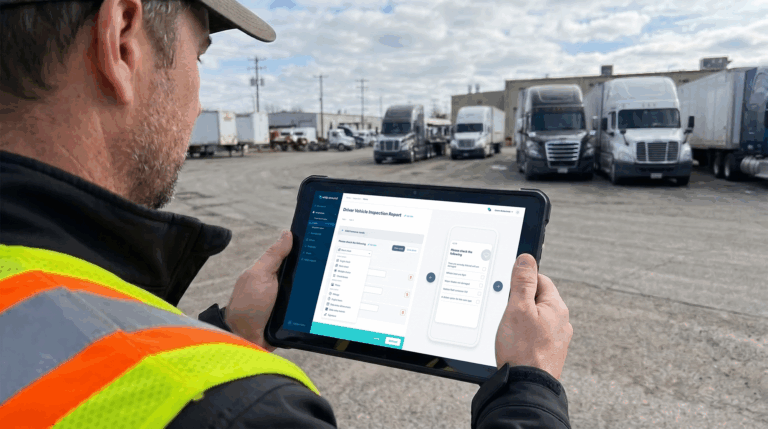
Digital inspection forms for any asset type. Whip Around’s customizable inspection forms work for trucks, trailers, excavators, lifts, generators, and any other equipment in the fleet — not just DOT-regulated vehicles. When an operator flags a defect in a pre-use inspection, it automatically generates a maintenance work order. That means issues get routed to the shop immediately, without anyone having to manually transcribe a paper report. Equipment that gets inspected consistently breaks down less often, and when it does go out of service, the turnaround is faster.
Centralized asset status and maintenance history. Fleet managers and operations teams get a single view of every asset — inspection records, open work orders, maintenance history, and upcoming PM schedules — without having to pull from multiple systems. When a redeployment decision needs to be made, the information to make it is in one place.
Engine-hour-based PM scheduling. Whip Around’s preventive maintenance scheduler lets you set service triggers by engine hours, mileage, or calendar date. For construction equipment, engine hours are typically the most accurate usage signal. Automated reminders go out before a PM window hits, so the work gets scheduled proactively rather than after the fact. Fleets that plan maintenance around natural project downtime — rather than reacting to failures — spend less time with assets out of service.
For construction fleets that also run commercial vehicles on public roads, Whip Around handles DOT safety audit readiness and compliance documentation alongside equipment inspections — keeping the whole fleet’s records in order in one platform.
Start Getting More From the Equipment You Already Own
Enterprise construction fleets don’t usually have an equipment shortage — they have a utilization problem. Assets sit idle at sites that don’t need them while other sites wait on rentals. Maintenance happens reactively instead of proactively. Allocation decisions get made on instinct because the data to make them well isn’t available.
Improving construction equipment utilization starts with visibility: knowing where every asset is, what it’s doing, and what condition it’s in. From there, the levers are consistent — centralized scheduling, preventive maintenance, daily inspections, and utilization tracking at the asset level. Fleets that build these workflows see measurable gains: fewer unplanned failures, less idle time, and better decisions about where to deploy and when to dispose.
Whip Around gives construction fleets the inspection and maintenance infrastructure to support all of it. See how it works for construction operations, or book a demo to walk through what it looks like for your fleet.