Optimize inspections, maintenance and compliance for the vehicles and equipment that power your trade or service business.
Technicians easily inspect any vehicle, tool or other asset from virtually anywhere with their phones.
Enjoy full visibility into your fleet’s health to prevent unnecessary repairs and the resulting downtime.
Manage work orders, service schedules, parts/inventory and vendor info from one platform.
Our fleet inspection software helps you prevent breakdowns that can harm your response time, reputation and bottom line. Use custom inspection forms with mandatory photos to hold drivers accountable and ensure staff safety.
Our fleet maintenance solutions are great for plumbers, electricians, HVAC workers, carpenters, roofers, painters and more. Keep your equipment in great shape and use powerful communication tools to quickly notify staff members of any issues found during an inspection.
By tracking your fleet’s condition and maintenance history, you can extend every vehicle and asset’s lifespan to ensure you’re maximizing its lifespan.
Keep key fleet information, permits and compliance documents in a single place for immediate access via mobile phone when needed.
Whip Around isn’t exclusive to trucks and trailers. Use Whip Around for:
Vehicles, dollies, forklifts, pallet jacks, scaffolds, lawn mowers and more.
Tools, machinery, fittings, building supplies, office equipment and more.
Facilities, safety gear, HVAC systems, signage, packaging and more.
Don’t take it from us. See what leading brands around the globe are saying about Whip Around.
I have 24 utility trucks and 2 Peterbilt's - this app-based program really helps. What first attracted me to it is how simple it looked for my field techs.
Love the ability to communicate with teams. Accountability from every angle. Great record keeping.
Easily let's drivers tell us there are any issues with their trucks.
Experience the transformative impact of our advanced service and trade equipment maintenance platform.
Yes. Whip Around tracks any physical asset, not just GPS-connected vehicles. Service vans, box trucks, enclosed and open trailers, generators, jetters, lifts, and individual high-value tools all get their own asset profile, custom inspection form, and maintenance schedule. That matters for trades fleets because the most expensive piece of gear on a job isn't always the truck, it can be the compressor, the trencher, or the calibrated test equipment. Putting everything in one system means inspections, PM, and service history live in the same place, instead of split across spreadsheets and shop whiteboards.

Yes. Inspection forms in Whip Around are fully customizable per asset or asset class. An HVAC van's pre-trip might include refrigerant recovery equipment, gauge sets, and ladder securement, while an electrical service truck's form covers PPE, voltage tester calibration, and lockout/tagout supplies. You can also build separate forms for monthly safety walkthroughs, annual DOT inspections, or end-of-shift returns. Most fleets start from a Whip Around template and modify it to match their existing checklist, usually in an afternoon, not a multi-week implementation project.
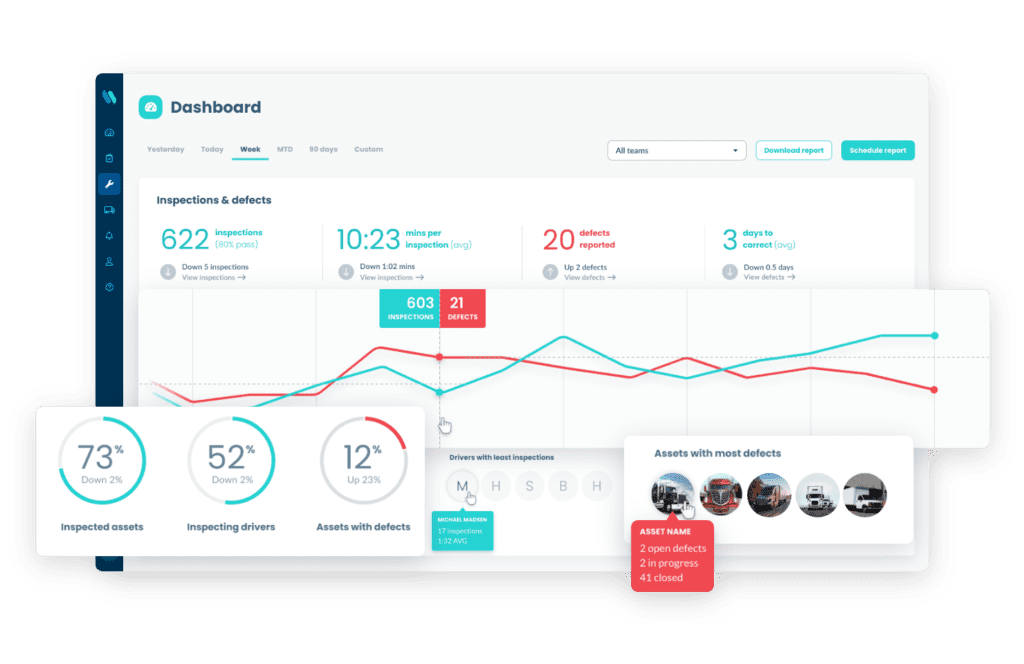
Whip Around's fleet dashboard shows inspection status across every asset in real time. You can filter by region, crew, asset type, or technician to see who's done their pre-trip and who hasn't. If a van skipped its morning inspection, it shows up on the dashboard immediately — not at the end of the week when paperwork comes back. For multi-site operations, you can group assets by yard or job site for cleaner reporting. Inspection compliance rates are tracked per driver, which gives supervisors something concrete to coach on when participation slips.
Shared vehicles are where damage gets hard to assign. Whip Around solves that with post-trip inspections tied to the specific driver who used the vehicle — time-stamped, photo-documented, and stored against that user's record. When the next crew picks up the same van, their pre-trip captures the starting condition. The handoff becomes a documented event rather than a he-said-she-said. AI Inspections Pro also reviews submitted photos automatically and flags new damage — a fresh dent on a panel, a missing tool from the bed — so supervisors don't have to scan every shift's photos by eye. If a tool walks off or a panel gets dented, you can pull the inspection timeline and see exactly when it appeared. Some fleets also use a dedicated handoff form between shifts for high-value assets.
Yes. Whip Around's preventive maintenance scheduler lets you set triggers by mileage, engine hours, calendar date, or custom intervals — and sends reminders to fleet managers and drivers before service comes due. If you've connected a telematics integration (Geotab, Samsara, Motive), mileage and engine hours pull in automatically, so PMs trigger on actual usage rather than estimates. For assets without telematics, drivers enter readings during inspection and the system tracks accumulation from there. Missed PMs are flagged on the dashboard so nothing slips through, and service history is kept per asset for warranty and resale documentation.
When a technician submits a defect in the field, Whip Around generates a work order automatically and notifies the dispatcher and shop. Critical defects can flag the vehicle as out-of-service immediately. From there, the dispatcher can reassign jobs to another crew, the shop can prep parts for the repair, and the technician's day doesn't disappear into a paperwork chase. Every step is logged — when the defect was reported, when the work order opened, who picked it up, when the asset returned to service — so the operational decision and the maintenance record stay connected.
Every inspection in Whip Around is tied to the user who completed it, with a timestamp and a location. If a defect or damage shows up in an inspection, the record shows who reported it, when, and on which asset. Combined with prior inspections from earlier shifts, you can usually reconstruct when the issue first appeared. That's useful for HR and accountability conversations, but it's also useful for warranty claims, insurance documentation, and identifying training gaps when the same defect keeps recurring across drivers.
Yes. Every inspection, work order, and maintenance record is stored in the cloud and exportable as a PDF or CSV. Insurers and underwriters increasingly ask fleets to demonstrate active inspection and maintenance programs — Whip Around gives you the audit trail to do that without a scramble. If an accident or incident happens, you can pull the asset's full history in a couple of clicks: every DVIR, every defect, every repair, with photos attached. That documentation often makes the difference between a defensible claim and an exposed one when an underwriter or attorney comes asking.
The driver app is built for fast adoption, most technicians can complete their first inspection within a few minutes of installing the app. Forms are mobile-first, with large buttons, photo capture, and pass/fail prompts that don't require typing. Fleet managers typically roll Whip Around out crew by crew, and most operators report meaningful adoption within the first week or two. There's no per-user fee, so there's no incentive to drag your feet on enrollment — every technician, mechanic, and supervisor can be added from day one without affecting your bill.
Yes. Whip Around pricing uses a fixed, unlimited-user pricing model, so adding a subcontractor or seasonal hire doesn't trigger an extra license fee. You can give them access to the assets and forms they need without exposing fleet-wide data, and remove access just as easily when the contract ends. For fleets that bring on temporary crews during peak season — common in trades like HVAC, landscaping, and electrical — this avoids the per-seat math that other platforms force you to run every time staffing changes.
Resources
Industries
Connect With Us
© 2026. Whip Around. All Rights Reserved. Privacy Policy | Terms of Service