Oil and gas fleet compliance is harder than standard fleet compliance. Most commercial fleets answer to one primary regulator. Oil and gas fleets answer to several at once: the FMCSA for commercial vehicles and driver records, OSHA for worksite safety and equipment, the EPA for emissions and spill prevention, PHMSA for hazardous materials in transport, and in many cases the specific safety and prequalification requirements of the operators whose sites they access.
A compliance gap in any one of these areas can mean fines, out-of-service orders, failed contractor prequalification scores, or removal from an approved vendor list. For oilfield service companies, that last consequence can be as damaging as a DOT violation. This guide covers the 10 compliance areas oil and gas fleets need to manage, the common challenges operators face, and how to build a system that keeps documentation audit-ready. For a broader look at how fleet operations fit into the field, see the guide on fleet management oil and gas best practices.
What oil and gas fleet compliance involves
Oil and gas fleet compliance is the practice of keeping every vehicle, driver, piece of equipment, and associated record in conformance with the federal, state, and client-specific regulations that apply to oilfield operations. It covers commercial vehicle registration and inspection, driver qualification and hours of service, hazardous materials handling, worksite safety, emissions records, and the contractor documentation that operators require before allowing crews on location.
What makes it more demanding than standard fleet compliance is the overlap. A tanker truck hauling produced water is simultaneously subject to FMCSA commercial vehicle rules, EPA spill prevention requirements, PHMSA hazmat transport standards, and OSHA driver safety protocols. Each framework has its own recordkeeping requirements, retention timelines, and audit exposure. Managing them separately, across paper files and disconnected systems, is where most compliance gaps originate.
Key oil and gas fleet compliance requirements to track
1. DOT and FMCSA requirements for commercial vehicles
Any commercial motor vehicle over 10,001 lbs GVWR operating in interstate commerce falls under FMCSA jurisdiction. For oil and gas fleets, that covers the majority of the fleet: service trucks, water trucks, vacuum trucks, tankers, and support vehicles. Requirements include a valid USDOT number displayed on all vehicles (as of October 2025, MC numbers have been eliminated and USDOT numbers are the sole federal identifier), current operating authority, and vehicle registration maintained in a retrievable format.
FMCSA’s Safety Measurement System underwent a significant overhaul in 2026, with compliance categories renamed, violations consolidated, and a new 12-month violation window fully enforced. CSA scores now update monthly and violations from the past 24 months remain visible, making consistent recordkeeping more important than at any point in the program’s history.
2. Driver qualification files, CDL records, and medical cards
Every driver operating a commercial motor vehicle must have a complete, current driver qualification file. That file includes a completed employment application, motor vehicle record (MVR) check at hire and annually, medical examiner’s certificate, road test record or equivalent, and documentation of prior employment verification. Files must be retained for three years after a driver’s termination date.
As of January 2026, the FMCSA’s paper medical examiner certificate waiver has expired. Medical examiners now transmit exam results electronically to the FMCSA National Registry, which forwards them to state DMVs. Carriers must verify medical certification through state MVR systems rather than collecting paper cards from CDL drivers. For non-CDL drivers who still require medical certification, physical certificates remain required. Keeping driver qualification files current, complete, and instantly retrievable is one of the most common audit failure points for oilfield fleets.
3. Hours of service and Electronic Logging Device rules
Hours of service rules apply to all CMV drivers in interstate commerce. The core limits remain: 11 hours of driving after 10 consecutive off-duty hours, all driving within a 14-hour on-duty window, a mandatory 30-minute break after 8 cumulative driving hours, and a 60/70-hour limit across 7 or 8 consecutive days. Violations carry penalties up to $16,000 per occurrence and contribute directly to CSA scores.
ELDs are required for most CMV drivers subject to HOS rules. Three ELD providers (PSS ELD, Black Bear ELD, and RT ELD Plus) were removed from the FMCSA registered list in late 2025, with a replacement deadline of February 2026. Carriers still running any of these devices are operating out of compliance. ELD data must be retained for six months, and drivers must be able to transfer logs via web service or local data transfer during a roadside inspection. For oilfield operators, the short-haul exemption and waiting-time provisions are worth reviewing, as some wellsite operations qualify for specific HOS accommodations. See the fleet safety program guide for more on how these rules interact with field operations.
4. Driver Vehicle Inspection Reports and pre-trip inspections
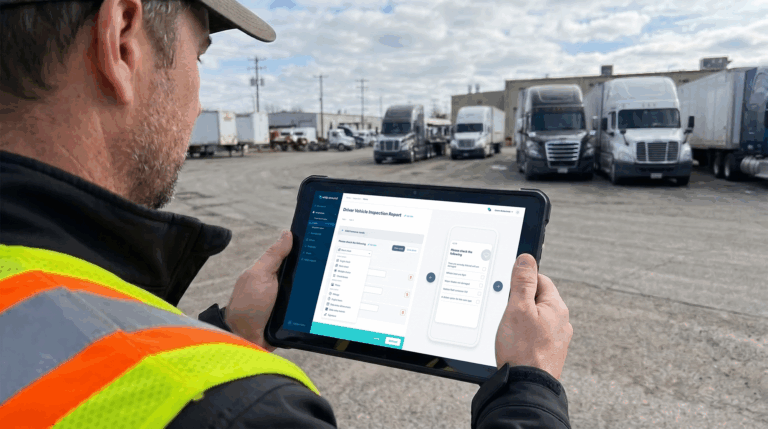
DVIRs are required before and after every trip for CMVs subject to FMCSA rules. The driver must inspect the vehicle and certify it is in safe operating condition before departure. If the previous DVIR noted any deficiencies, the driver must review that report and sign confirmation that repairs were completed before operating the vehicle. FMCSA estimates that DVIRs help prevent approximately 14,000 accidents annually through early defect identification.
DVIR records must be retained for three months, along with documentation of any repairs made in response to defects reported. Paper DVIRs create a retention and completeness risk: fields get skipped, reports get lost, and there is no real-time visibility into what drivers reported. Digital DVIR workflows with photo capture and automatic repair documentation close that gap and produce records that hold up during targeted audits.
5. Preventive maintenance records and repair documentation
FMCSA requires that CMVs be systematically inspected, repaired, and maintained, and that records of those activities be retained for the period the vehicle is in service plus one year. For oil and gas fleets running vehicles hard across remote terrain, this means PM schedules need to account for actual operating conditions, not just mileage or calendar intervals. A water truck making multiple wellsite runs daily accumulates wear far faster than its odometer reflects.
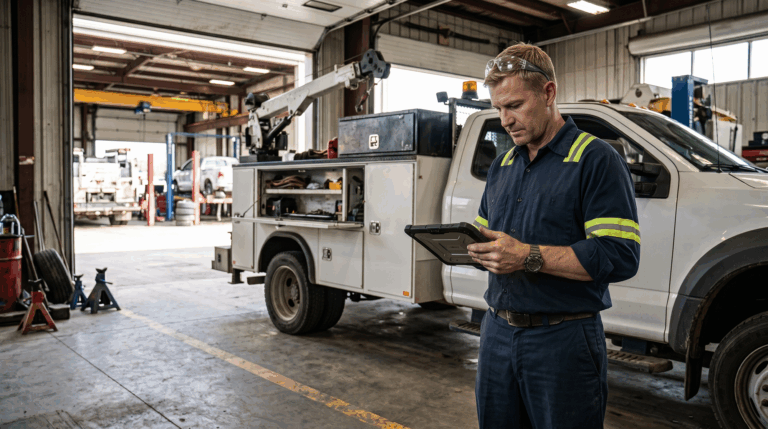
Maintenance records must document the date and nature of each inspection, repair, or maintenance event, along with the signature of the person responsible. Work orders that capture defect descriptions, parts used, labor performed, and technician sign-off meet this standard and build a repair history that supports warranty claims, insurance reviews, and replacement decisions. Connecting inspection defects directly to work orders, so that every flagged item has a documented resolution, is the most reliable way to satisfy this requirement. See how fleet management software for oil and gas supports this workflow.
6. Hazardous materials handling and transport requirements
Many oil and gas fleet operations involve hazardous materials: crude oil, produced water, drilling fluids, chemicals, and compressed gases. When those materials require placarding under 49 CFR Part 172, additional FMCSA and PHMSA requirements apply. Drivers must hold a valid CDL with a HAZMAT endorsement, which requires a TSA security threat assessment, background check, and renewal every five years.
Vehicles transporting placarded quantities must carry proper shipping papers, emergency response information, and placards displayed on all four sides. Routing restrictions apply for certain hazmat classes, particularly near tunnels and population centers. Driver training records for hazmat handling must be maintained and are a standard item in DOT audits and contractor prequalification reviews. Incidents involving hazardous materials in transport carry reporting obligations to PHMSA in addition to standard accident reporting requirements.
7. OSHA safety requirements for oilfield vehicles and equipment
OSHA’s general industry and construction standards apply broadly to oilfield vehicle operations. For fleets, the most relevant requirements cover personal protective equipment, hydrogen sulfide exposure protocols, vehicle safety equipment, and worksite hazard communication. At sites where H2S is present, fixed and portable monitors, escape respirators, and rescue plans are required at wellheads, tank batteries, and any sour gas assets.
OSHA also requires carriers to maintain OSHA 300 and 301 logs tracking workplace injuries and illnesses, with fatalities reported within 8 hours and inpatient hospitalizations, amputations, or eye injuries reported within 24 hours. Incident rate history, including total recordable incident rate (TRIR) and days away/restricted/transfer (DART) rate, is used directly in contractor prequalification scoring. A single recordable incident can affect a company’s prequalification status for three years.
8. EPA, emissions, idling, and spill prevention records
EPA compliance for oil and gas fleets primarily covers three areas: emissions system maintenance, idling restrictions, and spill prevention. Vehicles with diesel particulate filters (DPFs) must maintain emissions system maintenance records, DPF cleaning logs, and opacity test results where required. In California, CARB rules apply to any vehicle operating in the state regardless of registration, and as of 2026, CARB mandates trigger immediately for California operations with no grace period for out-of-state fleets.
For operations involving the transport or handling of oil and petroleum products, EPA’s Spill Prevention, Control, and Countermeasure (SPCC) rules require documented spill prevention plans, secondary containment procedures, and personnel training records. Fleets hauling crude or produced water should confirm whether their operations trigger SPCC applicability and ensure that associated documentation is maintained and current.
9. Contractor prequalification and site access documentation
Most major oil and gas operators require third-party contractor prequalification through platforms such as ISNetworld, Veriforce, or Avetta before allowing service companies onto active sites. These platforms verify safety programs, OSHA logs, insurance certificates, incident rate history, driver records, and training documentation against client-defined standards. A failed or lapsed prequalification score can prevent a fleet from accessing worksites and effectively disqualify a company from active contracts.
ISNetworld prequalification, which is the most common platform in U.S. oil and gas operations, requires three years of OSHA logs, certificates of insurance including EMR, written safety programs aligned to the RAVS framework, and ongoing documentation of training records for all field personnel. Prequalification scores are dynamic: expired documents, missed submissions, or newly recorded incidents update a company’s grade in real time. Maintaining current records across every required category is an ongoing operational task, not a one-time setup.
10. State-specific oilfield transportation rules
Beyond federal requirements, oil and gas fleets operating in active production basins face state-specific rules that vary significantly. Texas, North Dakota, New Mexico, Colorado, and other producing states each have their own oversize and overweight permit requirements, hazardous materials routing rules, and emissions standards that may exceed federal minimums. Some states require specific vehicle inspections beyond the annual federal inspection standard.
In Texas, for example, the Texas Department of Transportation administers its own oversize/overweight permitting for vehicles transporting equipment to wellsites, with route restrictions and escort requirements that apply independently of federal FMCSA rules. North Dakota has specific rules governing vehicles transporting crude oil by road, including weight restrictions on state highways during spring thaw periods. Fleets operating across multiple producing states need to track which rules apply in each jurisdiction and ensure permits and documentation are current before crossing state lines.
Common compliance challenges for oil and gas fleets
The most common challenge is documentation scattered across too many places. Driver files in a cabinet, inspection reports in a truck, maintenance records in a spreadsheet, HAZMAT training certificates in an email thread. When an auditor or a prequalification platform asks for a specific record, the answer should take seconds, not hours. Most compliance failures at audit are documentation failures, not operational failures.
A second challenge is the remote operating environment. Oilfield vehicles work in locations with limited connectivity, which makes real-time reporting and digital recordkeeping harder than it is for urban or highway fleets. Inspection forms that require a signal to submit, work orders that can only be updated from a desk, and compliance dashboards that drivers cannot access in the field all create gaps between what happened and what got recorded.
Third: the contractor prequalification burden. For service companies working across multiple operators, each prequalification platform has its own submission cadence, document format requirements, and scoring logic. A training certificate that satisfies ISNetworld may not meet the specific format Veriforce requires. Keeping active, compliant profiles across multiple platforms simultaneously is a significant administrative load that many smaller oilfield operators handle reactively rather than proactively.
Finally, driver turnover creates ongoing qualification file exposure. When a driver leaves and a new one starts, the qualification file process restarts: employment application, MVR check, medical certification verification, road test documentation, and prior employment verification. Oilfield service companies with high seasonal or project-based turnover need a system that flags incomplete files before a new driver operates a vehicle, not after a roadside inspection surfaces the gap.
How fleet maintenance software helps oil and gas fleets stay compliant
Fleet maintenance software addresses the documentation problem that sits at the center of most oil and gas compliance failures. When inspection records, maintenance history, defect reports, and work orders all live in one searchable platform, the records auditors and prequalification platforms ask for are available immediately, not assembled under pressure.
Digital DVIR workflows with offline capability solve the remote environment challenge. Drivers complete inspections from a mobile app regardless of connectivity, and records sync when signal returns. Defect-to-work-order automation ensures that every flagged item has a documented resolution, which satisfies both FMCSA maintenance recordkeeping requirements and the repair documentation standards that prequalification platforms verify. Whip Around integrates with telematics providers including Geotab, Samsara, and Motive, pulling engine hours and fault codes directly into maintenance workflows so PM schedules stay current without manual data entry. See the full fleet safety program guide for how these tools apply specifically to oil and gas field operations.
Oil and gas fleet compliance best practices
The following practices apply across fleet sizes and operating environments. For a more detailed operational framework, see the guide on fleet management oil and gas best practices.
- Centralize all compliance documentation in one platform. Driver files, inspection records, maintenance logs, HAZMAT training certificates, and insurance documents should all be searchable and instantly retrievable.
- Run digital DVIRs with offline capability. Drivers in remote locations should be able to complete and submit inspections without waiting for connectivity.
- Automate PM scheduling by engine hours, not just mileage or calendar date. Oilfield vehicles operate under conditions that make odometer-based intervals unreliable.
- Set expiration alerts for every time-sensitive document: medical certificates, CDL endorsements, HAZMAT endorsements, annual vehicle inspections, insurance certificates, and prequalification platform renewals.
- Connect defect reporting to work orders. Every inspection finding should have a documented resolution before the vehicle returns to service.
- Maintain three years of OSHA 300 log history at all times. This is a baseline requirement for ISNetworld, Veriforce, and Avetta prequalification, and gaps in incident history are one of the most common causes of score reductions.
- Assign a specific owner for each prequalification platform profile. Unmanaged accounts with expired submissions are a frequent source of avoidable contract disqualifications.
- Brief drivers on state-specific requirements before they cross into a new operating jurisdiction, particularly for oversize/overweight loads and HAZMAT routing.
Build a safer, more audit-ready oil and gas fleet
Oil and gas fleet compliance is not a one-time checklist. It is an ongoing operational discipline that requires current records, consistent inspection and maintenance workflows, and documentation systems that hold up when an auditor, a roadside inspector, or a prequalification platform asks for proof.
The operators who manage compliance well are not necessarily running larger fleets or dedicating more staff to paperwork. They have built systems that keep records current automatically, surface expiring documents before they lapse, and connect what happens in the field directly to the documentation that regulators and clients require. Fleet management software for oil and gas is where that system starts for most oilfield service operations.
Whip Around gives oil and gas fleets one platform to manage inspections, maintenance records, work orders, and compliance documentation across every vehicle and piece of equipment in the field. Book a demo to see how it fits your operation.