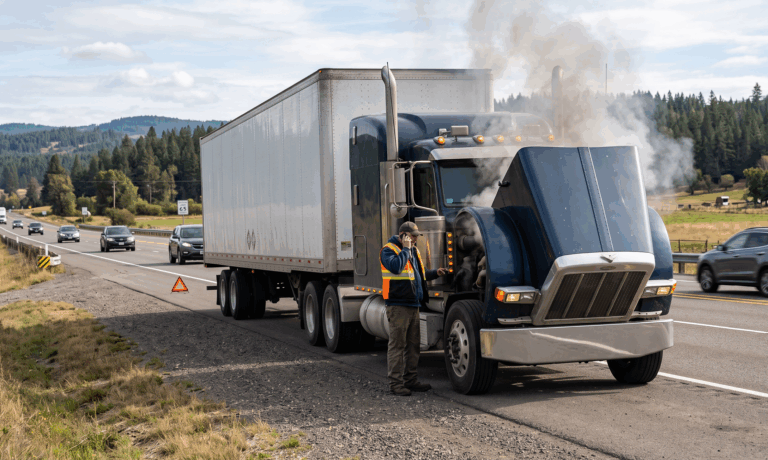
Pull the file on almost any preventable fleet accident and you’ll find the same uncomfortable detail a few lines into the report: the defect that caused it had already been flagged. A driver noted a brake pull three weeks earlier. An operator logged a hydraulic leak on a Tuesday inspection. Someone saw it, wrote it down, and the vehicle went back into service anyway — because the person who found the defect and the person responsible for fixing it were never really working from the same system.
That’s the gap between inspections and maintenance: the space between identifying a problem and actually resolving it. Most fleets don’t have an inspection problem. They have a handoff problem, and it usually stays invisible until an accident forces someone to go looking for where the process actually broke down. This article walks through why that gap forms, what it costs, and how to close it before it shows up in your next incident report instead of your last one.
What Is the Gap Between Inspections and Maintenance?
The gap between inspections and maintenance is the disconnect between the moment a defect is identified and the moment it’s actually repaired and verified fixed. It shows up as delay, as loss of information, or as no connection at all: a defect gets logged on a paper form or in an app, and nothing downstream automatically confirms that a technician saw it, worked on it, or closed it out.
Inspections and maintenance are frequently treated as two separate functions with two separate owners: drivers and operators handle inspections, shop staff handle repairs, and the two groups meet only when someone remembers to follow up. Under federal regulation, they’re not supposed to be separate at all. 49 CFR 396.3 requires motor carriers to “systematically inspect, repair, and maintain” their vehicles,o ne connected process, not two independent ones. When inspection and maintenance run as silos instead, the defect that gets caught is often the same defect that later causes the incident.
How Accidents Reveal the Gap
Post-accident investigations tend to follow a predictable pattern once you start looking at the maintenance history alongside the crash report.
The Defect Was Already Documented
In the majority of cases worth reviewing, the vehicle didn’t fail without warning. A pre-trip driver vehicle inspection report noted something: a slow leak, a soft brake pedal, a warning light — days or weeks before the incident. The documentation existed. The system built to act on it didn’t.
The Repair Was Never Confirmed
Under 49 CFR 396.11, a motor carrier must repair any DVIR-listed defect “likely to affect the safety of operation” and certify that repair before the vehicle is dispatched again. In practice, that certification step is where paper-based processes fail hardest — a defect gets acknowledged verbally, a mechanic gets a note, and no one produces the signed record confirming the fix actually happened before the truck rolled out again.
The Same Asset Went Back Into Rotation
Without a hard stop tied to the open defect, the vehicle or piece of equipment simply re-enters service on the next shift. Nothing in most paper or spreadsheet-based workflows physically prevents that from happening — the block exists on a form somewhere, not in the dispatch process itself.
Why the Gap Exists in the First Place
None of this happens because crews are careless. It happens because most fleets never built a single connected workflow from defect to repair to verification.
Inspections and maintenance run as separate systems. A digital or paper inspection form and a maintenance ticketing process, even a good one, often live in different tools entirely. Getting a defect from one to the other depends on a person remembering to make the transfer.
There’s no automatic handoff from defect to work order. A failed inspection item should generate a maintenance work order the moment it’s flagged. In most operations, it generates a note, and the note depends on someone reading it, prioritizing it, and acting on it before the next dispatch.
No one can see whether a defect was actually resolved. Even when a repair happens, fleets frequently lack a record that ties the original defect to a completed, verified fix. That missing link is exactly what an accident investigation, an insurance adjuster, or a DOT auditor will ask for first.
What the Data Says About Vehicle-Related Risk
Vehicle condition isn’t the leading cause of most crashes, driver behavior and roadway conditions account for more, but it’s a large enough factor to warrant a real process, not a best-effort one. FMCSA’s Large Truck Crash Causation Study found that vehicle-related factors, including brake and tire problems, were assigned as the critical reason in roughly 10% of large truck crashes studied, with brake problems the single largest vehicle-related factor identified. That’s not a small number when it’s entirely preventable by the time a defect has already been written down once.
The cost math reinforces the same point. Unplanned maintenance typically costs 3 to 9 times more than planned maintenance, and preventive maintenance programs can reduce equipment downtime by up to 45% when they’re actually followed through. A defect caught at inspection and fixed on schedule is a planned repair. The same defect, missed or deferred until it causes a breakdown or a crash, is the most expensive version of the same problem.
How to Close the Gap Between Inspections and Maintenance
Turn Every Failed Item Into a Work Order Automatically
The single highest-leverage fix is removing the manual handoff entirely. When a digital inspection form generates a maintenance work order the instant an item fails, there’s no window where a documented defect just sits waiting for someone to notice it. In Whip Around, that connection is built in by default, a failed inspection item creates the work order automatically, with the original defect notes and photos attached, so the shop isn’t starting from a secondhand description of the problem.
Track Defects Until They’re Verified Fixed, Not Just Logged
Logging a defect isn’t the same as closing it. Fleets need a record that shows a failed item, the work order it generated, the repair performed, and a technician’s sign-off confirming it’s resolved — the same chain 49 CFR 396.11 already expects on paper. Preventive maintenance software that ties service history to inspection data makes that chain visible instead of assumed.
Review Inspection-to-Repair Time as a Safety Metric
Most fleets track uptime and cost. Fewer track how long a defect sits open between being flagged and being resolved. That interval is a leading indicator of exactly the kind of gap that shows up in accident reports — and it’s worth reviewing the same way you’d review any other safety metric. Whip Around’s reporting dashboard surfaces this directly, since every inspection and every work order it generates share the same record — there’s no need to reconcile two separate systems to see how long a defect actually sat open.
Standardize the Process Across Every Site and Shift
A defect-to-work-order process that works at one location and breaks down at another isn’t really a process — it’s a habit that depends on who’s on shift. Standardizing inspections across every site closes the version of this gap that shows up specifically in multi-location fleets, where the same defect type gets caught reliably in one yard and missed in another.
General Insulation ran into exactly this kind of inconsistency before centralizing its inspection and compliance process — read the General Insulation case study for how that played out across their fleet.
What to Do After Your Next Incident
Every post-accident review should include one question most fleets don’t ask directly: had this defect, or one like it, been flagged before? Pull the inspection history for the asset involved, check it against the maintenance record, and look specifically for the gap — the point where a defect was documented but the loop was never closed. If that gap shows up, the fix isn’t a reminder to be more careful. It’s a process change: automate the handoff, verify the repair, and make sure the same defect can’t quietly re-enter service a second time.
Frequently Asked Questions
Does a documented defect legally require a vehicle to be taken out of service?
Under 49 CFR 396.11, any DVIR-listed defect likely to affect the safety of operation must be repaired, and the repair certified, before the vehicle is dispatched again. In practice, that means yes — a documented safety-related defect should stop the vehicle from returning to service until it’s fixed and verified, not just noted.
How quickly should a reported defect be repaired?
There’s no universal federal timeline, but the standard is “before the vehicle is operated again” for anything safety-related. Fleets that track inspection-to-repair time as a metric typically aim to close safety-critical defects within the same shift or before the asset’s next scheduled dispatch, whichever comes first.
Can telematics fault codes close this gap on their own?
Telematics data helps, but it isn’t a substitute for the inspection layer. Fault codes catch what the vehicle’s systems can detect electronically; they miss the physical, driver-reported defects — a cracked mirror, a loose fitting, a worn tire — that inspections are built to catch. Closing the gap means connecting both data sources to the same work order process, not relying on one instead of the other.
The gap between inspections and maintenance rarely shows up until something forces you to look for it. If you’d rather find it on a dashboard than in an accident report, book a demo to see how Whip Around connects failed inspections directly to work orders, repairs, and verified sign-off.