A single-farm operation can manage equipment with a whiteboard and a maintenance log. At five farms spread across two counties — or fifteen farms across three states — that system breaks down fast. Equipment disappears into a location no one can confirm. A combine goes into harvest season with a missed service interval because the records lived at the farm manager’s desk, not in any system headquarters could see. A grain truck gets flagged in a roadside inspection because the operation didn’t realize DOT requirements applied.
Agriculture equipment tracking at enterprise scale isn’t a technology problem — it’s an operational infrastructure problem. This article covers what that infrastructure needs to include, how large ag businesses build it, and what breaks when they don’t.
Why Equipment Visibility Is Hard to Maintain Across Multiple Farm Sites
Equipment visibility degrades quickly as operations grow across multiple sites. The core issue is that most large agriculture businesses didn’t build centralized tracking from the start — they grew into scale, and their equipment management systems didn’t keep up.
The result is familiar: an operations manager who needs to know where the spare grain cart is has to make three phone calls. A PM that was due in September gets missed because the service schedule lived in a spreadsheet at the farm, and no one at the regional level had eyes on it. One farm rents equipment to cover a shortage while a similar asset sits underutilized at a farm two hours away.
Good equipment maintenance software addresses these gaps, but only when it’s built around the realities of multi-site agriculture, where assets range from road-registered grain trucks to off-road combines that never touch a public road.
What Agriculture Equipment Tracking Actually Covers
Agriculture equipment tracking is more than GPS dots on a map. A complete tracking system covers six categories:
- Asset location and availability: Where each piece of equipment is, whether it’s in service, and when it’s expected to be available for redeployment.
- Engine hours and utilization rates: For agricultural equipment, engine hours — not mileage — are the primary indicator of usage and the primary trigger for maintenance intervals.
- Scheduled and unscheduled maintenance: PM schedules tied to engine hours or calendar intervals, plus documentation of repairs and defects across all sites.
- Inspection records: Pre-use and post-use inspection documentation for every asset, regardless of whether it operates on public roads.
- Operator assignments: Who used which piece of equipment, when, and for how long — relevant for accountability, training, and warranty documentation.
- Fuel consumption: Fuel tracking by asset, particularly for high-consumption equipment like combines and large tractors during planting and harvest.
The distinction between on-road and off-road assets matters here. Grain trucks, flatbeds, and water trucks that operate on public roads are subject to FMCSA regulations, including DVIR requirements for CMVs over 10,000 lbs GVWR. Off-road equipment — tractors, combines, sprayers, implements — operates under a different compliance framework, though OSHA agricultural safety requirements still apply. An enterprise tracking system needs to handle both without requiring two separate workflows.
The Scale Problem: What Changes When You Operate Across Regions
Managing equipment across multiple farms introduces three specific challenges that don’t exist at a single site.
Asset utilization imbalances. Without visibility across all locations, it’s nearly impossible to know whether you have the right equipment at the right farm at the right time. During peak seasons, this gap shows up as equipment rentals at one farm while an owned asset sits largely idle at another. Over a season, those rental costs add up fast.
Maintenance coordination. Agricultural equipment operates in intense bursts like heavy utilization during planting, spraying, and harvest, followed by extended periods of relative inactivity. PM schedules need to account for these patterns, and operations managers need to see service status across all assets at all locations simultaneously. When each farm maintains its own records, that cross-site visibility simply doesn’t exist.
Compliance exposure for road-registered vehicles. Many large agriculture operations run grain trucks, transport vehicles, and water trucks that operate on public roads and are fully subject to FMCSA requirements. Operations that don’t recognize this exposure — or that assume agricultural exemptions cover more than they do — can find themselves on the wrong side of DOT safety audits. Enforcement events affect CSA scores at the carrier level, meaning a violation at one farm location affects the operation’s overall safety measurement standing.
How Enterprise Agriculture Operations Build an Equipment Tracking System
1. Build a Centralized Asset Register
Every piece of equipment including tractors, combines, sprayers, grain trucks, trailers, implements, should exist in a single asset register that operations leadership can access, not just the farm it’s physically stationed at. The register should capture asset ID, type, current location, engine hours, service history, registration and compliance status, and warranty information.
This sounds basic, but it’s the foundation everything else depends on. Without a complete, centralized asset register, PM scheduling, utilization reporting, and compliance tracking are all working from incomplete data.
2. Track Engine Hours, Not Just Location
GPS location is useful, but for agricultural equipment, engine hours are what drive decisions. Oil changes, filter replacements, hydraulic fluid service, and most manufacturer-recommended intervals are tied to hours, not miles. A combine that runs 600 hours during a single harvest season has a very different maintenance profile than its calendar age would suggest.
Engine-hour tracking, whether through telematics integrations, manual operator logs, or OBD connections, gives operations managers the data they need to schedule PMs accurately and catch equipment that’s accumulating hours faster than expected.
3. Schedule Preventive Maintenance by Site and Season
Agricultural equipment has a utilization pattern unlike almost any other industry: weeks or months of intensive use during planting and harvest, followed by extended periods of light use or storage. PM schedules that ignore this pattern — scheduling by calendar month rather than by engine hours and seasonal windows — consistently produce either unnecessary service during idle periods or missed service heading into peak season.
Multi-site operations need a system that tracks PM status per asset across all locations simultaneously. Understanding vehicle maintenance basics is a starting point, but the scheduling system needs to be flexible enough to accommodate both the seasonal rhythms of agricultural work and the different utilization rates of different asset types at different farms.
4. Standardize Equipment Inspections Across All Sites
Pre-use and post-use inspection workflows should be consistent regardless of which farm the equipment operates at. Informal cultures — “just check it before you go” — don’t scale and don’t produce the documentation trail that operations managers need to identify recurring problems, track defect patterns, or demonstrate due diligence.
For road-registered vehicles, formal inspection documentation is a regulatory requirement. For off-road equipment, consistent equipment inspection checklists serve a different but equally important purpose: catching developing issues before they become breakdowns during a 14-hour harvest day when repair options are limited. Standardized inspection records also create the evidence base for warranty claims and insurance purposes.
5. Monitor Utilization to Balance Equipment Across Sites
Centralized utilization data is one of the most immediate operational payoffs of a multi-site tracking system. When operations managers can see that a planter at Farm A ran 40 hours last month while Farm B rented a planter to cover a shortage, the redeployment decision is obvious, but only visible if the data exists in one place.
Over a full season, utilization visibility enables better capital allocation decisions: which equipment types are consistently underutilized across the portfolio, which farms are consistently running assets hard, and where rental spend is covering gaps that an owned asset could fill. These decisions compound over years into meaningful differences in equipment ROI.
6. Manage Compliance for Road-Registered Vehicles
Not all agriculture equipment stays in the field. Grain trucks, flatbeds, livestock haulers, and water trucks that operate on public roads are subject to FMCSA regulations — including DVIR requirements for CMVs over 10,000 lbs GVWR. Operations that run CDL drivers on interstate transport don’t qualify for agricultural exemptions and must maintain full compliance with hours-of-service and inspection recordkeeping requirements.
Enterprise ag operations need a tracking system that handles both road-registered and off-road assets without splitting compliance documentation across separate platforms. When a DOT roadside inspection touches a grain truck, the DVIR record needs to be immediately accessible, not sitting in a paper binder at a farm office 80 miles away.
Common Mistakes Agriculture Operations Make When Tracking Equipment
Tracking location only. GPS tells you where equipment is; it doesn’t tell you whether it’s been serviced, how many hours it’s accumulated, or whether it passed its last inspection. Location tracking without utilization and maintenance data produces an incomplete (and sometimes misleading) picture of fleet health.
Managing on-road and off-road assets in separate systems. When road vehicles live in one platform and field equipment lives in spreadsheets (or nowhere), operations managers can’t see the full asset picture in one place. Compliance documentation, service history, and utilization reporting are all harder as a result.
Letting each farm maintain its own records. Farm-level recordkeeping works at single-site scale. Across multiple locations, it means operations leadership is always working with partial information and spending time consolidating data that should be automatically centralized.
Skipping formal inspections for off-road equipment. Because tractors and combines don’t go on public roads, it’s easy to let inspection discipline slide. But a hydraulic failure on a combine header during harvest, or a tire blowout on a sprayer in a remote field, carries real operational and safety consequences. The absence of a DOT requirement isn’t a reason to skip the inspection.
How Whip Around Supports Equipment Tracking for Multi-Site Agriculture Operations
The operational gaps described above — no centralized asset register, PM schedules that don’t account for seasonal utilization, inspection workflows that only cover road vehicles — are exactly the problems Whip Around is built to address for operations managing equipment across multiple locations.
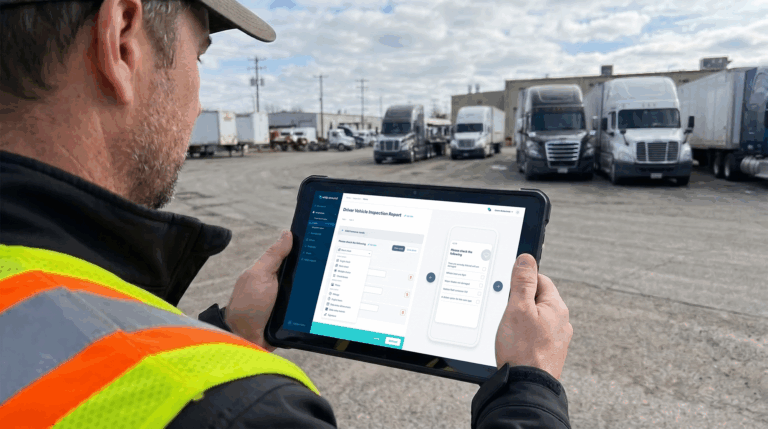
Fleet and equipment managers use Whip Around to maintain a single asset register across all sites, accessible to operations leadership in real time. Inspection forms are built centrally and pushed to operators on the mobile app — covering any asset type, whether it’s a grain truck completing a DVIR or a combine getting a pre-harvest walkaround. Defects flagged in an inspection automatically generate maintenance work orders, creating the documentation trail that connects a reported problem to a confirmed repair.
PM scheduling in Whip Around supports engine-hour-based triggers — the right interval type for agricultural equipment — with automated reminders that ensure service doesn’t slip heading into a critical seasonal window. For operations already running telematics platforms like Geotab, Samsara, or Motive on road vehicles, Whip Around integrates directly to pull engine hours and fault codes into the maintenance workflow automatically.
Whip Around’s platform is designed to handle non-vehicle assets alongside registered vehicles — the same system that manages FMCSA-compliant DVIRs for grain trucks can also manage inspection and maintenance records for tractors, sprayers, and implements. For operations looking at fleet management software for construction parallels — another industry with heavy off-road equipment, seasonal intensity, and mixed on-road/off-road asset profiles — Whip Around’s approach translates directly to agriculture.
Conclusion: Tracking Equipment Is the Foundation, Not the Goal
GPS location tells you where your equipment is. A complete agriculture equipment tracking system tells you whether it’s ready to work, when it needs service, whether it was properly inspected before the operator took it out, and whether your road-registered vehicles are meeting their compliance obligations.
For enterprise agriculture operations spread across multiple farms and regions, building that system is how you prevent a missed PM from turning into a combine breakdown during peak harvest, how you catch utilization imbalances before they turn into unnecessary rental spend, and how you keep road-registered vehicles compliant without a paper-records chase every time there’s a roadside inspection.
If you want to see how Whip Around handles equipment tracking across multiple sites, book a demo with the team or start a free trial to explore the platform yourself.