Waste and recycling fleets don’t get margin for error. A rear loader goes down mid-route and residential stops pile up with no flexibility in the schedule. A compactor develops a hydraulic leak that a driver noted on last Thursday’s inspection, but no one in the shop saw the report. A DOT compliance review surfaces incomplete DVIR records across three depots, and the operations director is scrambling to reconstruct paperwork that was never centralized.
These aren’t rare scenarios. They’re the routine pressure points of running a waste fleet at scale. And they all come back to the same three operational needs: meaningful asset reporting, real-time route visibility, and coordinated maintenance across the entire fleet. This article covers what each of those actually requires, and why most waste operations are underserved on at least one of them.
Why Waste Fleets Are Among the Most Demanding to Manage
Waste and recycling vehicles work harder, in harsher conditions, with less tolerance for service failure than almost any other fleet category. A rear loader running a residential route may complete 800–1,200 compactor cycles in a single shift. Vehicles operate in corrosive environments — leachate exposure, road salt, repeated hydraulic stress — that accelerate wear in ways that standard fleet management assumptions don’t account for.
Service windows are narrow and failures are immediately visible. When a collection doesn’t happen, customers notice the same day. That operational reality puts pressure on every layer of fleet management: inspections need to catch developing problems before they become mid-route breakdowns, maintenance needs to keep pace with actual wear rather than calendar-based guesses, and reporting needs to give operations leadership the fleet-wide visibility to make decisions before problems compound.
Good fleet management for waste and recycling addresses all three of these needs in a connected way. The challenge is that many operations have solutions for one or two, but not all three, and not integrated.
What Asset Reporting Actually Means for Waste & Recycling Operations
Asset reporting for waste fleets covers more than a list of vehicles and their registration status. Comprehensive reporting gives operations managers five categories of data they can act on:
- Utilization: Miles run per shift, compactor cycles per route, idle time by vehicle — the data that shows which assets are working hard and which aren’t pulling their weight.
- Inspection and defect history: A searchable record of every inspection submission, flagged defect, and resolution status per vehicle, accessible across all depots.
- Maintenance and PM records: Service history tied to each asset, including upcoming PM due dates, open work orders, and repair cost tracking over time.
- Compliance documentation: DVIRs, annual inspection certificates, and HOS records stored in a format that’s accessible and exportable when a compliance review requires them.
- Cost-per-asset data: What each vehicle is actually costing to operate — repair spend, parts, downtime — which informs replacement and capital planning decisions.
The distinction between operational reporting (what happened today, this week) and strategic reporting (trends over time that inform fleet investment decisions) matters here. Waste fleet managers need both, and they need equipment maintenance software that produces both without requiring a manual data consolidation effort after the fact.
Route Visibility: What Waste Fleets Need Beyond GPS
Route visibility for waste operations means knowing more than where your trucks are. GPS location is table stakes. What waste fleet managers and dispatch supervisors actually need is three layers of connected information.
Real-time location and status. Where each vehicle is, whether it’s actively running its route, and how far along it is, so dispatch can respond to a mid-route breakdown or unexpected delay without waiting for a driver to call in.
Stop completion data. Which stops have been serviced, which are still outstanding, and which were skipped or flagged for a service exception. This is the difference between knowing a truck is in a neighborhood and knowing whether the neighborhood is actually being serviced on schedule.
Exception alerts. When a vehicle goes out of service mid-route, when a truck has been idling longer than expected, or when a route is running significantly behind the service window, operations managers need to know in time to respond, not after the fact.
What route visibility is not in this context is route optimization — stop sequencing and routing algorithms are a separate capability, handled by dedicated routing software. The visibility layer described here is about operational awareness and exception management: knowing what’s happening across your active routes at any given moment, and connecting that awareness to the maintenance and compliance systems that sit alongside it.
Telematics platforms like Geotab, Samsara, and Motive provide strong GPS and location data. But route visibility connected to maintenance records, inspection status, and compliance documentation is a different capability, and one that requires those data sources to talk to each other.
Maintenance Coordination at Scale: The Specific Challenge for Waste Fleets
Waste fleet maintenance isn’t harder than other industries because the problems are more complex. It’s harder because the operating conditions are more punishing, the pace of wear is faster, and the consequences of unplanned downtime are immediately customer-facing. There are four specific coordination challenges that enterprise waste operations run into consistently.
1. High-Cycle Equipment Wears Faster Than Standard Intervals Assume
A residential rear loader completing 1,000 compactor cycles per day is accumulating wear on hydraulic systems, compactor blades, tailgate seals, and lift mechanisms at a rate that standard mileage-based PM intervals were never designed to capture. An oil change interval set at 10,000 miles looks very different on a vehicle that runs 150 miles per day versus one that runs 300. Cycles don’t show up in odometer readings at all.
Understanding vehicle maintenance basics is a starting point, but waste fleet PMs need to be triggered by the metrics that actually reflect usage — miles, engine hours, and in some cases operational cycles — not just calendar dates.
2. Corrosive Operating Environments Shorten Service Intervals
Leachate exposure, road salt, and the physical demands of daily heavy loading accelerate corrosion on frames, hydraulic lines, body components, and undercarriage hardware. Waste fleet managers in wet climates or northern regions need to build corrosive-environment assumptions into their inspection and service intervals like more frequent undercarriage inspections, hydraulic fluid and seal checks, and frame inspection protocols that would be overkill on a standard delivery fleet.
Skipping or deferring these checks because the calendar interval hasn’t come due is how minor corrosion becomes a major structural repair.
3. Unplanned Downtime During Active Routes Has Immediate Service Consequences
A breakdown on a residential route at 9am doesn’t just mean a repair bill. It means stops that don’t get serviced on a day when there’s no built-in capacity to absorb the gap. The pressure to keep trucks moving — even trucks with known developing problems — is real in waste operations, and it’s exactly the dynamic that defect-to-work-order workflows are designed to interrupt.
When a driver flags a brake issue on a post-trip inspection, that report needs to reach the shop immediately and generate a work order before the vehicle is dispatched again. It shouldn’t require a follow-up phone call, and it shouldn’t sit in an inspection app that no one in the shop has access to.
4. Multi-Depot Operations Require Centralized Maintenance Visibility
Waste operations running vehicles out of multiple depots or service yards face a familiar problem: maintenance records that live at each location, shop managers without visibility into what’s happening at other yards, and operations leadership that has to make phone calls to assemble a picture of fleet-wide maintenance status.
Centralized maintenance visibility — a single view of open work orders, upcoming PMs, and out-of-service vehicles across all depots — is a basic operational requirement for any enterprise waste fleet. It’s also the capability that most paper-based or depot-siloed systems fail to provide.
The Compliance Layer: What Waste Fleet Managers Can’t Ignore
Waste trucks operating as commercial motor vehicles on public roads are fully subject to FMCSA requirements. Under 49 CFR 396.11, drivers of CMVs over 10,000 lbs GVWR must complete a DVIR at the end of each operating day. The FMCSA no-defect DVIR rule reduces paperwork for clean trips, but the recordkeeping obligation doesn’t disappear, it just becomes simpler when no defects are found.
Annual inspections under 49 CFR 396.17 apply to the full fleet. CDL drivers on routes that don’t qualify for the short-haul exemption must comply with hours-of-service requirements. And when a DOT safety audit touches the operation, inspectors will look at DVIR records, annual inspection documentation, and driver qualification files across the entire carrier, not just the depot that triggered the review.
CSA scores are calculated at the carrier level. A roadside inspection violation at one service yard affects the organization’s overall safety measurement standing. For enterprise waste operations running dozens of vehicles across multiple locations, that carrier-level accountability means compliance can’t be managed depot-by-depot, it has to be managed as a fleet.
How Whip Around Addresses All Three Pillars for Waste & Recycling Fleets
The operational gaps that create problems in waste fleet management — scattered asset records, disconnected inspection and maintenance workflows, compliance documentation that’s hard to access under pressure — are exactly what Whip Around is built to close.
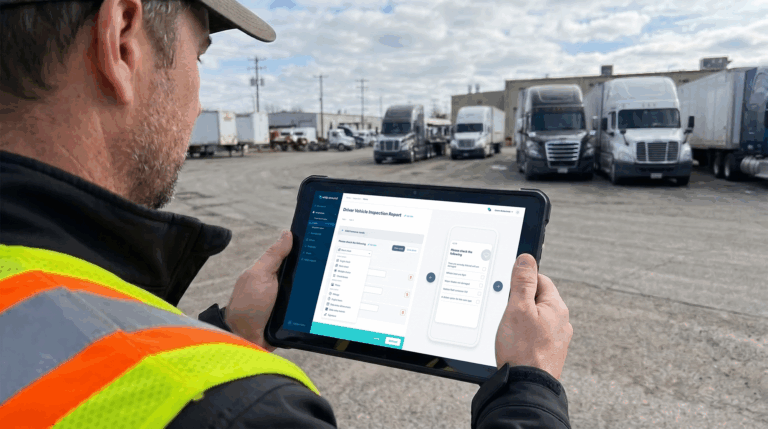
Drivers complete pre- and post-trip inspections on the Whip Around mobile app, with photo capture built in. Inspection records are stored centrally and searchable across the entire fleet — not sitting in a binder at a single depot. When a driver flags a defect, a maintenance work order is generated automatically and routed to the shop, so the problem gets tracked and resolved without manual follow-up. DVIR records are FMCSA-compliant and exportable on demand, which means compliance documentation is ready when a review requires it rather than assembled under pressure.
PM scheduling in Whip Around supports triggers by mileage, engine hours, or calendar date — giving waste fleet maintenance managers the flexibility to set intervals that reflect actual operating conditions rather than generic defaults. Operations leadership gets fleet-wide reporting dashboards that show inspection completion rates, open defects, upcoming PMs, and out-of-service vehicles across all depots in a single view.
For operations running telematics platforms like Geotab, Samsara, or Motive, Whip Around integrates directly — pulling fault codes, engine hours, and location data into the maintenance workflow so service triggers stay current without manual data entry.
Revolution Recovery and EnviroServe are among the waste and environmental services customers that rely on Whip Around for fleet inspection and maintenance coordination. For any waste operation looking at what connected fleet management looks like in practice, the fleet management for waste and recycling page is a good starting point.
Conclusion: Three Pillars, One Connected System
Asset reporting, route visibility, and maintenance coordination aren’t three separate problems that happen to affect the same fleet. They’re three interconnected needs that, when addressed together, give waste and recycling operations the control they need to prevent service failures, protect compliance standing, and manage equipment costs over the long term.
The waste fleet that runs its daily DVIRs, catches developing defects before they become mid-route breakdowns, and gives operations leadership a real-time picture of fleet status across every depot is a fleet that spends less time in reactive mode, and more time running the routes it’s contracted to run.
If you want to see how Whip Around connects inspections, maintenance, and compliance reporting for waste and recycling fleets, book a demo with the team or start a free trial to explore the platform yourself.